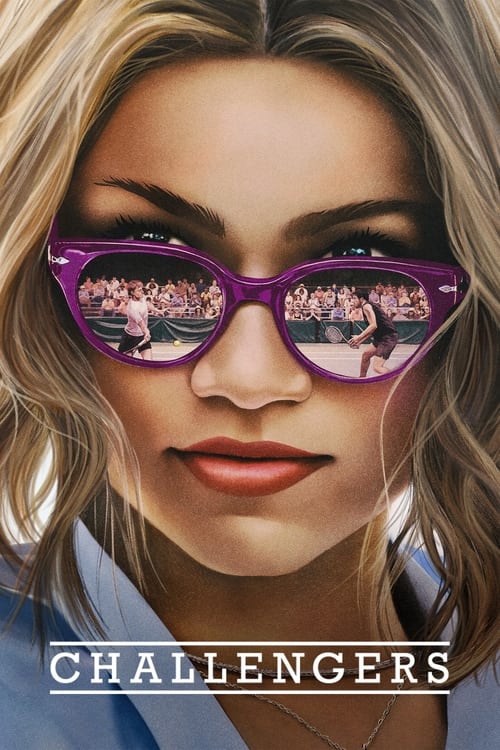
Challengers (2024)
Directed by Luca Guadagnino
No — Challengers is not especially woke, scoring 22 out of 100 on our wokeness meter.
Luca Guadagnino's Challengers is a glossy psychosexual triangle in which tennis serves as choreography for desire, rivalry, and the slow corrosion of professional intimacy.
Consciousness Markers
Zendaya headlines as Tashi, a role the screenwriter conceived as a Black woman, and the film features an interracial marriage and a notably diverse supporting cast; the casting is deliberate but not framed as a representational statement.
Guadagnino had the script modified to include a scene where Art and Patrick kiss, insisting that 'all the corners touch' in the love triangle, lending the male friendship explicit homoerotic charge.
Tashi wields considerable power as a coach and architect of the men's careers, inverting the usual gender dynamic, though the film's gaze remains heavily sexualized rather than polemical.
Tashi's race is present via an interracial marriage and the writer's meta-commentary on Black superstars in American tennis, but the film never engages racial themes as subject matter.
A psychosexual melodrama that shows rather than tells; it has essentially no didactic or preachy register.
No environmental or climate content whatsoever.
The contrast between the wealthy power couple and Patrick living out of his car is character texture, not a critique of capital.
No body-positivity themes; the film's athletic body standards are conventional.
No neurodivergence content.
A wholly fictional narrative with no historical revisionism.
Why it received this score
Luca Guadagnino's Challengers is a glossy psychosexual triangle in which tennis serves as choreography for desire, rivalry, and the slow corrosion of professional intimacy. Zendaya's Tashi is a Black woman by design, and the film surrounds her with an interracial marriage and a cast that reflects the actual demographics of American tennis. The construction is deliberate. It is not framed as a civic announcement, which keeps the representational temperature moderate. The screenwriter's awareness of Black superstars in the sport lingers at the edges, though race never becomes the film's subject. We get presence without argument.
The film's treatment of gender is more interesting. Tashi commands the careers of two men, and her authority as coach and strategist reverses the usual arrangement of athletic power. Guadagnino still photographs bodies with the appetite of a luxury perfume advertisement, so the inversion arrives wrapped in a conventional sexualized gaze. The male friendship receives an explicit homoerotic charge, including a kiss added at the director's insistence, which makes the love triangle literally touch all corners. This is texture, not sermon. The wealthy couple and the man living out of his car provide contrast in status, but the film shows no interest in indicting capital. There is no environmental agenda, no body-positivity theme, no neurodivergent framework, and no historical revisionism. It is a fictional melodrama with no past to correct.
The residue is a film that trusts behavior over commentary. It has almost no preachy register. The tennis match becomes a negotiation of ego, dependency, and attraction, and the final embrace lands without a thesis attached. We are left with sweat, sunlight, and three people who cannot quite separate competition from love. It is a serious film about unserious people, and it knows better than to explain itself.
Analysis generated by our Consciousness Algorithm


Synopsis
Tennis player turned coach Tashi has taken her husband, Art, and transformed him into a world-famous Major champion. To jolt him out of his recent losing streak, she signs him up for a "Challenger" event — close to the lowest level of pro tournament — where he finds himself standing across the net from his former best friend and Tashi's former boyfriend.
Questions about Challengers
Is Challengers woke?
No — Challengers is not especially woke, scoring 22 out of 100 on our wokeness meter. That earns it a verdict of Based.
Does Challengers have any woke elements?
3 of the 10 markers register at 30 or above, led by LGBTQ+ Themes (45), Representation Casting (45) and Feminist Agenda (35). On LGBTQ+ Themes: Guadagnino had the script modified to include a scene where Art and Patrick kiss, insisting that 'all the corners touch' in the love triangle, lending the male friendship explicit homoerotic charge.
How does Challengers compare to other 2024 movies?
It ranks #66 of the 189 films from 2024 we've scored; their average is 22. The wokest is The Six Triple Eight (92).
How is the Woke Score calculated?
An AI-assisted process researches the film and its reception, scores it 0–100 on ten markers, then combines those into one 0–100 Woke Score. It measures a specific set of 2020s cultural themes, not film quality.