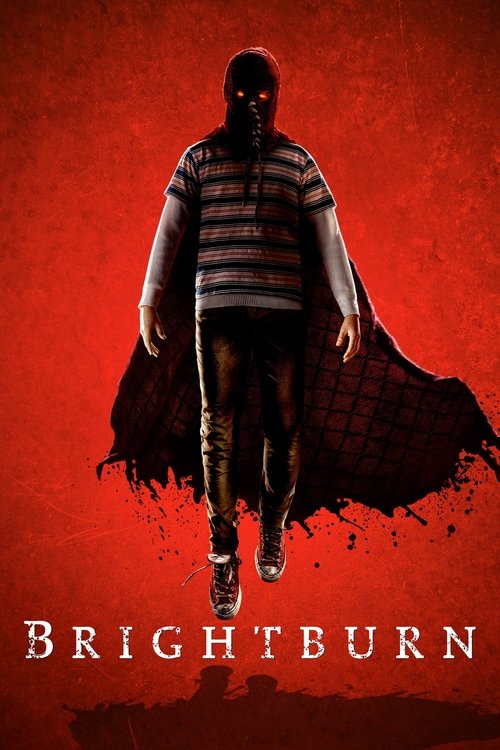
Brightburn (2019)
Directed by David Yarovesky
No — Brightburn is not woke, scoring 4 out of 100 on our wokeness meter.
Brightburn arrives with a premise of admirable economy: a child from the stars lands in rural Kansas, and instead of growing into a savior, he grows into something that kills his adoptive parents with heat vision.
Consciousness Markers
The cast is overwhelmingly white, with Gregory Alan Williams as the sheriff being the only notable minority presence, and his role carries no commentary on representation.
No LGBTQ+ characters, relationships, or themes appear anywhere in the film.
Elizabeth Banks plays a grieving adoptive mother, but the film offers no feminist framing or gender-conscious commentary.
The film engages no racial themes or commentary whatsoever; its Kansas setting and cast are racially unmarked.
There is no environmental or climate-related content in the film.
No economic critique or anti-capitalist themes are present; the story is a personal horror about a malevolent child.
The film contains no body-positivity messaging or body-image themes.
Brandon is depicted as introverted and bullied, but this is framed as sinister alienation rather than any neurodivergence narrative.
The film reworks the Superman origin myth into horror, but this is a genre deconstruction of fiction, not a revision of real historical events.
The film is a lean horror-thriller that never pauses to deliver moral instruction or social messaging to the audience.
Why it received this score
Brightburn arrives with a premise of admirable economy: a child from the stars lands in rural Kansas, and instead of growing into a savior, he grows into something that kills his adoptive parents with heat vision. It is a dark inversion of a familiar myth, executed with the brisk efficiency of a ninety-minute genre exercise. The film has no interest in instructing its audience. It wants to unsettle them, and for stretches it succeeds.
The cultural inventory here is thin to the point of austerity. The cast is almost entirely white, and the Kansas setting carries no racial texture or comment. Gregory Alan Williams appears as the local sheriff, a competent and largely unremarked presence, and the film asks nothing of his casting beyond the performance itself. There is no romantic or identity subplot of any stripe, no economic grievance dressed as horror, no environmental lament, no body-image discourse, no neurodivergent framing. Brandon is introverted and bullied, yes, but the film treats his alienation as the seed of something predatory, not as a condition to be understood or accommodated. The result is a horror film that seems to have been made without consulting the current moment at all.
Whether that constitutes a virtue is a matter of temperament. The film is lean, mean, and entirely uninterested in the moral instruction that has become standard issue in the superhero genre. It deconstructs a comic-book origin, which is a matter of fiction, not history, and it does so without a single sermon. A viewer seeking confirmation of their politics will find nothing here to confirm. A viewer seeking ninety minutes of a boy doing terrible things to people who love him will find exactly that, and very little else. There is something almost restful about the emptiness. The sommelier swirls the glass, finds no notes of social purpose, and sets it down with a small nod of respect for the honesty of a bad vintage that never pretended to be anything else.
That last image may be too generous. The film is not profound. It is simply unburdened, and in this climate, unburdened is its own small distinction.
Analysis generated by our Consciousness Algorithm


Synopsis
What if a child from another world crash-landed on Earth, but instead of becoming a hero to mankind, he proved to be something far more sinister?
Questions about Brightburn
Is Brightburn woke?
No — Brightburn is not woke, scoring 4 out of 100 on our wokeness meter. That earns it a verdict of Ultra Based.
Does Brightburn have any woke elements?
Very few. None of the 10 markers reaches 30, the level where a marker counts as present; the highest is Representation Casting at 10.
How does Brightburn compare to other 2019 movies?
It ranks #244 of the 284 films from 2019 we've scored; their average is 22. The wokest is Black Christmas (79).
How is the Woke Score calculated?
An AI-assisted process researches the film and its reception, scores it 0–100 on ten markers, then combines those into one 0–100 Woke Score. It measures a specific set of 2020s cultural themes, not film quality.