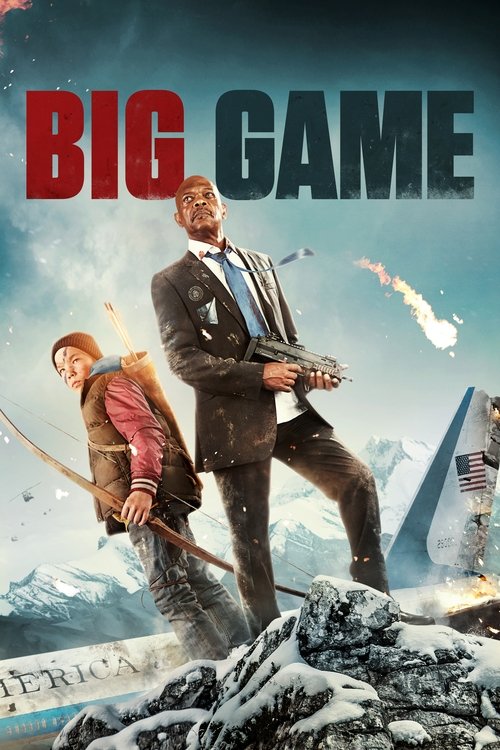
Big Game (2014)
Directed by Jalmari Helander
No — Big Game is not woke, scoring 12 out of 100 on our wokeness meter.
Big Game arrives from Finland in 2014, the most expensive production that country had mounted to that point, and it spends the money on a premise of magnificent silliness.
Consciousness Markers
Samuel L. Jackson plays the U.S. President, a notable non-white casting choice, but the film treats it as unremarkable and offers no diversity commentary.
No LGBTQ+ characters, themes, or subtext are present.
Felicity Huffman appears as the Vice President, but the film has no feminist thesis or gender-conscious framing.
A Black actor plays the President, yet race is never addressed or used as a thematic lens.
No climate or environmental themes are present.
The villains are terrorists and corrupt officials, but the film offers no eat-the-rich or anti-capitalist critique.
No body-positivity themes or messaging are present.
No neurodivergence themes or representation are present.
The story is fictional and does not revise or reinterpret historical events.
The film is a throwback action-adventure with no overt moralizing or issue-driven speeches.
Why it received this score
Big Game arrives from Finland in 2014, the most expensive production that country had mounted to that point, and it spends the money on a premise of magnificent silliness. Air Force One is shot down over Lapland, and the President of the United States must survive the wilderness alongside a thirteen-year-old boy on his first hunt. The director, Jalmari Helander, has cited the adventure pictures of the eighties and nineties as his inheritance, and the film wears that lineage openly. Terrorists chase. Helicopters explode. A refrigeration unit becomes a prison. The tone is brisk and unserious, which is its own kind of honesty.
Samuel L. Jackson plays the President, a casting decision that in a different film might have carried a thesis. Here it carries a man in a suit who complains about the cold. The film never remarks on his race, never builds a theme around it, never asks the audience to reflect on the distance between the Oval Office and the actor occupying it. It casts him and moves on. Felicity Huffman sits in as the Vice President, likewise unremarked. This is representation by arithmetic, not by argument, and it constitutes the film's only glancing contact with the social consciousness of its decade.
The moral machinery is genre-standard. A boy proves himself against his father's reputation. A corrupt Secret Service agent orchestrates the attack. A Vice President schemes toward the presidency and is quietly disposed of in a Pentagon bathroom. None of it is arranged to lecture. There are no speeches about the war on terror, no late pivot into institutional critique, no moment when the camera lingers on a lesson it expects us to absorb. The film wants to be Goonies with guns, and it succeeds at approximately that. Measured against the cultural currents that would soon dominate its industry, it reads as a relic of an older appetite: an action picture that never once turns to the audience and clears its throat.
Analysis generated by our Consciousness Algorithm

Synopsis
Air Force One is shot down by terrorists, leaving the President of the United States stranded in the wilderness of Finland. 13-year-old Oskari is on a hunting mission to prove his maturity to his kinsfolk by tracking down a deer, but instead discovers the President in an escape pod. With the terrorists closing in to capture their prize, the unlikely duo team up to escape their hunters.
Questions about Big Game
Is Big Game woke?
No — Big Game is not woke, scoring 12 out of 100 on our wokeness meter. That earns it a verdict of Ultra Based.
Does Big Game have any woke elements?
Very few. None of the 10 markers reaches 30, the level where a marker counts as present; the highest is Representation Casting at 20.
How does Big Game compare to other 2014 movies?
It ranks #113 of the 303 films from 2014 we've scored; their average is 13. The wokest is Selma (68).
How is the Woke Score calculated?
An AI-assisted process researches the film and its reception, scores it 0–100 on ten markers, then combines those into one 0–100 Woke Score. It measures a specific set of 2020s cultural themes, not film quality.