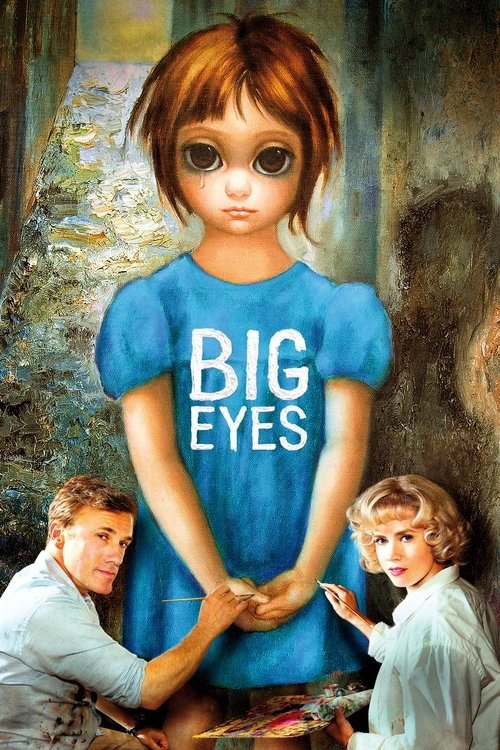
Big Eyes (2014)
Directed by Tim Burton
No — Big Eyes is not especially woke, scoring 25 out of 100 on our wokeness meter.
Tim Burton, an artist long associated with gothic whimsy and talking trees, here sets the talking trees aside to tell a quieter story about a woman whose paintings of saucer-eyed children made a fortune for a husband who never touched a brush.
Consciousness Markers
The core narrative concerns a woman whose artistic authorship is stolen by her husband, who gaslights and threatens her, and who ultimately reclaims her name in court — a genuine feminist arc, though presented as period drama rather than explicit advocacy.
The film is a true story explicitly aimed at correcting the historical record, restoring Margaret Keane's authorship of works long credited to her husband, though it does so through conventional biopic means rather than modern ideological reframing.
The film critiques the commodification of art, mass-produced reproductions, and celebrity-driven commercialism, but its target is fraud and vanity rather than capitalism as a system.
Burton's direction is restrained and character-driven; the film gestures at social commentary about art and criticism but rarely stops to preach at the audience.
The cast is overwhelmingly white, with James Saito as the only notable non-white performer in a minor role as the judge; no deliberate diverse casting effort is evident.
There are no LGBTQ+ characters, themes, or subtext anywhere in the film.
Race is entirely absent as a theme; the story unfolds in a uniformly white art-world milieu with no commentary on racial dynamics.
No environmental or climate-related content of any kind.
No body-positivity themes; the film's focus is authorship and deception, not body image.
No neurodivergent characters or themes are present or explored.
Why it received this score
Tim Burton, an artist long associated with gothic whimsy and talking trees, here sets the talking trees aside to tell a quieter story about a woman whose paintings of saucer-eyed children made a fortune for a husband who never touched a brush. Amy Adams plays Margaret Keane with a patience that curdles slowly into resolve, and Christoph Waltz plays Walter as a man whose charm is a business model. The camera observes the 1950s art world and finds it almost entirely white, which is accurate to the milieu and also the extent of the film's interest in demographics. There is no racial commentary here, no environmental concern, no meditation on body image, and nothing in the way of queer subtext. The film knows what it is about and declines to expand.
That subject is authorship, and the treatment is genuinely feminist in a period-drama register. Margaret is gaslit, threatened, and eventually vindicated in a courtroom where she paints while her husband stalls and claims a sore arm. The film takes real pleasure in restoring a name to work that was credited to a man for decades, a modest act of historical correction conducted through conventional biopic machinery. It also glances at the reproduction and celebrity machinery around the paintings, the cheap prints and the gallery openings, though its target is fraud and vanity, not the economic order that rewarded both.
Burton's restraint keeps the whole thing from turning into a sermon. He stages the humiliation and the recklessness without pausing to instruct the audience on what to conclude. The critic who sneers at the paintings is allowed his sneer. The lesson, if there is one, arrives through the paintbrush and the verdict, not through a speech. It is a well-mannered film about a badly behaved man, and it trusts us to notice. The result is a handsomely mounted piece of awards-season craftsmanship that carries its social consciousness lightly, the way a person carries a coat they may or may not need.
Analysis generated by our Consciousness Algorithm


Synopsis
In the late 1950s and early '60s, artist Walter Keane achieves unbelievable fame and success with portraits of saucer-eyed waifs. However, no one realizes that his wife, Margaret, is the real painter behind the brush. Although Margaret is horrified to learn that Walter is passing off her work as his own, she is too meek to protest too loudly. It isn't until the Keanes' marriage comes to an end and a lawsuit follows that the truth finally comes to light.
Questions about Big Eyes
Is Big Eyes woke?
No — Big Eyes is not especially woke, scoring 25 out of 100 on our wokeness meter. That earns it a verdict of Based.
Does Big Eyes have any woke elements?
2 of the 10 markers register at 30 or above, led by Feminist Agenda (50) and Revisionist History (35). On Feminist Agenda: The core narrative concerns a woman whose artistic authorship is stolen by her husband, who gaslights and threatens her, and who ultimately reclaims her name in court — a genuine feminist arc, though presented as period drama rather than explicit advocacy.
How does Big Eyes compare to other 2014 movies?
It ranks #34 of the 303 films from 2014 we've scored; their average is 13. The wokest is Selma (68).
How is the Woke Score calculated?
An AI-assisted process researches the film and its reception, scores it 0–100 on ten markers, then combines those into one 0–100 Woke Score. It measures a specific set of 2020s cultural themes, not film quality.