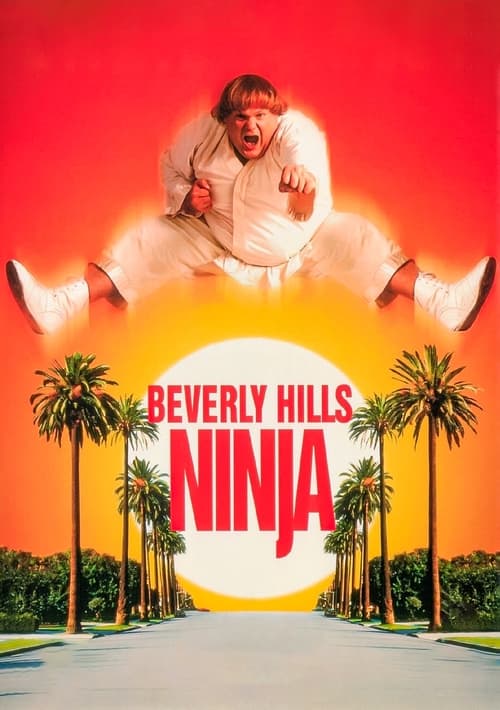
Beverly Hills Ninja (1997)
Directed by Dennis Dugan
No — Beverly Hills Ninja is not woke, scoring 8 out of 100 on our wokeness meter.
Beverly Hills Ninja arrives as a relic from a period when a leading man's body could serve as the entire architecture of a joke, and the film pursues that architecture with a dedication that borders on the monastic.
Consciousness Markers
The cast includes Asian actors (Robin Shou, Soon-Tek Oh, Frane7ois Chau) and Chris Rock in notable roles, but the film's whole premise is a white outsider crowned the 'Great White Ninja' atop a Japanese tradition, with ethnic roles largely serving stereotype comedy.
Nicollette Sheridan's Alison has moments of agency (running her own investigation, rescuing Haru), but she is fundamentally the damsel whose sister's murder motivates the plot.
The film traffics heavily in ethnic stereotype gags (Japanese ninja cliche9s, the 'Great Black Ninja' punchline), but these are comedic caricature, not progressive racial consciousness.
Farley's character is an overweight underdog who ultimately triumphs, yet the comedy is relentlessly built on fat jokes and physical mockery of his body, which is the opposite of a body-positive sensibility.
No LGBTQ+ characters, relationships, or themes whatsoever.
No environmental or climate themes present.
A criminal counterfeiting plot features Yakuza gangsters and a wealthy crime boss, but the film has no economic critique or eat-the-rich sentiment.
No neurodivergent characters or themes.
No historical revisionism; the film is a contemporary slapstick comedy with no historical subject matter.
The film is pure slapstick goofball comedy with no preachy messaging or moral instruction.
Why it received this score
Beverly Hills Ninja arrives as a relic from a period when a leading man's body could serve as the entire architecture of a joke, and the film pursues that architecture with a dedication that borders on the monastic. Chris Farley plays Haru, an American foundling raised in a Japanese dojo under a prophecy that a white outsider will become the greatest ninja of all. The premise is a cultural collision engineered for pratfalls, and the film rarely aspires to more. Asian actors populate the clan and the criminal underworld with professional competence, yet the narrative's central joke is the elevation of a clumsy Caucasian above them. The picture is not hostile so much as oblivious, which is its own kind of statement.
The comedy leans hard on Farley's weight, treating his frame as a piñata for lampposts, forklifts, and the occasional sheave. There is an underdog arc, and the underdog does triumph, but the path to victory is paved with fat jokes delivered without a trace of irony. Chris Rock's bellboy dreams of ninja glory and settles for a punchline about being the Great Black Ninja, a gag the film presents without apparent self-examination. Nicollette Sheridan's Alison runs her own investigation and pulls Haru out of captivity, though the plot still requires her to be captured so the men can resolve things. No environmental concerns intrude. No economic critique surfaces, despite a counterfeiting ring that could have invited one. Nobody lectures. The film has no designs on our conscience whatsoever.
What remains is a 1997 studio comedy doing exactly what 1997 studio comedies did, with a geniality that makes its laziness almost forgivable. It opened at number one, reviews were unkind, and Christian Bale has reportedly watched it more than once. The cultural record is richer for the trivia and poorer for the jokes. We file it accordingly, without malice.
Analysis generated by our Consciousness Algorithm


Synopsis
Haru, an orphaned American who washes ashore in Japan and is mistaken for the great White Ninja of legend. Raised among the finest Ninjas, Haru grows strong and big - very big. With the grace of all Three Stooges rolled into one body, Haru is an embarrassment to his clan. But when a beautiful blonde pleads for his help, Haru is given one dangerous, disastrously funny chance to prove himself.
Questions about Beverly Hills Ninja
Is Beverly Hills Ninja woke?
No — Beverly Hills Ninja is not woke, scoring 8 out of 100 on our wokeness meter. That earns it a verdict of Ultra Based.
Does Beverly Hills Ninja have any woke elements?
1 of the 10 markers register at 30 or above, led by Representation Casting (30). On Representation Casting: The cast includes Asian actors (Robin Shou, Soon-Tek Oh, Frane7ois Chau) and Chris Rock in notable roles, but the film's whole premise is a white outsider crowned the 'Great White Ninja' atop a Japanese tradition, with ethnic roles largely serving stereotype comedy.
How does Beverly Hills Ninja compare to other 1997 movies?
It ranks #53 of the 109 films from 1997 we've scored; their average is 12. The wokest is Happy Together (65).
How is the Woke Score calculated?
An AI-assisted process researches the film and its reception, scores it 0–100 on ten markers, then combines those into one 0–100 Woke Score. It measures a specific set of 2020s cultural themes, not film quality.