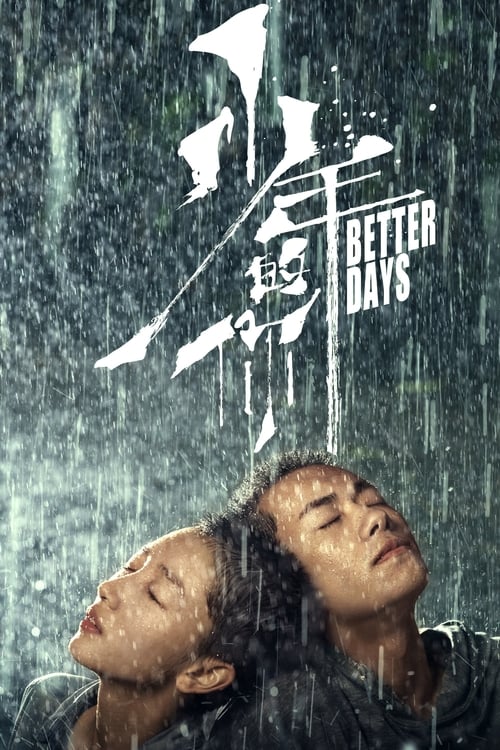
Better Days (2019)
Directed by Derek Tsang Kwok-cheung
No — Better Days is not woke, scoring 13 out of 100 on our wokeness meter.
Better Days arrives with the weight of a national conversation about school bullying and the college entrance examination, and it carries that weight with a straight back.
Consciousness Markers
The closing sequence explicitly displays government policy screens about anti-bullying measures and delivers a direct plea for collective responsibility toward youth, giving the film a clear didactic, message-forward ending.
The film centers a girl's suffering at the hands of bullies and critiques a system that fails to protect her, giving it a mild gendered-justice undercurrent, but it is not framed as a feminist manifesto.
The cast is entirely Chinese, which reflects the film's native setting rather than any deliberate diversity-casting initiative. No conscious representation agenda is present.
There are no LGBTQ+ characters, relationships, or themes anywhere in the narrative.
The story unfolds in a racially homogeneous Chinese society with no engagement with racial identity or racial justice themes.
No environmental or climate themes appear in the film.
The film critiques the exam-driven social system and institutional neglect, but offers no anti-capitalist or class-warfare argument.
There is no body-positivity messaging; the shaved-head imagery is about solidarity and trauma, not body acceptance advocacy.
No neurodivergent characters or themes are present.
The film is a contemporary social drama with no historical revisionism.
Why it received this score
Better Days arrives with the weight of a national conversation about school bullying and the college entrance examination, and it carries that weight with a straight back. Derek Tsang's film follows Chen Nian, a girl whose classmate's suicide turns her into the next target, and Xiao Bei, a street thug who becomes her self-appointed bodyguard. The performances are raw, the Chongqing locations are damp and unkind, and the film's central relationship has a desperate tenderness that keeps the melodrama from tipping into soap. It is a serious work about institutional failure and adolescent cruelty, and it earns its grimness.
The film's social consciousness is of a specific and limited vintage. Its critique of a system that leaves bullied children to fend for themselves has a faint gendered edge, since the camera never flinches from the particular humiliations visited upon Chen Nian, but the story does not organize itself around a feminist argument. The cast is Chinese because the film is Chinese, not because a casting directive demanded it. There is no racial thesis, no environmental sermon, no class-warfare subplot, and no attempt to retrofit the narrative with contemporary identity markers. The shaved heads are a gesture of solidarity and shared trauma, not a body-acceptance manifesto.
The closing sequence, however, drops the film's careful restraint and hands the audience a policy presentation. Screens list anti-bullying measures and stricter punishments, followed by a plea for collective responsibility toward the young. This is lecture energy of a mild but unmistakable sort, the cinematic equivalent of a public service announcement appended to a tragedy. Better Days remains a strong and sobering drama, but it ends by telling us exactly what to think, which is a shame for a film that had already shown us.
Analysis generated by our Consciousness Algorithm


Synopsis
A bullied teenage girl forms an unlikely friendship with a mysterious young man who protects her from her assailants, while she copes with the pressures of her final examinations.
Questions about Better Days
Is Better Days woke?
No — Better Days is not woke, scoring 13 out of 100 on our wokeness meter. That earns it a verdict of Ultra Based.
Does Better Days have any woke elements?
1 of the 10 markers register at 30 or above, led by Lecture Energy (35). On Lecture Energy: The closing sequence explicitly displays government policy screens about anti-bullying measures and delivers a direct plea for collective responsibility toward youth, giving the film a clear didactic, message-forward ending.
How does Better Days compare to other 2019 movies?
It ranks #158 of the 284 films from 2019 we've scored; their average is 22. The wokest is Black Christmas (79).
How is the Woke Score calculated?
An AI-assisted process researches the film and its reception, scores it 0–100 on ten markers, then combines those into one 0–100 Woke Score. It measures a specific set of 2020s cultural themes, not film quality.