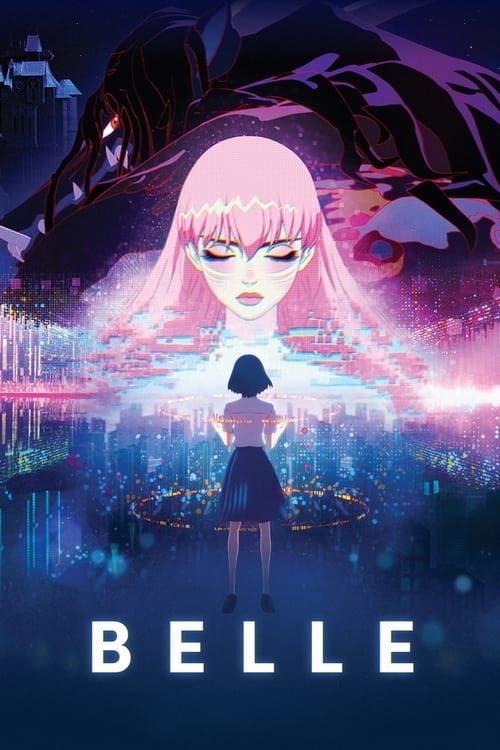
Belle (2021)
Directed by Mamoru Hosoda
No — Belle is not especially woke, scoring 22 out of 100 on our wokeness meter.
Belle arrives from Studio Chizu with a Cannes ovation, a Beauty and the Beast lineage, and the full weight of Mamoru Hosoda's reputation behind it.
Consciousness Markers
The title character is literally 'the freckled princess,' and the film contrasts Suzu's self-consciousness about her appearance with the beauty of her avatar, culminating in a message about inner worth and self-acceptance.
Suzu is a female protagonist who finds her voice, rescues an abused boy, and confronts his father, with a supportive female best friend in Hiro. However, this is a coming-of-age empowerment arc rather than an explicit feminist thesis.
Themes of child abuse and online empathy are woven into an emotional narrative rather than delivered as direct moral instruction; the messaging is heartfelt rather than preachy.
A wholly Japanese production with a Japanese voice cast; the characters are Japanese by default rather than through any deliberate diversity-casting initiative. No modern representation-casting markers present.
No LGBTQ+ characters, relationships, or themes appear anywhere in the story.
The film is set in rural Japan with an all-Japanese cast and engages no racial themes or commentary whatsoever.
The mother's death occurs during a river flood rescue, but the event is framed as personal tragedy and sacrifice, not as climate commentary.
The virtual world 'U' and its self-appointed Justices are critiqued for surveillance and mob justice, but this is a meditation on online society, not an economic or anti-capitalist argument.
No characters are depicted with or discussed in terms of neurodivergence.
The film is a contemporary original story inspired by a fairytale; it makes no historical claims to revise.
Why it received this score
Belle arrives from Studio Chizu with a Cannes ovation, a Beauty and the Beast lineage, and the full weight of Mamoru Hosoda's reputation behind it. It is a wholly Japanese production, set in rural Kochi Prefecture, performed by a Japanese voice cast, and concerning itself with a teenage girl, a virtual world, and a dead mother. There is no diversity casting initiative at work here, no racial commentary, no LGBTQ subplot, no economic grievance, no climate reckoning. Those registers simply are not opened. The film is content to be a science fantasy musical about grief, and it commits to that brief with unusual sincerity.
Where a certain contemporary sensibility does surface is in the encouragement of the self. Suzu is a girl who has lost her singing voice and her confidence, and the avatar the system assigns her, freckles included, becomes the vessel through which she reclaims both. The title translates literally as the dragon and the freckled princess, and the arc moves from shame about her appearance toward a working peace with it. She also takes it upon herself to save a boy from a violent father, staring the man down without flinching, a rescue performed alone, at night, in Kawasaki. That is empowerment of a sturdy, old-fashioned kind, closer to a coming-of-age catharsis than a manifesto.
The moral instruction, such as it is, stays light. Child abuse and the mob justice of a virtual world's self-appointed Justices are folded into an emotional story instead of announced from a pulpit. The messaging is heartfelt, occasionally indulgent, and never sermonizing. This critic, wearied by a decade of cinema that lectures first and entertains second, found the restraint a small mercy.
Analysis generated by our Consciousness Algorithm


Synopsis
Suzu is a 17-year-old high-school student living in a rural town with her father. Wounded by the loss of her mother at a young age, Suzu one day discovers the massive online world "U" and dives into this alternate reality as her avatar, Belle. Before long, all of U's eyes are fixed on Belle, when, suddenly, a mysterious, dragon-like figure appears before her.
Questions about Belle
Is Belle woke?
No — Belle is not especially woke, scoring 22 out of 100 on our wokeness meter. That earns it a verdict of Based.
Does Belle have any woke elements?
1 of the 10 markers register at 30 or above, led by Body Positivity (35). On Body Positivity: The title character is literally 'the freckled princess,' and the film contrasts Suzu's self-consciousness about her appearance with the beauty of her avatar, culminating in a message about inner worth and self-acceptance.
How does Belle compare to other 2021 movies?
It ranks #90 of the 242 films from 2021 we've scored; their average is 23. The wokest is The Forever Purge (83).
How is the Woke Score calculated?
An AI-assisted process researches the film and its reception, scores it 0–100 on ten markers, then combines those into one 0–100 Woke Score. It measures a specific set of 2020s cultural themes, not film quality.