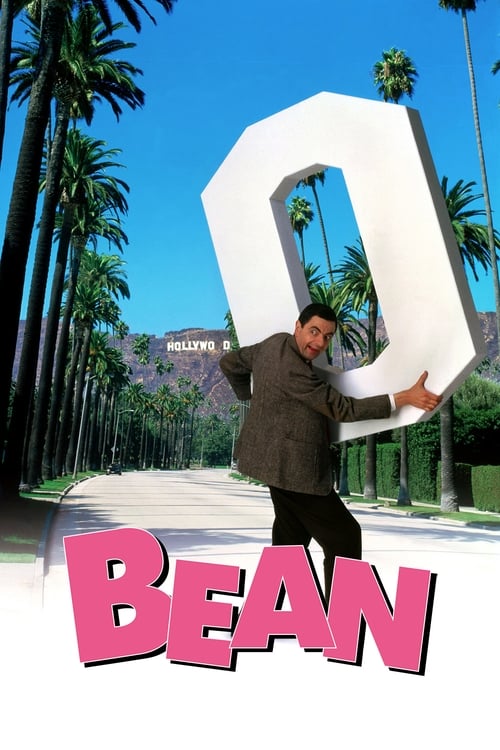
Bean (1997)
Directed by Mel Smith
No — Bean is not woke, scoring 0 out of 100 on our wokeness meter.
Bean arrives from a gentler era of British comedy, a 1997 vehicle for Rowan Atkinson's near-silent buffoon, and it conducts its business with an almost monastic indifference to the cultural preoccupations that would later consume the medium.
Consciousness Markers
The cast is overwhelmingly white, with only one Black actor in a minor supporting role; no deliberate diversity casting or commentary.
No LGBTQ+ characters, themes, or subtext appear in the film.
Female characters are present but the film does not engage with feminist themes or gender politics.
Race is not addressed or explored; the film contains no racial commentary or consciousness.
There is no environmental or climate-related content in the film.
The film does not critique capitalism, wealth inequality, or the art market in any meaningful way.
No body positivity themes or diverse body representation are present.
Mr. Bean's eccentric behavior is played for comedy and not framed as neurodivergence.
The film uses a real painting but does not revise or reinterpret historical events or figures.
The film is a slapstick comedy with no preachy or lecture-like messaging.
Why it received this score
Bean arrives from a gentler era of British comedy, a 1997 vehicle for Rowan Atkinson's near-silent buffoon, and it conducts its business with an almost monastic indifference to the cultural preoccupations that would later consume the medium. The premise is simple: a gallery sends its worst employee to Los Angeles to embarrass itself in front of a painting. Whistler's Mother is treated as a prop, not a thesis. No institution is indicted, no market is interrogated, no historical record is revised. The art world exists here only to be disrupted by a man who mistakes lacquer thinner for cleaning fluid.
The cast is a parade of white faces, and the film never pauses to consider this. Racial identity, gender politics, and questions of who gets to speak are absent from the frame entirely. Female characters exist as wives and daughters, tasked with exasperation, and the screenplay asks nothing more of them. There is no romantic subplot to complicate matters, no sermon tucked inside the slapstick, no moment where a character turns to the lens and explains how we ought to feel about the world. Even the destruction is egalitarian. Bean injures riders on a simulator, explodes a turkey, and ruins a dinner party without regard to anyone's identity.
What remains is a curious artifact. A film so thoroughly uninterested in messaging that it becomes, by default, a document of comic timing and very little else. The painting is smuggled home at the end, a small crime offered without moral commentary. Ebert observed that ninety minutes was thirty too many, and the assessment holds. The film is pleasant, weightless, and entirely without an argument to make. In the current climate, that absence reads almost as a provocation.
Analysis generated by our Consciousness Algorithm


Synopsis
Childlike Englishman, Mr. Bean, is an incompetent watchman at the Royal National Gallery. After the museum's board of directors' attempt to have him fired is blocked by the chairman, who has taken a liking to Bean, they send him to Los Angeles to act as their ambassador for the unveiling of a historic painting to humiliate him. Fooled, Mr. Bean must now successfully unveil the painting or risk his and a hapless Los Angeles curator's termination.
Questions about Bean
Is Bean woke?
No — Bean is not woke, scoring 0 out of 100 on our wokeness meter. That earns it a verdict of Ultra Based.
Does Bean have any woke elements?
No. All 10 markers score zero.
How does Bean compare to other 1997 movies?
It ranks #95 of the 109 films from 1997 we've scored; their average is 12. The wokest is Happy Together (65).
How is the Woke Score calculated?
An AI-assisted process researches the film and its reception, scores it 0–100 on ten markers, then combines those into one 0–100 Woke Score. It measures a specific set of 2020s cultural themes, not film quality.