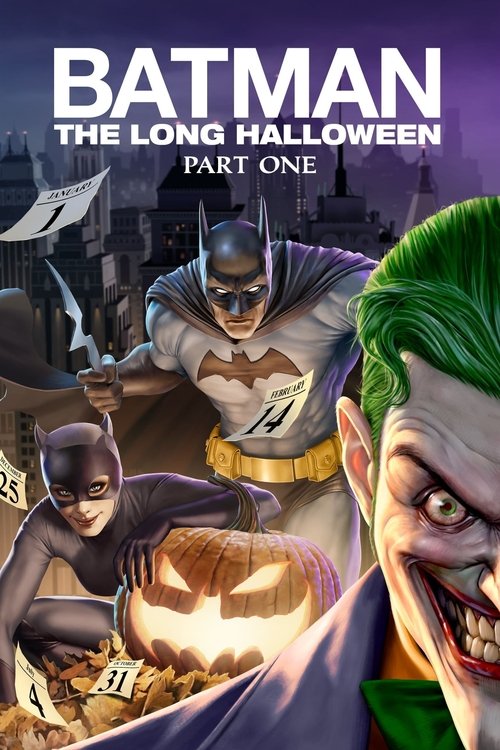
Batman: The Long Halloween, Part One (2021)
Directed by Chris Palmer
No — Batman: The Long Halloween, Part One is not woke, scoring 5 out of 100 on our wokeness meter.
Batman: The Long Halloween, Part One arrives as the first half of a two-part animated adaptation of the Jeph Loeb and Tim Sale graphic novel, and it conducts itself with the grim patience of a procedural.
Consciousness Markers
The voice cast includes Naya Rivera, Frances Callier, and Greg Chun in an otherwise traditionally white Batman roster, but the film makes no explicit point of race-conscious casting or identity.
Catwoman is a capable and independent figure, but the noir plot offers no feminist critique or agenda.
No LGBTQ+ characters, relationships, or themes are present.
The story is a mob mystery with no engagement with racial themes or systemic racism.
No environmental or climate themes appear in the film.
The Falcone crime family is corrupt, but the film is not an economic critique or eat-the-rich parable.
No body-positivity themes or diverse body representations are present.
No exploration of neurodivergence or neurodiverse characters occurs.
This is a fictional superhero noir with no historical revisionism.
The film is a straightforward crime mystery without didactic social messaging.
Why it received this score
Batman: The Long Halloween, Part One arrives as the first half of a two-part animated adaptation of the Jeph Loeb and Tim Sale graphic novel, and it conducts itself with the grim patience of a procedural. A killer works through the calendar, striking on Halloween, Thanksgiving, and Christmas, and the film tracks Batman, James Gordon, and Harvey Dent as they attempt to connect the bodies to the Falcone crime family. The structure is a countdown, and the mood is rain-soaked and municipal. Chris Palmer directs the material with restraint, allowing the mystery to breathe across its runtime without reaching for grand statements about power or justice. It is a story about a city, told through its holidays and its funerals.
The voice cast includes Naya Rivera as Catwoman, Frances Callier, and Greg Chun, and the film treats their presence as unremarkable, which is the correct approach. Catwoman moves through the plot with competence and independence, a capable figure in a noir landscape, though the screenplay asks nothing of her beyond the next scene. There is no sermonizing here, no moment where the narrative pauses to instruct the audience on how to feel about Gotham's corruption. The Falcones are criminals because criminals exist in this genre, not because the film wishes to indict an economic order. The mob is a plot device, not a thesis.
This is a picture content to be a mystery. It has no interest in the cultural arguments of its moment, no lesson appended to the final act, no messaging to deliver. We are left with a moody, well-executed slab of animated noir that respects its source and its audience. In the present climate, that restraint reads almost as a novelty.
Analysis generated by our Consciousness Algorithm
Part of


Synopsis
Following a brutal series of murders taking place on Halloween, Thanksgiving, and Christmas, Gotham City's young vigilante known as the Batman sets out to pursue the mysterious serial killer alongside police officer James Gordon and district attorney Harvey Dent.
Questions about Batman: The Long Halloween, Part One
Is Batman: The Long Halloween, Part One woke?
No — Batman: The Long Halloween, Part One is not woke, scoring 5 out of 100 on our wokeness meter. That earns it a verdict of Ultra Based.
Does Batman: The Long Halloween, Part One have any woke elements?
Very few. None of the 10 markers reaches 30, the level where a marker counts as present; the highest is Representation Casting at 10.
How does Batman: The Long Halloween, Part One compare to other 2021 movies?
It ranks #214 of the 242 films from 2021 we've scored; their average is 23. The wokest is The Forever Purge (83).
How is the Woke Score calculated?
An AI-assisted process researches the film and its reception, scores it 0–100 on ten markers, then combines those into one 0–100 Woke Score. It measures a specific set of 2020s cultural themes, not film quality.