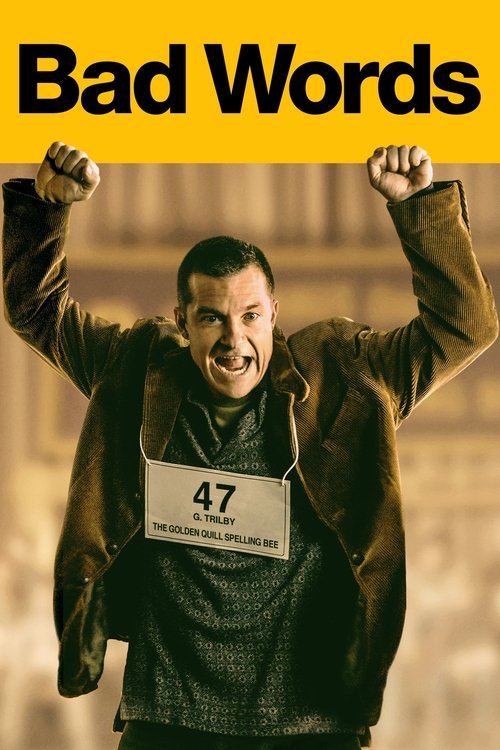
Bad Words (2014)
Directed by Jason Bateman
No — Bad Words is not woke, scoring 10 out of 100 on our wokeness meter.
Jason Bateman's Bad Words is a black comedy about a forty-year-old misanthrope who exploits a spelling bee loophole and spends ninety minutes being unpleasant in a blazer.
Consciousness Markers
Rohan Chand's Chaitanya, a 10-year-old Indian-American boy, is the film's co-lead and emotional anchor, a notably non-white central pairing for a 2013 studio comedy, though the casting was driven by open-call audition rather than any representational mandate.
Chaitanya's Indian-American family and the spelling-bee milieu provide incidental cultural texture, but the film never engages race as a subject or theme.
The film is a satire, but a gleefully amoral one that pointedly refuses to moralize or deliver a message — critics noted its deliberate lack of redemption or preaching.
No LGBTQ characters, themes, or subtext appear anywhere in the film.
The film's humor is aggressively retrograde — a prostitute is hired to flash a child, a girl is tricked into believing she has begun menstruating via ketchup, and women are largely props for Guy's contempt. This is the opposite of a feminist agenda.
No environmental or climate content whatsoever.
No economic critique or eat-the-rich sentiment; the satire targets a spelling bee, not capital.
No body-positivity themes; the film's comedy is largely at the expense of others rather than celebratory of body diversity.
Guy is characterized as a misanthrope with anger issues, but this is played as antisocial personality rather than any neurodivergent identity or advocacy.
No historical revisionism; the film is a contemporary fictional comedy.
Why it received this score
Jason Bateman's Bad Words is a black comedy about a forty-year-old misanthrope who exploits a spelling bee loophole and spends ninety minutes being unpleasant in a blazer. The film's cultural inventory is thin, but not entirely empty. Rohan Chand's Chaitanya, a ten-year-old Indian-American contestant, becomes the co-lead and emotional anchor, giving a 2013 studio comedy a non-white central pairing that was uncommon enough to register. That registration is modest. The script treats Chaitanya's family as texture, not subject. Race is present in the room and absent from the argument.
The film's gender politics are ancient and hostile. A prostitute is hired to flash a child. A girl is tricked with ketchup into believing she has begun menstruating. Women exist mostly as obstacles or props for Guy's contempt. There is no LGBTQ current, no climate concern, no economic critique, no body-positive rejoicing, and no neurodivergent identity. Guy's anger is played as misanthropy, not diagnosis. History is not revised because history is not invited. The satire aims at the spelling bee, not at capital, and the movie has no interest in reforming its protagonist. It ends with a note and a police car, not a lesson.
That refusal to moralize is the film's only claim to contemporary virtue, and it is a negative one. Bad Words is gleefully amoral, occasionally sulfurous, and almost never preachy. Its social consciousness sits in a low register: a faint representational pulse, a few incidental cultural details, and no sustained argument about anything. The final act offers a flicker of warmth, a co-winner's handshake, a chase after bullies. Warmth is not politics. It is a punchline with a pulse. The picture wants to watch a grown man be terrible at a children's competition, and it does. The rest is silence, spelling, and the faint smell of ketchup.
Analysis generated by our Consciousness Algorithm
Part of


Synopsis
Forty-year-old misanthrope, Guy Trilby, enters the National Golden Quill Spelling Bee through a loophole in the rules.
Questions about Bad Words
Is Bad Words woke?
No — Bad Words is not woke, scoring 10 out of 100 on our wokeness meter. That earns it a verdict of Ultra Based.
Does Bad Words have any woke elements?
1 of the 10 markers register at 30 or above, led by Representation Casting (35). On Representation Casting: Rohan Chand's Chaitanya, a 10-year-old Indian-American boy, is the film's co-lead and emotional anchor, a notably non-white central pairing for a 2013 studio comedy, though the casting was driven by open-call audition rather than any representational mandate.
How does Bad Words compare to other 2014 movies?
It ranks #130 of the 303 films from 2014 we've scored; their average is 13. The wokest is Selma (68).
How is the Woke Score calculated?
An AI-assisted process researches the film and its reception, scores it 0–100 on ten markers, then combines those into one 0–100 Woke Score. It measures a specific set of 2020s cultural themes, not film quality.