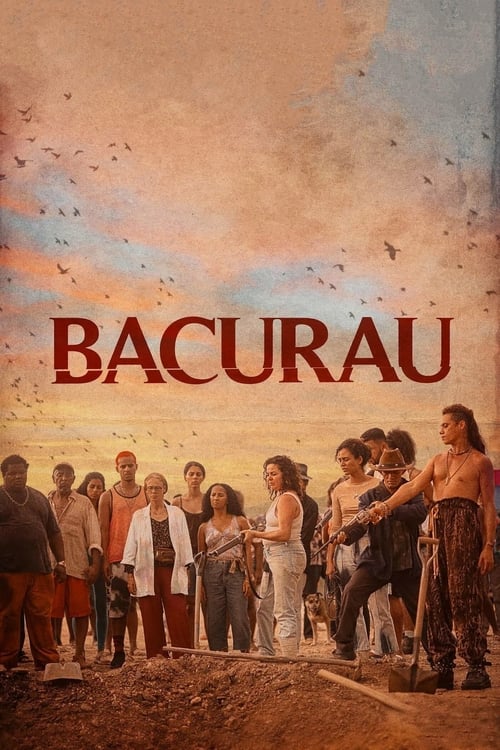
Bacurau (2019)
Directed by Kleber Mendonça Filho
Partly — Bacurau is somewhat woke, scoring 59 out of 100 on our wokeness meter.
Bacurau is a near-future Weird Western that treats the Brazilian sertão as a stage for colonial revenge.
Consciousness Markers
The central allegory pits armed white American and European foreigners hunting impoverished Black and mixed-race Brazilians for sport, foregrounding colonial and racial violence explicitly.
The corrupt mayor's water monopoly, the wealthy foreign hunters scoring 'points' on human lives, and the townspeople's violent uprising against their exploiters form an explicit anti-elite, anti-colonial thesis.
The cast is overwhelmingly Afro-Brazilian and mixed-race sertanejos, centering a region and population rarely given leading roles, though this reads as organic to the setting rather than identity-driven casting.
The plot turns on a corrupt damming and water-rights scheme depriving the drought-stricken sertão, making resource extraction and water justice a concrete narrative engine.
Its anti-colonial and anti-imperialist message is delivered through genre action, gore, and allegory rather than explicit preaching, keeping didacticism moderate.
The community is defined by its matriarch Carmelita and led in resistance by women like Domingas and Teresa, but gender is not the film's organizing concern.
The film carries a queer subtext around the revolutionary Lunga (played by Silvero Pereira) and his bond with Pacote, and a TMDB keyword flags 'transsexuality,' but it remains a minor, embedded element rather than a thematic focus.
No meaningful engagement with body image or size acceptance appears in the film.
There is no depiction or thematic treatment of neurodivergence.
The film is a fictional near-future allegory rather than a reworking of actual historical events, so it does not revise recorded history.
Why it received this score
Bacurau is a near-future Weird Western that treats the Brazilian sertão as a stage for colonial revenge. The town mourns its matriarch, vanishes from digital maps, and becomes the prey of wealthy foreign hunters. The film's social consciousness is not imported from a seminar. It grows from the drought, the dam, and the specific people of this place. The cast is largely Afro-Brazilian and mixed-race, a demographic rarely given this kind of narrative center. That choice reads as organic, not as a casting memo. A queer thread runs through Lunga and Pacote, though it stays in the margins. The community's matriarch and its women, Domingas and Teresa among them, organize the resistance, but gender is not the film's chief concern.
Racial violence drives the allegory. White Americans and Europeans hunt Black and mixed-race Brazilians for sport, scoring points like tourists on a packaged safari. The corrupt mayor sells water rights and hoards the river, turning a basic resource into a monopoly. When the townspeople rise up, the film's anti-elite and anti-colonial anger becomes explicit. Climate and water justice are not decorative. They are the plot's machinery. The message arrives through gore, Western tropes, and surreal humor, which keeps the sermonizing to a moderate hum. It lectures less than it ambushes.
The film has no interest in body image, no engagement with neurodivergence, and no revision of recorded history. Its near-future setting is an allegorical invention, not a historical correction. What remains is a politically charged genre piece that earns its anger through action and atmosphere. The result is not a pamphlet. It is a strange, violent, and controlled act of cultural memory. The sommelier's note: dry, bloody, with a long colonial finish.
Analysis generated by our Consciousness Algorithm


Synopsis
Bacurau, a small town in the Brazilian sertão, mourns the loss of its matriarch, Carmelita, who lived to be 94. Days later, its inhabitants notice that their community has vanished from most maps.
Questions about Bacurau
Is Bacurau woke?
Partly — Bacurau is somewhat woke, scoring 59 out of 100 on our wokeness meter. That earns it a verdict of Woke-Adjacent.
What makes Bacurau woke?
7 of the 10 markers register at 30 or above, led by Eat the Rich (65), Racial Consciousness (65) and Representation Casting (55). On Eat the Rich: The corrupt mayor's water monopoly, the wealthy foreign hunters scoring 'points' on human lives, and the townspeople's violent uprising against their exploiters form an explicit anti-elite, anti-colonial thesis.
How does Bacurau compare to other 2019 movies?
It ranks #22 of the 284 films from 2019 we've scored; their average is 22. The wokest is Black Christmas (79).
How is the Woke Score calculated?
An AI-assisted process researches the film and its reception, scores it 0–100 on ten markers, then combines those into one 0–100 Woke Score. It measures a specific set of 2020s cultural themes, not film quality.