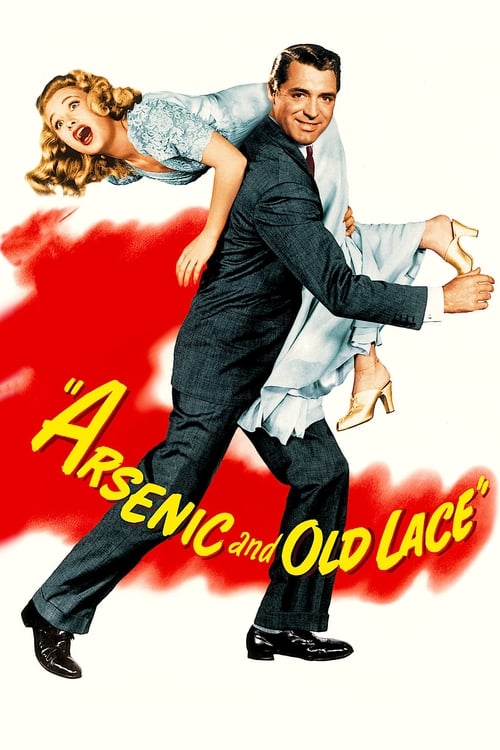
Arsenic and Old Lace (1944)
Directed by Frank Capra
No — Arsenic and Old Lace is not woke, scoring 3 out of 100 on our wokeness meter.
Frank Capra's Arsenic and Old Lace arrives from 1944 with the confidence of a picture that has nothing to prove to anyone living now.
Consciousness Markers
The cast is entirely white and reflects the racial homogeneity of 1940s Hollywood; no meaningful representation casting.
No LGBTQ+ characters, themes, or subtext.
Female characters exist as comedic murderesses and a love interest, but the film advances no feminist agenda.
A passing joke about Mayflower settlers scalping Indians is not racial consciousness; no engagement with racial justice.
No environmental or climate themes.
No critique of capitalism or wealth inequality.
No body positivity themes.
Mental illness and delusion are played for dark comedy, not framed as neurodivergent acceptance.
Historical references to Teddy Roosevelt and the Panama Canal are comedic devices, not progressive historical revision.
The film is a screwball farce with no preachy social-justice lecture.
Why it received this score
Frank Capra's Arsenic and Old Lace arrives from 1944 with the confidence of a picture that has nothing to prove to anyone living now. Cary Grant plays Mortimer Brewster, a drama critic who has spent his public life denouncing marriage and then marries the minister's daughter next door. He returns home to announce the news and finds a corpse in the window seat. His aunts, Abby and Martha, have poisoned twelve lonely old men out of kindness and buried them in the cellar, with the help of a brother who believes he is Theodore Roosevelt. The film was adapted from Joseph Kesselring's stage hit and held back from release until the Broadway run ended, which tells us where the priorities of the era lay.
The cast is uniformly white, and the screenplay makes no apology or comment on the matter. The two murderesses are elderly women played for laughs, and the only young woman in the picture exists to be kissed and to be silenced by a kiss in the final scene. Mental illness is the engine of the comedy: Teddy charges up the stairs with a bugle, Jonathan's face has been rebuilt by a drunk surgeon into something resembling a monster, and the aunts' cheerful homicide is treated as a domestic quirk. There is no critique of wealth or capital, no environmental anxiety, no revision of the historical record, and no moment in which the audience is instructed how to feel about any of it.
The film's historical references are gags. The Panama Canal is a place where imaginary yellow fever victims go. The Mayflower is invoked so that scalping can be reassigned to the wrong side. Kesselring wrote in an anti-war mood, and scholars have found metaphors about American liberty in the bodies under the floorboards, which is the sort of reading a film can survive without endorsing. The remainder is a tight, fast, very funny farce with a body count and no sermon. On the modern index of social instruction, it registers as a blank page. The scorecard is empty, and the picture is entirely at peace with that.
Analysis generated by our Consciousness Algorithm
Part of


Synopsis
Mortimer Brewster, a newspaper drama critic, playwright, and author known for his diatribes against marriage, suddenly falls in love and gets married; but when he makes a quick trip home to tell his two maiden aunts, he finds out his aunts' hobby - killing lonely old men and burying them in the cellar!
Questions about Arsenic and Old Lace
Is Arsenic and Old Lace woke?
No — Arsenic and Old Lace is not woke, scoring 3 out of 100 on our wokeness meter. That earns it a verdict of Ultra Based.
Does Arsenic and Old Lace have any woke elements?
No. All 10 markers score zero.
How does Arsenic and Old Lace compare to other 1944 movies?
It ranks #3 of the 6 films from 1944 we've scored; their average is 2. The wokest is Double Indemnity (4).
How is the Woke Score calculated?
An AI-assisted process researches the film and its reception, scores it 0–100 on ten markers, then combines those into one 0–100 Woke Score. It measures a specific set of 2020s cultural themes, not film quality.