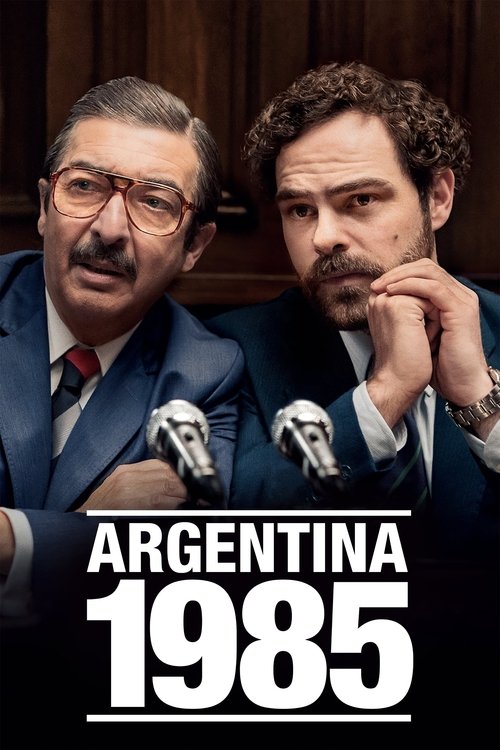
Argentina 1985 (2022)
Directed by Santiago Mitre
No — Argentina 1985 is not woke, scoring 10 out of 100 on our wokeness meter.
Argentina, 1985 arrives with the sober bearing of a courtroom sketch rendered in oil.
Consciousness Markers
The film builds to Strassera's famous 'Nunca más' (Never again) closing argument, which carries a moral weight about human rights and democracy, though it is delivered diegetically within the courtroom drama rather than as overt preaching.
The cast is a natural ensemble of Argentine actors reflecting the real historical figures; women appear on the prosecution team and as witnesses, but this is organic to the story rather than a deliberate diversity mandate.
Women serve on the prosecution team and as key witnesses, but the film is a legal procedural about a dictatorship's crimes, not a vehicle for a feminist thesis.
No LGBTQ+ characters, relationships, or themes appear anywhere in the film.
The film concerns Argentina's largely European-descended society and the crimes of a military junta; there is no engagement with racial identity or racial justice themes.
No environmental or climate themes are present in this courtroom drama.
The film's antagonist is a military dictatorship prosecuted for torture and forced disappearances; there is no economic critique of capitalism or class-based 'eat the rich' narrative.
No body positivity themes or commentary on body image appear in the film.
No neurodivergent characters or themes of neurodiversity are present.
The film is a faithful, well-researched dramatization of the 1985 Trial of the Juntas, drawing on interviews with actual participants; it presents history as it occurred rather than reinterpreting it through a modern ideological lens.
Why it received this score
Argentina, 1985 arrives with the sober bearing of a courtroom sketch rendered in oil. Santiago Mitre's film concerns the prosecution of Argentina's military junta, a legal endeavor undertaken by Julio César Strassera and a ragtag band of junior lawyers who agree to sign their names to a case that could get them killed. The camera sits still. The witnesses speak. The evidence accumulates. There is no montage set to a pop song, no narrator informing us how to feel. The film trusts the material, which is the rarest instinct in contemporary cinema and the reason it never needs to raise its voice.
For the purposes of our classification, the picture is remarkably clean. Women populate the prosecution team and the witness stand, but they are there because they were there in 1985, not because a spreadsheet demanded them. No romantic subplot arrives to validate anyone's identity. The antagonists are generals who threw people from airplanes, not hedge fund managers, so there is nothing to say about the crimes of capital. The Argentine society on display is largely of European descent, and the film has no interest in inventing a racial discourse it cannot support. The environment, body image, neurodiversity: absent, and honestly, the courtroom has enough on its docket.
The closing argument, the famous 'Nunca más,' is delivered within the drama itself and earned by two hours of testimony. It carries moral weight because it is not aimed at the audience like a finger. It is aimed at judges. A lesser production would have turned the victims into props for a lecture. This one lets them testify. The result is a film of conscience that resists the contemporary compulsion to sermonize, and for that restraint alone it deserves our quiet respect.
Analysis generated by our Consciousness Algorithm

Synopsis
In the 1980s, a team of lawyers takes on the heads of Argentina's bloody military dictatorship in a battle against odds and a race against time.
Questions about Argentina 1985
Is Argentina 1985 woke?
No — Argentina 1985 is not woke, scoring 10 out of 100 on our wokeness meter. That earns it a verdict of Ultra Based.
Does Argentina 1985 have any woke elements?
Very few. None of the 10 markers reaches 30, the level where a marker counts as present; the highest is Lecture Energy at 25.
How does Argentina 1985 compare to other 2022 movies?
It ranks #155 of the 223 films from 2022 we've scored; their average is 22. The wokest is Bros (92).
How is the Woke Score calculated?
An AI-assisted process researches the film and its reception, scores it 0–100 on ten markers, then combines those into one 0–100 Woke Score. It measures a specific set of 2020s cultural themes, not film quality.