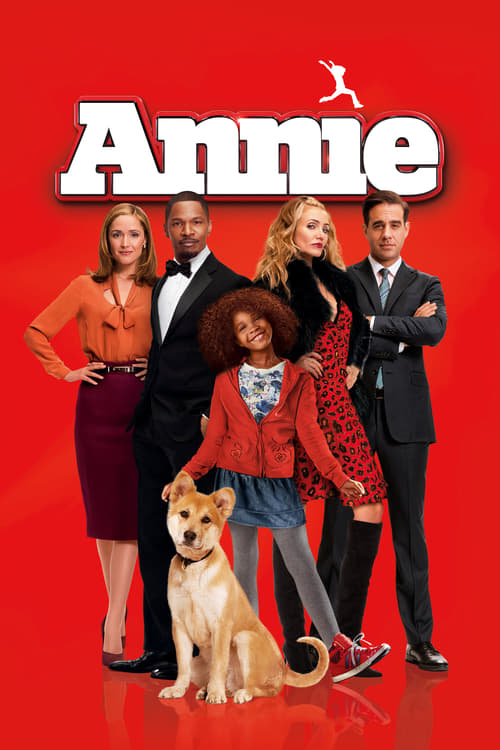
Annie (2014)
Directed by Will Gluck
Partly — Annie is somewhat woke, scoring 44 out of 100 on our wokeness meter.
The 2014 Annie arrives with its Depression-era setting traded for a Harlem foster home and its redheaded orphan recast as a Black girl with a Shiba Inu and a talent for deflection.
Consciousness Markers
The film deliberately reimagines the iconic orphan as a Black girl in a Harlem foster home and casts Jamie Foxx as a Black Daddy Warbucks analogue, surrounding her with a racially diverse ensemble.
The Harlem setting and multiracial cast are notable, but race is not examined or used as a thematic lens; diversity is present without comment.
The plot briefly skewers a billionaire’s mayoral campaign as a publicity stunt and lets Miss Hannigan sneer that rich people are selfish, yet the film ultimately celebrates a benevolent tycoon and material success.
The film tacks on earnest messages about literacy, foster care, and family, but they arrive as musical-family-film sentiment rather than sustained preaching.
Annie is a self-assured girl surrounded by female foster siblings and a female antagonist, but the film offers no explicit feminist argument or critique of gender structures.
No LGBTQ+ characters, relationships, or themes are present.
No climate or environmental themes appear in the film.
No body-positivity themes or messaging are present.
Annie’s illiteracy is a plot point, but it is framed as a literacy gap rather than neurodivergence or a diagnosed learning difference.
The film is a contemporary remake, not a historical revision or counter-narrative.
Why it received this score
The 2014 Annie arrives with its Depression-era setting traded for a Harlem foster home and its redheaded orphan recast as a Black girl with a Shiba Inu and a talent for deflection. This is a casting decision made with visible intent, and it works on its own terms: Quvenzhané Wallis is the most watchable thing in the frame, and the film surrounds her with a genuinely multiracial ensemble. Whether that constitutes a statement is another matter. The film places its diversity in front of the camera and then declines to say anything about it, which is a choice, and a telling one.
The politics are similarly decorative. Will Stacks, a cellphone mogul running for mayor, is briefly skewered as a publicity opportunist, and Miss Hannigan gets a line about rich people being selfish, but the movie cannot sustain the thought for a full musical number. It ends by celebrating a benevolent billionaire, a literacy center named after him, and the warm embrace of material comfort. The critique dissolves the moment the helicopter appears. There is a girl at the center who is self-assured and surrounded by women, and a drunk female antagonist who gets a redemption arc, but the film never argues anything about gender. It simply casts women and moves on.
What the film does offer is earnest sentiment about reading, foster care, and family, delivered in the soft register of a family musical instead of a sermon. Annie cannot read at ten years old, a fact the plot treats as a literacy gap and nothing more. No romantic subplot steps outside convention, no environmental concern intrudes, no body or brain is examined for its difference. This is a remake that updates the surface and leaves the machinery untouched. It wants to be liked. It is, at moments. It is not trying to teach us anything we did not already agree to.
Analysis generated by our Consciousness Algorithm


Synopsis
Annie is a young, happy foster kid who's also tough enough to make her way on the streets of New York in 2014. Originally left by her parents as a baby with the promise that they'd be back for her someday, it's been a hard knock life ever since with her mean foster mom Miss Hannigan. But everything's about to change when the hard-nosed tycoon and New York mayoral candidate Will Stacks—advised by his brilliant VP and his shrewd and scheming campaign advisor—makes a thinly-veiled campaign move and takes her in. Stacks believes he's her guardian angel, but Annie's self-assured nature and bright, sun-will-come-out-tomorrow outlook on life just might mean it's the other way around.
Questions about Annie
Is Annie woke?
Partly — Annie is somewhat woke, scoring 44 out of 100 on our wokeness meter. That earns it a verdict of Woke-Adjacent.
What makes Annie woke?
1 of the 10 markers register at 30 or above, led by Representation Casting (78). On Representation Casting: The film deliberately reimagines the iconic orphan as a Black girl in a Harlem foster home and casts Jamie Foxx as a Black Daddy Warbucks analogue, surrounding her with a racially diverse ensemble.
How does Annie compare to other 2014 movies?
It ranks #12 of the 303 films from 2014 we've scored; their average is 13. The wokest is Selma (68).
How is the Woke Score calculated?
An AI-assisted process researches the film and its reception, scores it 0–100 on ten markers, then combines those into one 0–100 Woke Score. It measures a specific set of 2020s cultural themes, not film quality.