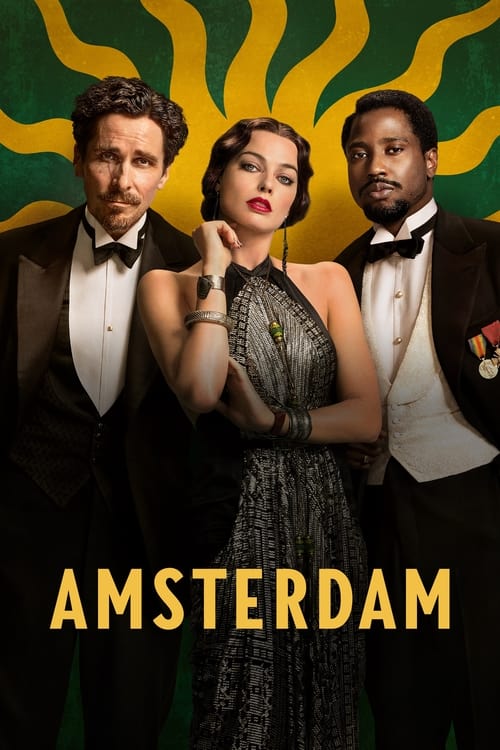
Amsterdam (2022)
Directed by David O. Russell
Partly — Amsterdam is somewhat woke, scoring 59 out of 100 on our wokeness meter.
David O. Russell's Amsterdam arrives with the self-assurance of a film that believes it has something important to say.
Consciousness Markers
Ensemble features a Black co-lead (John David Washington) and a notably multiracial cast, with the 369th Infantry Regiment's African American soldiers woven into the narrative. Diversity is present and historically grounded rather than incidental.
Harold's experience as a Black lawyer and veteran, the segregated 369th Regiment, and the film's reach toward contemporary race commentary give it a real racial-consciousness dimension.
The villains are a cabal of wealthy industrialists plotting a fascist coup, giving the film a clear 'the rich are the enemy' current, though it is framed as antifascism more than economic critique.
Critics noted the film functions as an 'antifascist history lesson' with contemporary political overtones about race and concentrated wealth, though the messaging is muddled rather than preachy.
The Business Plot is heavily fictionalized—invented cabals, renamed figures, and a Nazi-linked conspiracy—recasting 1930s history through a modern antifascist lens.
Valerie and Irma are capable, self-directed women, but the film offers no explicit feminist thesis; Valerie remains partly a romantic object and the arc is driven by the male trio.
Burt's war-disfigured face is treated matter-of-factly and he is a romantic lead, a mild body-acceptance gesture, but it is not a thematic concern.
No LGBTQ+ characters, relationships, or themes appear anywhere in the plot or subtext.
No environmental or climate themes whatsoever.
Valerie's supposed nerve disease and epilepsy are a poisoning ruse, not genuine neurodivergent representation.
Why it received this score
David O. Russell's Amsterdam arrives with the self-assurance of a film that believes it has something important to say. It is a 1930s-set mystery comedy loosely based on the Business Plot, a real conspiracy to unseat President Roosevelt. The film takes generous liberties with that history, inventing a cabal called the Committee of the Five and linking it to Nazism. This revisionist approach recasts the era through a modern antifascist lens. The result plays as an antifascist history lesson, though the lesson is muddled. Critics noted the contemporary overtones, and the film does reach for something about race and concentrated wealth. It does not preach, but it does lecture.
The ensemble features John David Washington as Harold, a Black lawyer and veteran. His experience of racism and his service in the segregated 369th Infantry Regiment give the film a genuine racial-consciousness dimension. The diversity is historically grounded, not incidental. Valerie and Irma are capable, self-directed women, but the film offers no explicit feminist thesis. Valerie remains partly a romantic object, and the arc belongs to the male trio. There is no LGBTQ representation, no environmental theme, and no neurodivergent characters. Valerie's supposed nerve disease is a poisoning ruse, not a portrait of disability.
The villains are wealthy industrialists plotting a fascist coup, which gives the film a clear sentiment that the rich are the enemy. It is framed as antifascism more than economic critique, but the sentiment is there. Burt's war-disfigured face is treated matter-of-factly, and he is a romantic lead, a mild gesture toward body acceptance. The film's social consciousness is present but uneven. It is a curious artifact, applying 2020s sensibilities to 1930s history without fully committing to any of them. The whole endeavor feels like a beautiful, overstuffed cabinet of curiosities, and like the conspiracy it depicts, it never quite comes together.
Analysis generated by our Consciousness Algorithm


Synopsis
In the 1930s, three friends—a doctor, a nurse, and an attorney—witness a murder, become suspects themselves and uncover one of the most outrageous plots in American history.
Questions about Amsterdam
Is Amsterdam woke?
Partly — Amsterdam is somewhat woke, scoring 59 out of 100 on our wokeness meter. That earns it a verdict of Woke-Adjacent.
What makes Amsterdam woke?
5 of the 10 markers register at 30 or above, led by Representation Casting (60), Racial Consciousness (55) and Eat the Rich (48). On Representation Casting: Ensemble features a Black co-lead (John David Washington) and a notably multiracial cast, with the 369th Infantry Regiment's African American soldiers woven into the narrative.
How does Amsterdam compare to other 2022 movies?
It ranks #23 of the 223 films from 2022 we've scored; their average is 22. The wokest is Bros (92).
How is the Woke Score calculated?
An AI-assisted process researches the film and its reception, scores it 0–100 on ten markers, then combines those into one 0–100 Woke Score. It measures a specific set of 2020s cultural themes, not film quality.