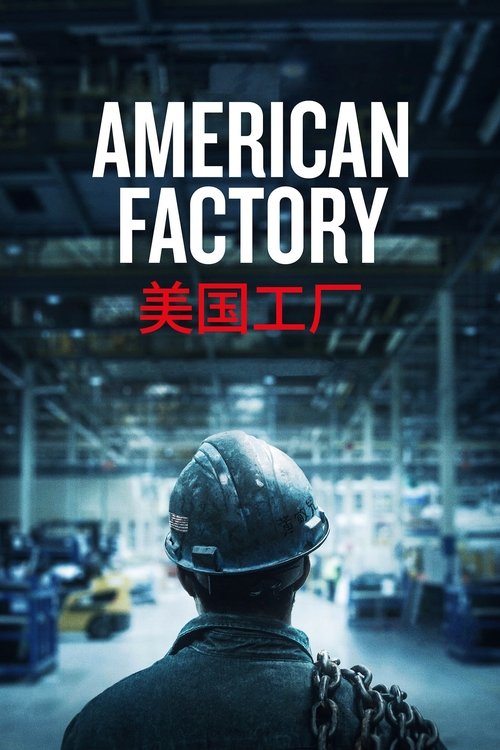
American Factory (2019)
Directed by Steven Bognar
No — American Factory is not especially woke, scoring 24 out of 100 on our wokeness meter.
American Factory arrives with the pedigree of a documentary that has already been sorted onto its proper shelf.
Consciousness Markers
The film's core is the tension between workers and management: union-busting, safety shortcuts, wage cuts, and the subordination of labor to profit, all rendered with clear sympathy for the workers.
The documentary naturally features a large ensemble of American and Chinese blue-collar workers, including several women, but this reflects the real subjects rather than any deliberate diversity-casting agenda.
Critics specifically praised the film for being political without being didactic or strident, letting the workers' own voices carry the argument rather than preaching to the audience.
The film explores Chinese-versus-American cultural friction in the workplace, but it is a study of labor and economics rather than a racial-justice narrative.
A few women workers are among the subjects, but the film makes no feminist argument and frames its conflict around class and globalization, not gender.
No LGBTQ+ themes or characters are present in this labor documentary.
Environmental concerns play no role in the film's account of the Fuyao plant.
No body-positivity themes appear in the film.
Neurodivergence is not a subject of the documentary.
The film documents contemporary events as they happened rather than reinterpreting the historical record.
Why it received this score
American Factory arrives with the pedigree of a documentary that has already been sorted onto its proper shelf. It is the first film from the Obama production company, it won the Academy Award for Best Documentary Feature, and it concerns a Chinese billionaire named Cao Dewang who reopens a shuttered General Motors plant in Moraine, Ohio, hiring two thousand people who had been waiting for something to happen. The film is patient. It watches the ribbon cutting, the optimism, the safety posters, and then it watches the optimism curdle.
The engine of the picture is class. Managers explain that American workers are too slow, too expensive, too inclined to want things like ventilation and weekends. Union organizers circulate petitions. Consultants are flown in to explain how to keep a union out, and the camera stays in the room while the workers realize they are being studied like a problem to be solved. Sympathy sits plainly with labor. What the film does not do is reach for adjacent causes. There is no environmental argument, no gender thesis, no meditation on identity. It is a study of who owns the building and who has to stand inside it.
The restraint is the achievement. Bognar and Reichert use no narrator, no captions telling us how to feel, no experts flown in to explain the meaning of it all. The workers speak for themselves, which is why the film lands as an argument instead of a sermon. It is political without being preachy, a rarer trick than it sounds. Two hours of people trying to hold a job in a global economy, and the lasting impression is not outrage but arithmetic. The documentary is excellent. By the standards of our current cultural accounting, it is also a fairly narrow one.
Analysis generated by our Consciousness Algorithm


Synopsis
In post-industrial Ohio, a Chinese billionaire opens a new factory in the husk of an abandoned General Motors plant, hiring two thousand blue-collar Americans. Early days of hope and optimism give way to setbacks as high-tech China clashes with working-class America.
Questions about American Factory
Is American Factory woke?
No — American Factory is not especially woke, scoring 24 out of 100 on our wokeness meter. That earns it a verdict of Based.
Does American Factory have any woke elements?
2 of the 10 markers register at 30 or above, led by Eat the Rich (60) and Representation Casting (35). On Eat the Rich: The film's core is the tension between workers and management: union-busting, safety shortcuts, wage cuts, and the subordination of labor to profit, all rendered with clear sympathy for the workers.
How does American Factory compare to other 2019 movies?
It ranks #92 of the 284 films from 2019 we've scored; their average is 22. The wokest is Black Christmas (79).
How is the Woke Score calculated?
An AI-assisted process researches the film and its reception, scores it 0–100 on ten markers, then combines those into one 0–100 Woke Score. It measures a specific set of 2020s cultural themes, not film quality.