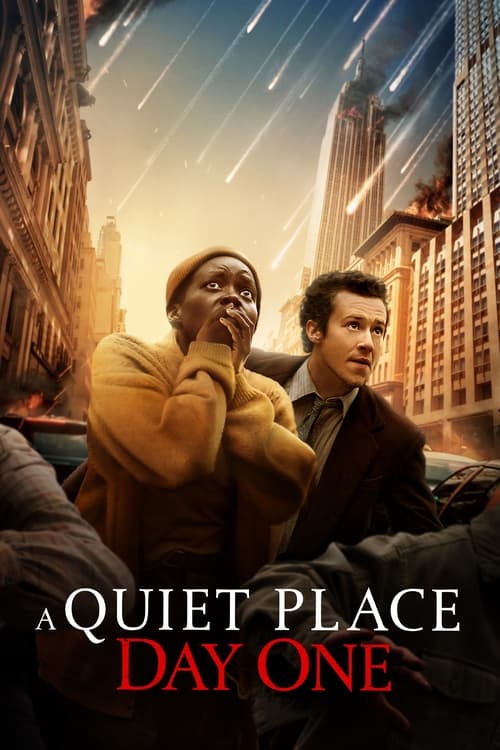
A Quiet Place: Day One (2024)
Directed by Michael Sarnoski
No — A Quiet Place: Day One is not woke, scoring 17 out of 100 on our wokeness meter.
A prequel that declines to explain itself, A Quiet Place: Day One drops us into Manhattan on the afternoon the meteors fall and asks us to hold our breath for ninety minutes.
Consciousness Markers
Lupita Nyong'o headlines as a terminally ill Black woman and Djimon Hounsou appears in support, giving the film a notably diverse principal cast, though the roles are cast without any in-story commentary on race or identity.
Sam is a woman-led protagonist with agency and a defiant final act, but the film frames her arc around mortality, memory, and pizza rather than any feminist thesis.
The film is a tense survival thriller that shows rather than tells; its only thematic gesture is a quiet carpe-diem note, delivered without preaching.
No LGBTQ+ characters, relationships, or themes appear anywhere in the film.
The diverse cast exists naturally within the survival narrative; the film makes no statement about race, racism, or racial identity.
The alien invasion has no environmental or climate dimension whatsoever.
No critique of wealth, class, or capitalism is present; the enemy is extraterrestrial, not economic.
Sam's illness is treated as a personal tragedy, not as a vehicle for body-positivity messaging.
No neurodivergent characters or themes are depicted.
The film is a fictional alien-invasion prequel with no historical subject matter to revise.
Why it received this score
A prequel that declines to explain itself, A Quiet Place: Day One drops us into Manhattan on the afternoon the meteors fall and asks us to hold our breath for ninety minutes. Michael Sarnoski, who made Pig, brings an unexpected patience to the franchise's premise. Lupita Nyong'o plays Sam, a hospice patient who has already made peace with dying and now watches the rest of the city arrive at her position. It is a sly inversion of the usual survival arithmetic, and the film commits to it without a whiff of sentiment. The monsters are loud. The movie is not.
The casting is diverse and the film declines to mention it. Nyong'o headlines as a terminally ill Black woman. Djimon Hounsou returns in support, reprising his role from the second installment. Nobody delivers a speech about any of this, which reads as either admirable restraint or simple indifference to the question. Joseph Quinn's Eric, a law student in shock, trails Sam through flooded subways with the devotion of a man who has found something to protect. Her arc belongs to a woman, built on agency and a final act of defiant generosity, though the film frames the whole journey around memory, mortality, and a slice of pizza. The gender is present. The thesis is not.
What stays absent is more instructive than what remains. No economic grievance. No ecological subtext. No identity sermon, no lesson handed down from a pulpit. The enemy is extraterrestrial and hungry, and the film's only philosophical gesture is a quiet nudge toward living while you can, delivered with a shrug. Then it fades out on Nina Simone and a cat. A rare vintage, served unadorned.
Analysis generated by our Consciousness Algorithm
Part of


Synopsis
As New York City is invaded by alien creatures who hunt by sound, a woman named Sam fights to survive with her cat.
Questions about A Quiet Place: Day One
Is A Quiet Place: Day One woke?
No — A Quiet Place: Day One is not woke, scoring 17 out of 100 on our wokeness meter. That earns it a verdict of Ultra Based.
Does A Quiet Place: Day One have any woke elements?
1 of the 10 markers register at 30 or above, led by Representation Casting (45). On Representation Casting: Lupita Nyong'o headlines as a terminally ill Black woman and Djimon Hounsou appears in support, giving the film a notably diverse principal cast, though the roles are cast without any in-story commentary on race or identity.
How does A Quiet Place: Day One compare to other 2024 movies?
It ranks #94 of the 189 films from 2024 we've scored; their average is 22. The wokest is The Six Triple Eight (92).
How is the Woke Score calculated?
An AI-assisted process researches the film and its reception, scores it 0–100 on ten markers, then combines those into one 0–100 Woke Score. It measures a specific set of 2020s cultural themes, not film quality.