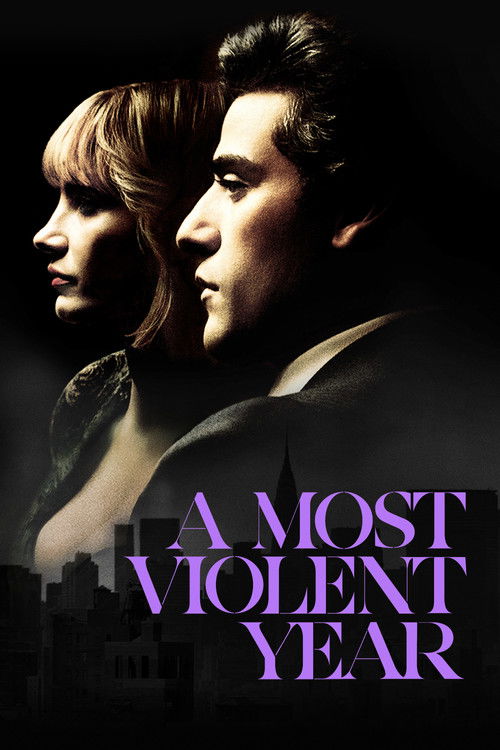
A Most Violent Year (2014)
Directed by J.C. Chandor
No — A Most Violent Year is not woke, scoring 17 out of 100 on our wokeness meter.
A Most Violent Year arrives dressed as a thriller and behaves like a ledger.
Consciousness Markers
The lead is a Latino immigrant (Oscar Isaac) and the cast includes David Oyelowo and Catalina Sandino Moreno, but these are organic to the story of an immigrant striver rather than a statement of diverse casting.
The film anatomizes the corrupting machinery of American capitalism and the price of the American Dream, but it observes rather than indicts, offering no eat-the-rich polemic.
Jessica Chastain's Anna is a sharp, pragmatic partner who has quietly skimmed company money, but the film offers no feminist thesis or gendered critique.
The immigrant-versus-establishment dynamic and the ethnic patchwork of Hasidic, Italian, and Latino players give a faint racial texture, but the film is about business ethics, not racial justice.
A slow-burn crime drama that trusts its audience, with only a closing exchange about taking the 'most right' path edging toward moral commentary.
No LGBTQ+ characters or themes appear anywhere in the film.
The heating-oil trade involves fossil fuels, but the film has no environmental or climate dimension whatsoever.
No body-positivity themes or messaging are present.
Julian is depicted as desperate and unstable, but this is dramatic characterization, not a neurodivergence narrative.
The 1981 New York setting is a period backdrop, not a revisionist reframing of history.
Why it received this score
A Most Violent Year arrives dressed as a thriller and behaves like a ledger. J.C. Chandor's 1981 New York is a city of hijacked trucks, price-fixing, and men in heavy coats who speak in the flat register of men closing deals. Oscar Isaac's Abel Morales is a Latino immigrant building a heating oil empire on borrowed money and borrowed patience. That casting deserves a nod and nothing more. The film treats his origins as biography, not as a banner. David Oyelowo and Catalina Sandino Moreno appear without ceremony. The ethnic patchwork of Hasidic sellers, Italian brokers, and Latino strivers lends the film a faint texture of the melting pot. It never stops to congratulate itself for noticing.
The film's real subject is the machinery of American commerce and what it costs to keep your hands clean inside it. Chandor anatomizes the loans, the mortgages, the favors owed to men with Mafia cousins. He observes the corruption. He does not indict it. Nobody eats the rich here. The rich eat each other, politely, over drinks. Jessica Chastain's Anna is the sharpest instrument in the drawer, a partner who has quietly skimmed the company for years and presents the theft as housekeeping. She is a fine character. She is not a thesis. The closing exchange about taking the path that is most right gestures toward moral commentary and then steps back.
Much is simply absent. The heating oil trade involves fossil fuel and the film has no environmental thought in its head. There is no LGBTQ presence, no body-positivity messaging, no neurodivergence narrative, though Julian's desperation is rendered with care. History is backdrop, not argument. This is a patient, well-tailored crime drama that trusts its audience to sit still. It mostly earns that trust, which is its own quiet rebuke to the age of the sermon.
{"thematic_tags": []} would be appended, but as plain JSON the object follows below.
{"review": "A Most Violent Year arrives dressed as a thriller and behaves like a ledger. J.C. Chandor's 1981 New York is a city of hijacked trucks, price-fixing, and men in heavy coats who speak in the flat register of men closing deals. Oscar Isaac's Abel Morales is a Latino immigrant building a heating oil empire on borrowed money and borrowed patience. That casting deserves a nod and nothing more. The film treats his origins as biography, not as a banner. David Oyelowo and Catalina Sandino Moreno appear without ceremony. The ethnic patchwork of Hasidic sellers, Italian brokers, and Latino strivers lends the film a faint texture of the melting pot. It never stops to congratulate itself for noticing. The film's real subject is the machinery of American commerce and what it costs to keep your hands clean inside it. Chandor anatomizes the loans, the mortgages, the favors owed to men with Mafia cousins. He observes the corruption. He does not indict it. Nobody eats the rich here. The rich eat each other, politely, over drinks. Jessica Chastain's Anna is the sharpest instrument in the drawer, a partner who has quietly skimmed the company for years and presents the theft as housekeeping. She is a fine character. She is not a thesis. The closing exchange about taking the path that is most right gestures toward moral commentary and then steps back. Much is simply absent. The heating oil trade involves fossil fuel and the film has no environmental thought in its head. There is no LGBTQ presence, no body-positivity messaging, no neurodivergence narrative, though Julian's desperation is rendered with care. History is backdrop, not argument. This is a patient, well-tailored crime drama that trusts its audience to sit still. It mostly earns that trust.", "thematic_tags": []}
Analysis generated by our Consciousness Algorithm


Synopsis
A thriller set in New York City during the winter of 1981, statistically one of the most violent years in the city's history, and centered on the lives of an immigrant and his family trying to expand their business and capitalize on opportunities as the rampant violence, decay, and corruption of the day drag them in and threaten to destroy all they have built.
Questions about A Most Violent Year
Is A Most Violent Year woke?
No — A Most Violent Year is not woke, scoring 17 out of 100 on our wokeness meter. That earns it a verdict of Ultra Based.
Does A Most Violent Year have any woke elements?
1 of the 10 markers register at 30 or above, led by Representation Casting (38). On Representation Casting: The lead is a Latino immigrant (Oscar Isaac) and the cast includes David Oyelowo and Catalina Sandino Moreno, but these are organic to the story of an immigrant striver rather than a statement of diverse casting.
How does A Most Violent Year compare to other 2014 movies?
It ranks #73 of the 303 films from 2014 we've scored; their average is 13. The wokest is Selma (68).
How is the Woke Score calculated?
An AI-assisted process researches the film and its reception, scores it 0–100 on ten markers, then combines those into one 0–100 Woke Score. It measures a specific set of 2020s cultural themes, not film quality.