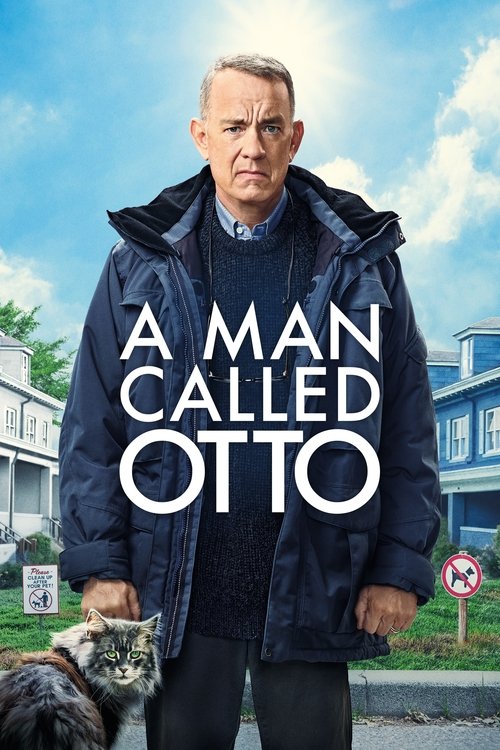
A Man Called Otto (2022)
Directed by Marc Forster
No — A Man Called Otto is not especially woke, scoring 29 out of 100 on our wokeness meter.
Tom Hanks plays Otto Anderson, a widower of six months who has decided to stop bothering with the bother of living, and the film spends two hours interrupting him.
Consciousness Markers
The central neighbor family is Latino (Mariana Treviño, Manuel Garcia-Rulfo), and the supporting cast includes Black actors, giving the suburban Pittsburgh setting a deliberately multiethnic texture. The diversity is present but largely unremarked upon.
A concrete subplot involves Malcolm, a trans teenager whom the late Sonya supported as a student, and Otto befriends him. It is a genuine, if secondary, LGBTQ+ thread.
The villain is a predatory real estate firm, Dye & Merika, exploiting an elderly couple's Parkinson's diagnosis to buy up the neighborhood, and the community bands together to stop them. A clear anti-corporate, eat-the-rich undercurrent.
The immigrant family and Black neighbors exist naturally in the story, but the film never interrogates race or racism as a theme.
The film gestures at community solidarity and corporate malfeasance, but it delivers these as sentimental beats rather than sermon. The messaging is soft and subordinated to the tearjerker.
Sonya and Marisol are capable, warm women, but the film's engine is Otto's grief and redemption rather than any feminist critique. No structural gender politics are on offer.
No environmental themes whatsoever.
Sonya's paraplegia is treated as tragedy and motivation, not as a body-positivity statement. No body-diversity messaging.
No neurodivergence themes are present.
No historical revisionism; the film is a contemporary domestic drama.
Why it received this score
Tom Hanks plays Otto Anderson, a widower of six months who has decided to stop bothering with the bother of living, and the film spends two hours interrupting him. This is a remake of a Swedish film, itself drawn from a Swedish novel, which means the machinery has been tested in two languages before arriving in suburban Pittsburgh. The machinery works. Hanks glowers, a stray cat appears, a pregnant neighbor bangs on the door, and the audience is guided toward the exits with damp tissues and a mild sense of having been handled.
The film's social furniture is arranged with care. The new neighbors are Latino. Malcolm, the teenager Otto reluctantly befriends, is trans, and the late Sonya is remembered as the teacher who supported him at school. Anita and Reuben, the elderly couple down the street, are Black. None of this is announced. It sits in the frame like a well-placed fern, and the film never asks us to think about it again. The villain is a real estate concern, Dye & Merika, sniffing around a Parkinson's diagnosis and a neighborhood it would like to absorb. The neighbors form a small barricade. The corporation retreats. It is a satisfying scene, and it costs the film nothing.
This is a tearjerker with a conscience kept politely in the next room. The corporate malfeasance, the immigrant family, the trans kid, the community solidarity: these are ingredients, not arguments. The film wants us to cry, not to organize. It is competent, warm, and entirely harmless, which is its own kind of achievement in a marketplace that usually demands a sharper edge. The heart, as the doctor observes, is too big. The point of view is quite small.
Analysis generated by our Consciousness Algorithm


Synopsis
When a lively young family moves in next door, grumpy widower Otto Anderson meets his match in a quick-witted, pregnant woman named Marisol, leading to an unlikely friendship that turns his world upside down.
Questions about A Man Called Otto
Is A Man Called Otto woke?
No — A Man Called Otto is not especially woke, scoring 29 out of 100 on our wokeness meter. That earns it a verdict of Based.
Does A Man Called Otto have any woke elements?
3 of the 10 markers register at 30 or above, led by Eat the Rich (45), LGBTQ+ Themes (45) and Representation Casting (45). On Eat the Rich: The villain is a predatory real estate firm, Dye & Merika, exploiting an elderly couple's Parkinson's diagnosis to buy up the neighborhood, and the community bands together to stop them.
How does A Man Called Otto compare to other 2022 movies?
It ranks #58 of the 223 films from 2022 we've scored; their average is 22. The wokest is Bros (92).
How is the Woke Score calculated?
An AI-assisted process researches the film and its reception, scores it 0–100 on ten markers, then combines those into one 0–100 Woke Score. It measures a specific set of 2020s cultural themes, not film quality.