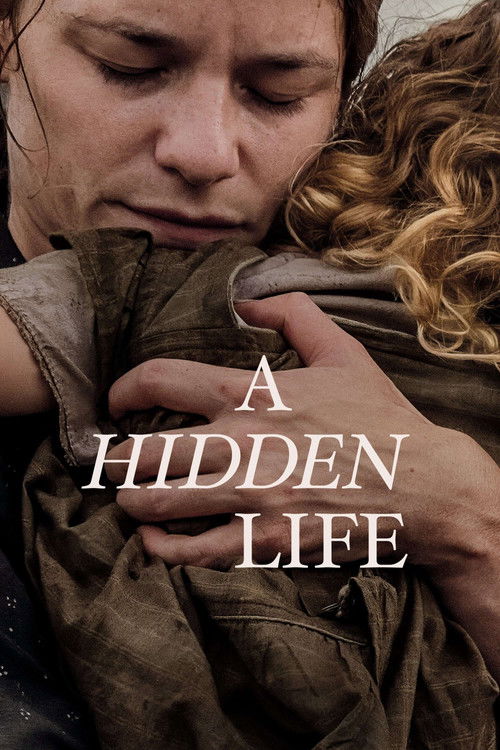
A Hidden Life (2019)
Directed by Terrence Malick
No — A Hidden Life is not woke, scoring 7 out of 100 on our wokeness meter.
A Hidden Life tells the story of Franz Jägerstätter, an Austrian farmer and devout Catholic who refuses to swear allegiance to Hitler and is executed for it.
Consciousness Markers
Malick's impressionistic, voiceover-driven style is the opposite of didactic; the moral about conscience is felt rather than preached. Any contemporary resonance is drawn by critics, not delivered by the film itself.
Franziska (Fani) is given substantial screen time and dignity as a co-sufferer, but this reflects the historical reality of the Jägerstätters' marriage rather than a feminist agenda. No explicit gender-politics framing.
The cast is almost entirely white European actors playing Austrian villagers, which is historically appropriate rather than a deliberate diversity initiative. No evidence of representational casting choices.
No LGBTQ+ characters, themes, or subtext appear anywhere in this story of a Catholic farmer and his wife.
The film concerns white Austrian peasants and the Nazi regime; there is no engagement with racial identity or racial justice themes.
Malick's lingering Alpine nature photography is aesthetic and spiritual, not an environmentalist message. No climate crusade present.
The film's conflict is with fascism and state coercion, not capitalism. No eat-the-rich economic critique.
No body positivity themes or messaging of any kind.
No neurodivergent characters or themes are depicted.
The film faithfully recounts the documented life and execution of Franz Jägerstätter, with the cooperation of his biographer. This is historical accuracy, not revisionist reframing.
Why it received this score
A Hidden Life tells the story of Franz Jägerstätter, an Austrian farmer and devout Catholic who refuses to swear allegiance to Hitler and is executed for it. Terrence Malick directs with his usual whisper and drift. The film is a historical and theological object, and from the vantage of modern social consciousness it is a sparse specimen. The cast is white European because the village was white European. There is no LGBTQ thread, no racial reckoning, no climate sermon. The Alpine photography is spiritual, not environmentalist. The conflict is with fascism and state coercion, not with capitalism. No body positivity, no neurodivergence, no revisionist reframing. The screenplay follows the documented life, with the cooperation of Jägerstätter's biographer. That is accuracy, not a cultural update.
The one element with any warmth is Franziska. Valerie Pachner gives Fani a substantial presence as a co-sufferer, a mother, a correspondent, a visitor to prison. Her dignity is real. It also belongs to the historical record of a marriage, not to a feminist program. The film does not organize itself around gender politics. Malick's voiceover and images are equally resistant to lecturing. The moral about conscience is felt in the body of the film. Critics may draw a line from Jägerstätter to present-day demagogues, but the film itself does not deliver that line. It trusts silence and suffering to make the argument.
Taken as a whole, this is a serious religious drama of the old school. Its gravity comes from faith, stubbornness, and the slow grind of prison. It is not built to satisfy a contemporary checklist, and it does not pretend to be. The result can be monotonous, and Malick's mannerisms remain an acquired taste. Still, the film has a moral weight that few recent studio releases approach. On the ledger of modern progressive markers, the account is nearly empty. A small allowance is due for Fani's screen time and for the faint pulse of ethical urgency that runs beneath the whispers. The classification is otherwise clean: a martyr's story, told with reverence, immune to the fashions of the moment.
Analysis generated by our Consciousness Algorithm


Synopsis
Austrian farmer Franz Jägerstätter faces the threat of execution for refusing to fight for the Nazis during World War II.
Questions about A Hidden Life
Is A Hidden Life woke?
No — A Hidden Life is not woke, scoring 7 out of 100 on our wokeness meter. That earns it a verdict of Ultra Based.
Does A Hidden Life have any woke elements?
Very few. None of the 10 markers reaches 30, the level where a marker counts as present; the highest is Lecture Energy at 15.
How does A Hidden Life compare to other 2019 movies?
It ranks #214 of the 284 films from 2019 we've scored; their average is 22. The wokest is Black Christmas (79).
How is the Woke Score calculated?
An AI-assisted process researches the film and its reception, scores it 0–100 on ten markers, then combines those into one 0–100 Woke Score. It measures a specific set of 2020s cultural themes, not film quality.