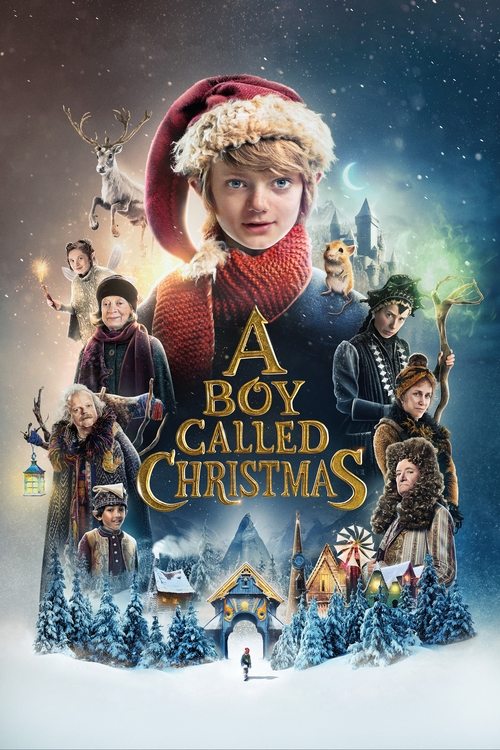
A Boy Called Christmas (2021)
Directed by Gil Kenan
No — A Boy Called Christmas is not woke, scoring 0 out of 100 on our wokeness meter.
A Boy Called Christmas arrives as a British Christmas fantasy assembled with evident care: a dead mother, a missing father, a talking mouse, a reindeer named Blitzen, and a snowy north where belief determines visibility.
Consciousness Markers
The framing device has Aunt Ruth gently explaining the meaning of the tale and the children's grief, but the moralizing is soft, warm, and woven into the story rather than delivered as a sermon.
The cast is overwhelmingly white British, with no diverse casting choices made as a statement; the ensemble is assembled for comedic and dramatic fit, not representation.
There are no LGBTQ+ characters, relationships, or themes anywhere in this Santa Claus origin story.
Female characters like Aunt Ruth, Mother Vodol, and the Truth Pixie exist within the story, but the film advances no feminist argument or gendered critique.
Race is entirely absent as a subject; the film is a snowy Nordic fantasy with no engagement with racial identity or history.
No environmental or climate themes appear; the snowy setting is decorative rather than didactic.
The film's toy-making and gift-giving are framed as pure-hearted generosity, with no critique of commerce, greed, or economic systems.
No body-image themes or messaging of any kind are present.
No neurodivergent characters or themes are depicted or referenced.
The film invents a fantasy origin for Santa Claus but makes no revisionist claims about real historical events or figures.
Why it received this score
A Boy Called Christmas arrives as a British Christmas fantasy assembled with evident care: a dead mother, a missing father, a talking mouse, a reindeer named Blitzen, and a snowy north where belief determines visibility. It is adapted from Matt Haig's 2015 novel, and it tells its Santa Claus origin story through a framing device in which an elderly aunt, played by Maggie Smith, entertains three recently bereaved children on Christmas Eve. The production is handsome, the Lapland locations are cold, and the whole enterprise radiates the warmth of a department store window in December.
We have run the film through our instruments, and the readings are quiet. The cast is a procession of white British character actors, and no effort is made to suggest otherwise, so representation registers at nothing. Race is not a subject here. Neither is sexuality, gender critique, climate, body image, nor neurodivergence. The toy-making and gift-giving arrive untainted by any critique of commerce; generosity is simply generosity, and the elves serve as cheerful labor without complaint or manifesto. Nor does the film attempt to revise the historical record, since its inventions concern a fictional toymaker in a fictional north. This is a film that wants to be liked and asks nothing of the viewer beyond seasonal goodwill.
Where it stirs at all is in the framing device. Aunt Ruth explains the meaning of Nikolas's choices to the children, and she names the grief they are carrying. The moralizing is present but gentle, folded into the story like a note tucked into a coat pocket. It comforts instead of scolds. For a classification exercise, this makes for a thin specimen: a sincere holiday bauble, well made, ideologically inert, and content to leave the culture exactly as it found it.
My advice for the holiday viewer: watch it if you want warmth, skip it if you want argument. It provides the former in reliable supply and the latter not at all, which is its own kind of honesty. I logged it, I sorted it, and I return, unprovoked, to my shelf.
{"review": "A Boy Called Christmas arrives as a British Christmas fantasy assembled with evident care: a dead mother, a missing father, a talking mouse, a reindeer named Blitzen, and a snowy north where belief determines visibility. It is adapted from Matt Haig's 2015 novel, and it tells its Santa Claus origin story through a framing device in which an elderly aunt, played by Maggie Smith, entertains three recently bereaved children on Christmas Eve. The production is handsome, the Lapland locations are cold, and the whole enterprise radiates the warmth of a department store window in December.\n\nWe have run the film through our instruments, and the readings are quiet. The cast is a procession of white British character actors, and no effort is made to suggest otherwise, so representation registers at nothing. Race is not a subject here. Neither is sexuality, gender critique, climate, body image, nor neurodivergence. The toy-making and gift-giving arrive untainted by any critique of commerce; generosity is simply generosity, and the elves serve as cheerful labor without complaint or manifesto. Nor does the film attempt to revise the historical record, since its inventions concern a fictional toymaker in a fictional north. This is a film that wants to be liked and asks nothing of the viewer beyond seasonal goodwill.\n\nWhere it stirs at all is in the framing device. Aunt Ruth explains the meaning of Nikolas's choices to the children, and she names the grief they are carrying. The moralizing is present but gentle, folded into the story like a note tucked into a coat pocket. It comforts instead of scolds. For a classification exercise, this makes for a thin specimen: a sincere holiday bauble, well made, ideologically inert, and content to leave the culture exactly as it found it.", "thematic_tags": ["book_adaptation"]}」}IPremature ending. Let me write just the JSON object properly with review and thematic_tags. Thematic tag: book_adaptation (based on Matt Haig's novel). Not true_story, not superhero, sequel no, remake no, box office no, oscar no. So [
Analysis generated by our Consciousness Algorithm


Synopsis
An ordinary young boy called Nikolas sets out on an extraordinary adventure into the snowy north in search of his father who is on a quest to discover the fabled village of the elves, Elfhelm. Taking with him a headstrong reindeer called Blitzen and a loyal pet mouse, Nikolas soon meets his destiny in this magical and endearing story that proves nothing is impossible…
Questions about A Boy Called Christmas
Is A Boy Called Christmas woke?
No — A Boy Called Christmas is not woke, scoring 0 out of 100 on our wokeness meter. That earns it a verdict of Ultra Based.
Does A Boy Called Christmas have any woke elements?
Very few. None of the 10 markers reaches 30, the level where a marker counts as present; the highest is Lecture Energy at 10.
How does A Boy Called Christmas compare to other 2021 movies?
It ranks #234 of the 242 films from 2021 we've scored; their average is 23. The wokest is The Forever Purge (83).
How is the Woke Score calculated?
An AI-assisted process researches the film and its reception, scores it 0–100 on ten markers, then combines those into one 0–100 Woke Score. It measures a specific set of 2020s cultural themes, not film quality.