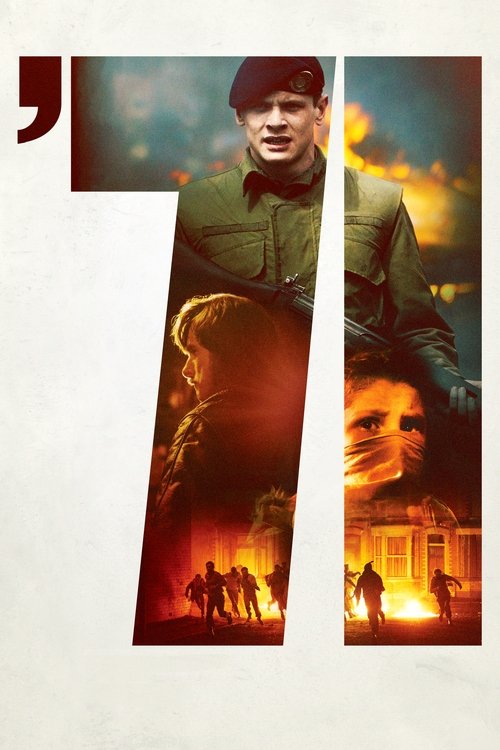
'71 (2014)
Directed by Yann Demange
No — '71 is not woke, scoring 5 out of 100 on our wokeness meter.
Yann Demange's feature debut arrives with the grim efficiency of a squaddie who has been told to leave his riot gear behind.
Consciousness Markers
The cast is overwhelmingly white British and Irish, appropriate to a period piece about the Troubles; Babou Ceesay appears in a supporting role but there is no deliberate diversity-casting agenda.
The film is a taut, visceral thriller that shows rather than tells; its political acuity is embedded in action rather than delivered as a sermon.
No LGBTQ+ characters, themes, or subtext of any kind.
Female characters (Brigid, the sympathetic woman) exist naturally within the story but the film advances no feminist thesis.
The conflict depicted is sectarian (Catholic vs. Protestant) and national, not racial; no racial-consciousness theme is present.
No environmental or climate themes whatsoever.
No critique of capitalism or economic inequality; the film is a survival thriller about a sectarian conflict.
No body-positivity themes or messaging.
No neurodivergent characters or themes.
The film is a fictional story grounded in the real history of the Troubles; it depicts British Army misconduct but does not rewrite history for ideological purposes.
Why it received this score
Yann Demange's feature debut arrives with the grim efficiency of a squaddie who has been told to leave his riot gear behind. Belfast, 1971. Jack O'Connell plays Gary Hook, a young British soldier abandoned by his unit during a street protest and forced to navigate a city that wants him dead. What could have been a lecture about empire and occupation is instead a chase. The politics are present, embedded in the rough treatment of Catholic homes and the quiet collusion between British intelligence and Loyalist bombers, but they arrive through mud, blood, and bad decisions. The film trusts the audience to draw its own conclusions, which in this genre is a rare courtesy.
A count of the cultural markers yields mostly zeroes, and the film earns them honestly. The cast is white British and Irish, which a period piece about the Troubles can hardly avoid; Babou Ceesay appears briefly in support, and no diversity agenda intrudes. There is no LGBTQ content, no feminist thesis, no environmental crusade, no body-positivity messaging, no neurodivergent character. The conflict here is sectarian and national, not racial, so no racial-consciousness theme applies. Female characters exist naturally within the story, and that is all they are asked to do.
Where the film might have drifted toward revisionism, it holds its ground. It depicts British Army misconduct, the Military Reaction Force, the bomb assembled in a Loyalist pub, the commanding officer dismissing a killing as a confused situation. This is history rendered as thriller, not history rewritten for a thesis. The sermonizing is absent. A taut, visceral piece of filmmaking that respects its audience enough to leave the moral arithmetic to them. It is a film about a man trying to get home, and it never pretends otherwise.
Analysis generated by our Consciousness Algorithm


Synopsis
A young British soldier must find his way back to safety after his unit accidentally abandons him during a riot in the streets of Belfast.
Questions about '71
Is '71 woke?
No — '71 is not woke, scoring 5 out of 100 on our wokeness meter. That earns it a verdict of Ultra Based.
Does '71 have any woke elements?
Very few. None of the 10 markers reaches 30, the level where a marker counts as present; the highest is Lecture Energy at 10.
How does '71 compare to other 2014 movies?
It ranks #212 of the 303 films from 2014 we've scored; their average is 13. The wokest is Selma (68).
How is the Woke Score calculated?
An AI-assisted process researches the film and its reception, scores it 0–100 on ten markers, then combines those into one 0–100 Woke Score. It measures a specific set of 2020s cultural themes, not film quality.