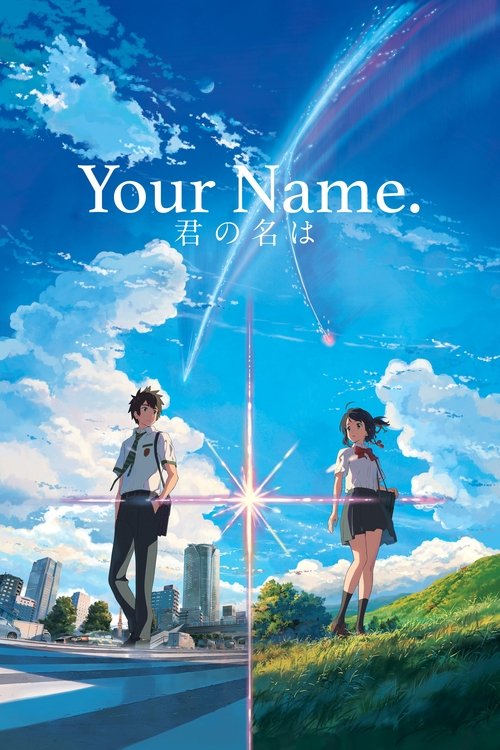
Your Name. (2016)
Directed by Makoto Shinkai
No · Ultra Based
How we score movies →Consciousness Markers
While the body-swap premise could enable feminist commentary, the film treats gender differences as charming obstacles to romance rather than as sites of systemic inequality. The female character is competent and central to the narrative, but this reflects basic storytelling rather than feminist intent.
The cast consists entirely of Japanese voice actors in a Japanese production, reflecting the film's local context naturally rather than through any conscious diversity initiative. There is no attempt at inclusive representation beyond the film's natural cultural specificity.
The film allows its narrative to unfold through action and emotion rather than exposition or explanation. Characters learn through experience rather than through being educated by the film itself about social realities.
The film contains no LGBTQ+ themes or representation. The body swap is presented as a heterosexual romantic complication, not as an exploration of gender identity or sexual orientation.
The film makes no attempt to examine or comment upon race, racism, or racial identity. The homogeneous cast reflects the film's Japanese setting without any self-conscious engagement with these categories.
The meteorite and comet imagery function as pure romantic and temporal devices. There is no environmental messaging, climate anxiety, or ecological commentary underlying the film's use of these cosmic elements.
The film presents no critique of capitalism or economic systems. Characters operate within their social positions without interrogating class structures or wealth inequality.
The film's treatment of bodies is aesthetic and romantic in nature, not activist. There is no commentary on body standards, disability, or non-normative embodiment.
The film contains no representation of or commentary on neurodivergence, mental health, or psychological difference as matters of social significance.
The film makes no attempt to reframe or reexamine historical events. Its engagement with time is purely romantic and fantastical rather than historical.


Synopsis
High schoolers Mitsuha and Taki are complete strangers living separate lives. But one night, they suddenly switch places. Mitsuha wakes up in Taki's body, and he in hers. This bizarre occurrence continues to happen randomly, and the two must adjust their lives around each other.
Why it received this score
Your Name stands as a monument to the apolitical romance, a film so thoroughly disinterested in contemporary social consciousness that it achieves a kind of purity that modern audiences might find either refreshing or incomprehensible. The body-swap premise, which could have been mined for commentary on gender, embodiment, or the construction of identity, instead serves purely as a romantic catalyst. When Mitsuha discovers she is inhabiting a boy's body, the film's response is not to interrogate what this might mean about gender or social positioning, but rather to present the situation as cosmically amusing and vaguely erotic. The characters navigate their swapped lives with the self-awareness of people in a rom-com, not people grappling with genuine dissonance between their assigned and experienced gender.
The film's cultural specificity, rooted in rural and urban Japan, remains largely free of any attempt to universalize or interrogate its own cultural particulars. There are no lectures about tradition versus modernity, no grand pronouncements about what it means to be Japanese, no attempts to educate the audience about the historical or social forces that might have shaped these characters. The meteorite subplot, which provides the film's emotional and temporal stakes, is treated as pure magical realism rather than as an opportunity for climate commentary or warnings about ecological fragility. The characters themselves are drawn from comfortable, educated backgrounds, and their economic circumstances are simply accepted as the baseline reality of their world rather than as something requiring critical examination.
What emerges from Your Name is a film utterly confident in its own narrative enchantment, one that believes romance and beauty are sufficient unto themselves. One might argue this is precisely what art should be: unburdened by the obligation to comment on social structures or educate audiences about systemic injustices. The film's refusal to weaponize its premise for progressive purposes reads as either admirably innocent or willfully ignorant, depending on one's temperament. Either way, it remains a document of a pre-reckoning cinema, one that existed before the cultural insistence that all narratives must acknowledge and address the social consciousness of their moment.
Analysis generated by our Consciousness Algorithm
Critic Reviews
“The beauty of the feature lies in its ability to stir the imagination with eerie, resonant hand-drawn animation.”
“The only way to understand it is to swim in it for yourself, feel your own heart braid around these two interwoven lives, and gaze up in awe at the silvery arc those falling stars trace across the sky. ”
“Part body-swap comedy, part long-distance romance, part... something else. If you only see one Japanese animated feature this year, see this one, and see it more than once.”
“That’s a lot for a viewer to take in, and as pleasing as some aspects of Your Name can be, there’s no question Shinkai’s overstuffed movie often trips over itself.”