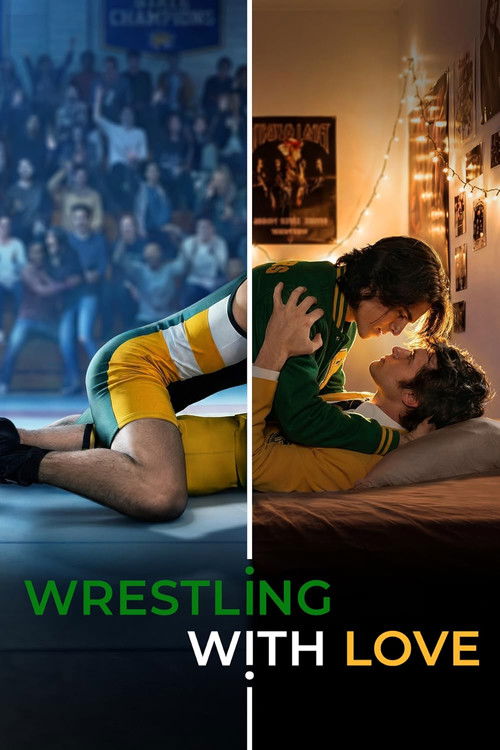
Wrestling with Love (2026)
Yes · Woke
How we score movies →Consciousness Markers
The entire narrative engine is a same-sex romance between two young men, explicitly categorized as Boys' Love drama. The plot hinges on the emotional and social stakes of their attraction being 'exposed,' making LGBTQ+ identity the film's central organizing principle.
The film centers two male leads in a same-sex romance, which represents a deliberate casting choice oriented around LGBTQ+ visibility. Beyond that axis, there is no documented emphasis on broader diversity in the cast.
The film's emphasis on characters 'finally opening up' and 'sharing truths that redefine their connection' suggests some degree of earnest emotional messaging around authenticity and social acceptance. It reads as heartfelt rather than sermonizing, but the scaffolding is familiar.
A shy artist forced into the physically demanding world of competitive wrestling carries some implicit tension around body image and physical self-worth, though this does not appear to be foregrounded as an explicit thematic statement.
There is no documented feminist framing, female empowerment arc, or gender politics commentary in this film. The story is entirely focused on two male characters.
No evidence of racial consciousness themes, commentary on systemic racism, or racially charged narrative elements appears in any available material about this film.
This is a high-school wrestling romance. The climate is entirely emotional. No environmental themes of any kind are present.
No critique of capitalism, class structures, or wealth disparity is evident in the film's premise or documented themes.
No characters are identified as neurodivergent, and no themes related to neurodivergence appear in any available description or review of the film.
The film is a contemporary high-school drama with no historical setting and no apparent interest in recontextualizing past events or figures.
Synopsis
Shy artist Cal is forced onto the wrestling team and trained by his bully, Ricky. As humiliation turns into tension, secrets and rivalry push them closer. With a tournament ahead, both must confront feelings they can't fight.
Why it received this score
Wrestling with Love arrives in 2026 as a short-form Boys' Love drama about a shy artist named Cal who is conscripted onto a wrestling team and subsequently trained by the very person who has been making his life miserable. The film belongs to a well-established genre with its own devoted international audience, a genre that has spent decades doing the quiet work of normalizing same-sex romance by wrapping it in the universally legible language of sports rivalry and repressed longing. On the spectrum of progressive sensibilities, this film is not particularly interested in making an argument. It is interested in making you feel things. These are different projects, and the distinction matters.
The LGBTQ+ dimension is not a layer applied to the story. It is the story. The central dramatic question, which is what happens when two young men's growing connection is exposed to the social pressures around them, is entirely dependent on the characters being two young men. The film earns a high marker score in that category not because it is lecturing anyone about acceptance, but because the entire architecture of the narrative, the secrecy, the tension, the eventual confrontation with feeling, is built on the specific vulnerabilities of same-sex attraction in an environment that does not exactly encourage it. A wrestling gym is not, historically, a place associated with emotional openness. The film is aware of this irony and appears to be leaning into it with both hands.
Elsewhere, the scorecard is sparse. There is no racial consciousness at work, no climate anxiety, no anti-capitalist grievance, no feminist reframing of the sports genre. What we have is a focused, narrow drama doing one thing with apparent sincerity. The faint trace of body positivity in its subtext, a soft boy deposited into a hard sport, and a mild undercurrent of emotional authenticity messaging keep the score from bottoming out entirely on the secondary markers. But this is not a film that came to change your politics. It came to make you root for two boys who are very bad at admitting what they want. In the current cultural landscape, that is, in its own quiet way, a position.
Analysis generated by our Consciousness Algorithm