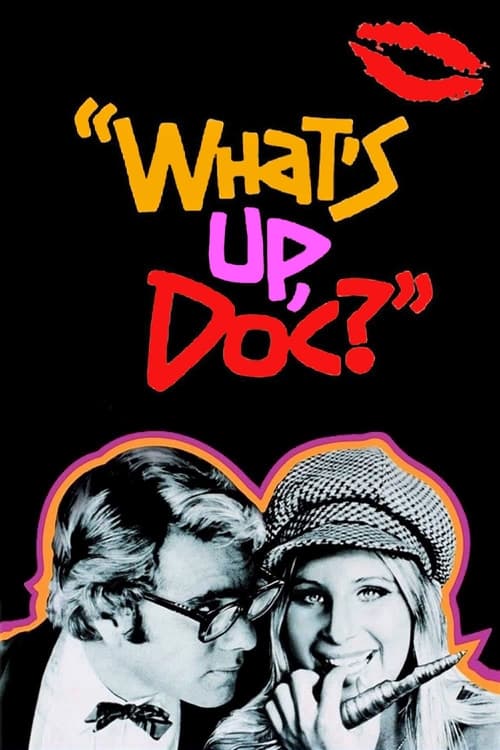
What's Up, Doc? (1972)
Directed by Peter Bogdanovich
No · Ultra Based
How we score movies →Consciousness Markers
Barbra Streisand carries the film as the female lead in an active, comedic role, though her character exists primarily as a romantic pursuit device. The supporting cast is entirely white.
Streisand's character pursues the male lead actively, inverting traditional romantic dynamics somewhat, but this is comedic rather than ideological. No engagement with feminist consciousness.
The plot involves wealthy characters and some gentle satire of pretension, but no systematic critique of economic systems or power structures.
No LGBTQ+ themes, characters, or representation of any kind. The film is purely heterosexual romance and slapstick.
No engagement with racial themes whatsoever. The film operates in an all-white universe of privilege and consequence-free comedy.
Environmental concerns do not exist in this film's universe. The plot involves car chases and destruction with no ironic commentary.
No engagement with body diversity or body positivity. The film operates within conventional Hollywood beauty standards of 1972.
No representation of neurodivergence or any acknowledgment of neurological diversity.
The film makes no claims about historical events or revisionist interpretations. It is purely fictional comedy.
The film exists entirely in the register of entertainment. No character addresses the audience with moral instruction or preachy messaging.


Synopsis
The accidental mix-up of four identical plaid overnight bags leads to a series of increasingly wild and wacky situations.
Why it received this score
What's Up, Doc? remains a masterpiece of chaos, a screwball comedy so thoroughly committed to pure mayhem that it scarcely notices the world around it. Peter Bogdanovich constructs an elaborate homage to the classical comedies of the 1930s, complete with mistaken identities, overlapping overnight bags, and the kind of slapstick precision that requires actual skill to execute. Barbra Streisand anchors the film as Judy Maxwell, a woman whose primary function is to pursue Ryan O'Neal's character with relentless, admirable determination, which is perhaps the film's most progressive element by accident rather than design.
The film exists in a hermetically sealed universe where social consciousness is not merely absent but actively irrelevant. There is no consideration of gender dynamics beyond the basic comedic premise, no acknowledgment of race or class except as background texture, no engagement with environmental or economic systems. This is not malice; this is simply the 1970s version of a 1930s film, made by people for whom such concerns were not part of the creative vocabulary.
The comedy works because the film understands itself as pure entertainment, a mechanism for generating laughs through escalating absurdity. We might respect this commitment to frivolity in an era increasingly self-conscious about representation and messaging. The film stands as a time capsule of a particular Hollywood moment, before progressive consciousness became a visible element in mainstream comedy.
Analysis generated by our Consciousness Algorithm
Critic Reviews
“The script and cast are excellent; the direction and comedy staging are outstanding; and there are literally reels of pure, unadulterated and sustained laughs.”
“The particular brand of slapstick comedy and barbed romance in What’s Up, Doc? is an homage to a bygone era of Hollywood cinema that in 1972 was considered outdated. But Bogdanovich embraced it without irony.”
“Only a director in complete control can fashion something so effortlessly chaotic. What’s Up Doc? is one of the signature comedies of the 1970s whose throwback mixture of madcap hijinks and rat-a-tat-tat dialogue still works for a generation twice removed from its influences.”
“The result is a comedy made by a man who has seen a lot of movies, knows all the mechanics, and has absolutely no sense of humor.”