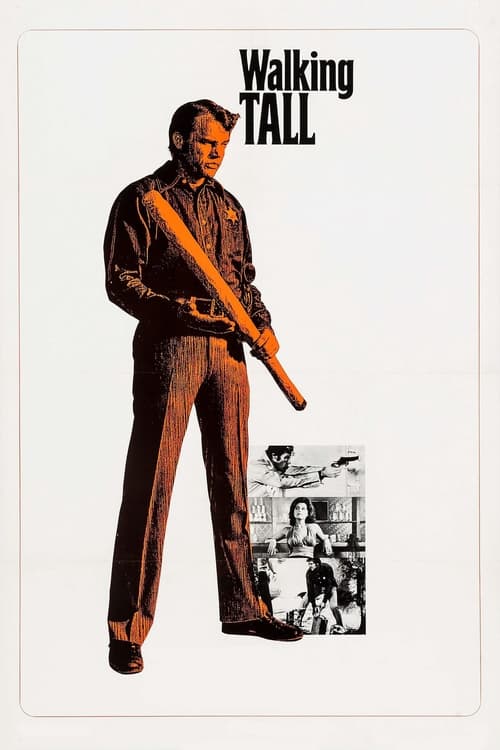
Walking Tall (1973)
Directed by Phil Karlson
No · Ultra Based
How we score movies →Consciousness Markers
The cast is predominantly white with minimal representation of other groups. Felton Perry appears in a minor role, but the film makes no effort toward diverse or inclusive casting beyond what the setting provided.
The film contains no examination of racial issues or consciousness. The rural setting is presented without any commentary on racial dynamics, and the antagonists are simply criminals without socioeconomic or racial context.
Elizabeth Hartman's character exists primarily as a supportive wife and concerned domestic figure. She has no agency in the plot and serves only to validate the protagonist's mission through emotional attachment.
While the film criticizes corruption and criminal enterprise, it does so from a law-and-order perspective rather than any critique of capitalism. The solution is stronger individual enforcement, not systemic change.
The film is content to show rather than tell, avoiding explicit moral lectures. However, its celebration of vigilantism carries implicit ideological assumptions that go unexamined.
There are no LGBTQ+ characters, themes, or subtext present in this film. The narrative is entirely heteronormative and traditional in its family dynamics.
Climate concerns are entirely absent from this crime drama. The film shows no environmental awareness or sustainability themes whatsoever.
Body positivity is not a concept present in this 1973 action film. The protagonist's physical strength is celebrated as a tool for violence, not as an expression of body acceptance.
There is no representation of or engagement with neurodivergent characters or perspectives. The film contains no such themes.
The film is based on a true story and presents historical events straightforwardly without revisionist intent. It does not reframe history to accommodate modern sensibilities.


Synopsis
Ex-wrestler and Tennessee Sheriff Buford Pusser walks tall and carries a big stick as he tussles with county-wide corruption and moonshining thugs.
Why it received this score
Walking Tall stands as a curious artifact of 1970s exploitation cinema, a film that treats vigilante justice and extrajudicial violence as the natural remedy for systemic corruption. The narrative presents us with a protagonist who solves problems with a two-by-four and the conviction of a man who has never questioned whether the state apparatus he represents might itself be the problem. There is no self-awareness here, no examination of whether might makes right, only the straightforward assumption that a tough guy with a stick is what a community needs. The film operates within a strictly reactionary worldview where institutions fail and individual masculine force becomes the only recourse, a thesis that has aged poorly in an era increasingly skeptical of such remedies.
The cast is overwhelmingly white, reflecting the rural Tennessee setting but also the production values and casting priorities of 1970s mainstream cinema. Elizabeth Hartman appears as Pusser's wife, functioning primarily as concerned domestic support rather than as an autonomous agent in the narrative. The supporting players, including Felton Perry among the ensemble, occupy peripheral roles in a story that centers entirely on one man's crusade. There are no female law enforcement figures, no substantive examination of class dynamics beyond moonshining thugs as an undifferentiated antagonistic force, and no hint that the communities being protected might have complex needs beyond violent crime prevention.
The film is untroubled by questions of accountability or systemic reform. It celebrates individual authority and physical dominance without irony or critique, making it an almost perfect embodiment of what the current moment would find objectionable, though it arrived before such objections were fashionable. This is cinema that knows exactly what it wants to be, which is to say it wants to be none of what contemporary cultural consciousness would demand of it.
Analysis generated by our Consciousness Algorithm
Critic Reviews
“The cast acquits itself well, with the Rock evincing a quiet balance between humor and brawn. ”
“Moves along at a clip and provides a terrific action lead for Dwayne "the Rock" Johnson. ”
“It still celebrates the vigilante spirit and justice delivered with a biblical swiftness, but it has been cleansed of much of its gratuitous violence and more offensive red-neck sensibilities. Mercifully, it's also a full 40 minutes shorter than the original. ”
“Short on story, character, and attempts to win viewers' emotional investment, the film only seems to take a breath when The Rock is making the baddies lose theirs. ”