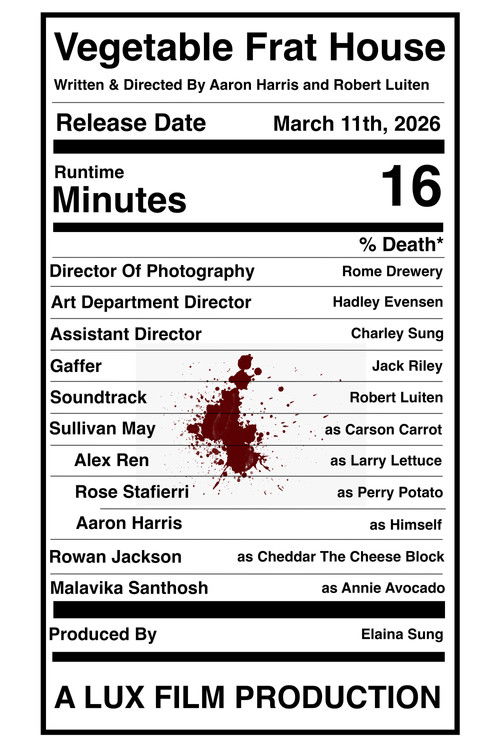
Vegetable Frat House (2026)
Directed by Aaron Harris
No · Ultra Based
How we score movies →Consciousness Markers
While the film features vegetables as central characters, this appears to be purely for comedic absurdism rather than any environmental commentary or climate consciousness.
The cast consists entirely of vegetables portrayed by actors whose names are provided but whose identities or demographics are irrelevant to the narrative. No meaningful representation exists in a film about produce.
There is no evidence of LGBTQ+ themes or representation in this vegetable-based absurdist comedy about fraternity life.
The film contains no discernible feminist agenda or commentary on gender dynamics. Vegetables lack gender in meaningful ways.
Racial consciousness is entirely absent from a narrative centered on the internal struggles of anthropomorphic vegetables at a social gathering.
No critique of capitalism, wealth inequality, or systemic economic oppression is evident in this straightforward narrative about vegetable-based social dysfunction.
Body positivity messaging is absent. The vegetable characters are anthropomorphized for comedic effect without commentary on physical appearance or body acceptance.
There is no representation of neurodivergent characters or exploration of neurological difference in this film's surreal but fundamentally apolitical premise.
The film contains no historical content whatsoever, revisionist or otherwise. It exists in a vegetable-based present tense.
No preachy elements, moral instruction, or lecture-like exposition about social issues characterizes this absurdist comedy.
Synopsis
In a world where vegetables are people & people are people, Carson the Carrot is trying to get litty "Ay Eff" at his awesome vegetable frat rager but everyone keeps dying and totally killing the vibe.
Why it received this score
We are confronted here with a film so thoroughly committed to absurdist vegetable-based humor that it appears to have been engineered in a laboratory designed to produce the maximum possible distance from contemporary social consciousness. Carson the Carrot's quest to "get litty" at his fraternity rager exists in a realm so aggressively nonsensical that concepts like representation, marginalization, or systemic critique become as relevant as discussing the carbon footprint of a fever dream. The film's documentary classification appears to be an elaborate joke, though one that arrives without punchline or explanation.
What we witness is pure comedic nihilism dressed in the aesthetic of a crime thriller. The premise, in which everyone dies and this somehow constitutes a problem for the film's narrative, suggests a sensibility unconcerned with moral instruction or cultural awareness. The cast of vegetables exhibits no discernible identity politics beyond their vegetable status, and their frat house setting invokes no critique of toxic masculinity, elitism, or the problematic nature of college culture. The film simply asks us to accept that anthropomorphized produce can perish in amusing quantities while pursuing the timeless goal of collegiate intoxication.
One must acknowledge a certain purity in this commitment to irrelevance. In an era where every film bears the weight of cultural expectation, "Vegetable Frat House" has chosen to be about nothing whatsoever, which is itself a kind of honesty. The March 2026 release date suggests someone believes this vegetable tragedy has commercial potential, though what demographic specifically hungers for dead carrots remains a mystery we are not equipped to solve.
Analysis generated by our Consciousness Algorithm