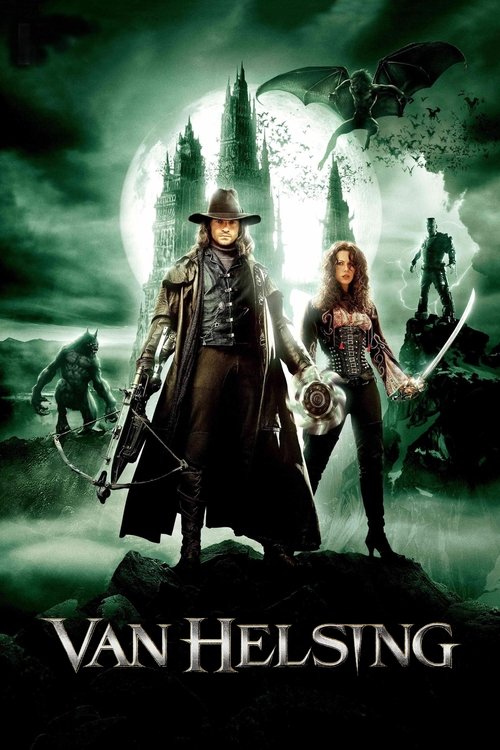
Van Helsing (2004)
Directed by Stephen Sommers
No · Ultra Based
How we score movies →Consciousness Markers
Anna Valerious functions as a co-lead with genuine agency in pursuing her family's vendetta, though she remains ultimately dependent on Van Helsing's intervention and expertise.
Kate Beckinsale appears as a capable female action lead, though the film's sensibilities remain firmly rooted in 2004 action cinema conventions where her agency is limited by the male hero's narrative centrality.
No LGBTQ+ themes, characters, or representation present in the film.
The film contains no meaningful exploration of racial themes or consciousness, operating within a largely homogeneous European Gothic setting.
No climate or environmental themes present in this monster-hunting adventure film.
The narrative contains no critique of capitalism, wealth inequality, or systemic economic structures.
The film features conventionally attractive leads and contains no commentary on body diversity or acceptance.
No representation of neurodivergent characters or exploration of neurodivergence in the narrative.
While the film reimagines classic monster mythology, it does not engage in revisionist historical narratives about real historical events or marginalized communities.
The film prioritizes action spectacle and plot momentum over preachy exposition or moral instruction about social issues.


Synopsis
Famed monster slayer Gabriel Van Helsing is dispatched to Transylvania to assist the last of the Valerious bloodline in defeating Count Dracula. Anna Valerious reveals that Dracula has formed an unholy alliance with Dr. Frankenstein's monster and is hell-bent on exacting a centuries-old curse on her family.
Why it received this score
Van Helsing arrives as a thoroughly conventional early-2000s action vehicle, a time capsule of pre-conscious blockbuster filmmaking when such concerns were not yet industry fixtures. The film's primary concession to progressive sensibilities is Kate Beckinsale's Anna Valerious, a female character permitted to carry a crossbow and express agency in her family's vendetta. Yet this represents less a bold statement and more the baseline competence one might expect of any action heroine circa 2004, when female characters in adventure films had already begun receiving basic autonomy as a matter of course. The film operates within the comfortable confines of Gothic pastiche, treating its Eastern European setting and Transylvanian geography as mere backdrop for supernatural spectacle rather than as sites of cultural or historical examination.
The remainder of the film's DNA remains untouched by contemporary cultural consciousness. Hugh Jackman's Van Helsing pursues his mission with the grim determination of a mercenary action hero, supported by a cast drawn almost entirely from European and North American performers. The narrative makes no gestures toward exploring the identities or experiences of marginalized communities, contains no LGBTQ+ representation, and treats its monstrous antagonists as supernatural obstacles rather than as metaphorical vehicles for social commentary. Dracula and Frankenstein's creature exist purely as plot engines, not as complex figures through which we might interrogate power structures or systemic oppression.
What emerges is a film content to be exactly what it appears: a competent if uninspired monster-action hybrid designed to deliver spectacle and entertainment without the burden of cultural messaging. This is not a failing in the film's own context, but rather a straightforward reflection of early-2000s blockbuster priorities. One might praise its lack of pretension to social consciousness as refreshing honesty, yet such praise would be beside the point. Van Helsing simply existed before the cultural landscape demanded such considerations from its studio productions.
Analysis generated by our Consciousness Algorithm
Critic Reviews
“This creature feature is exhilarating fun, a richly designed and often quite funny re-exploration of the movie past. ”
“This beast is as subtle as a Red Bull enema, but it succeeds magnificently as compulsively watchable spectacle. ”
“A movie that's underwritten, overdirected, overproduced and almost constantly over-the-top. But it's also, at its best, a big tongue-in-cheek extravaganza. ”
“Sommers film just lies there, weighted down by a complete lack of wit, artfulness and internal logic. So it's a disaster -- a big, loud, boring wreck. ”