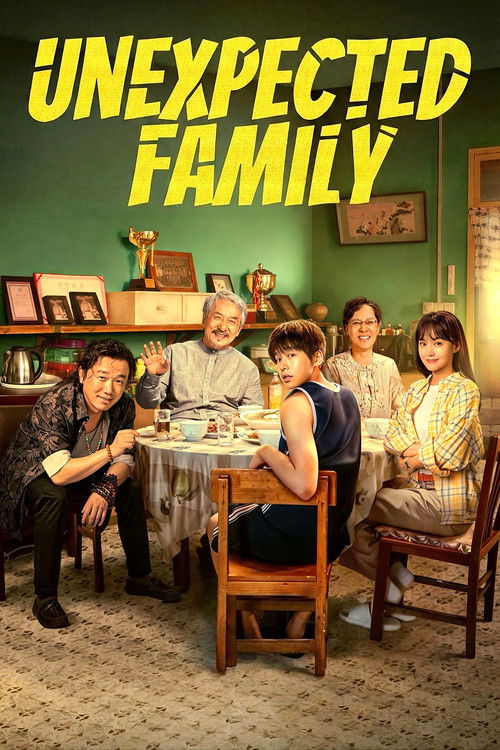
Unexpected Family (2026)
Directed by Li Taiyan
No · Based
How we score movies →Consciousness Markers
The cast includes a mix of Chinese actors of varying ages and backgrounds, reflecting contemporary ensemble casting practices. However, the film makes no particular statement about representation itself, and the diversity appears incidental rather than intentional.
Alzheimer's disease functions as the film's central plot device. While the condition receives sympathetic treatment and Jackie Chan's portrayal demonstrates the character's humanity, the film approaches neurodivergence as tragedy and plot mechanism rather than as a lived experience worthy of nuanced examination.
The film does engage in some preachy messaging about the importance of family, kindness, and connection, though these themes are woven into the narrative rather than delivered as explicit lectures. The emotional manipulation is calculated but not overtly preachy.
Female characters exist in supporting roles but receive minimal character development. The film does not engage with feminist perspectives on aging, caregiving, or family dynamics in any sustained way.
The film contains no critique of capitalism or wealth inequality. Economic systems remain entirely unexamined, though the story does celebrate community and human connection over material concerns.
The film is set within a homogenous cultural context and does not address racial or ethnic themes. No racial consciousness is evident in the narrative or its treatment of social structures.
There is no discernible LGBTQ+ content or themes in the film. The narrative centers entirely on heteronormative family structures and relationships.
The film contains no historical narrative or revisionist historical content. It is a contemporary domestic story unconcerned with reinterpreting the past.
There is no climate-related content, messaging, or environmental consciousness present in the film.
The film does not engage with body positivity discourse. Aging bodies are treated with dignity but without any particular commentary on conventional beauty standards or body acceptance.
Synopsis
When an aging local starts to lose his memory, those around him decide to recreate an important family moment in his life for him to relive. What they discover isn't what they expect — about both themselves and about the mysterious man's past.
Why it received this score
Jackie Chan's latest effort marks a decisive pivot away from martial arts spectacle toward the trembling terrain of family drama, a transition that reveals both his range and the film's fundamental limitations. The narrative revolves around an aging man with Alzheimer's disease and the ad hoc family that assembles around him, a setup that might have yielded genuine insight into aging, memory, and belonging. Instead, the film treats dementia as a plot mechanism for generating emotional beats, with a calculated precision that feels more like engineering than storytelling. Chan himself delivers what several critics rightly identified as his finest dramatic work, yet the machinery surrounding his performance operates on such transparent mechanics that even his earnestness cannot quite overcome the film's shallow characterization of its supporting players.
The cast composition reflects contemporary Chinese cinema, with a mix of established and younger actors performing a story about community and connection. Yet the film makes no particular effort to interrogate social structures, inequality, or the systemic challenges facing elderly citizens in urban environments. Its vision of family is deliberately sentimental rather than critical, preferring emotional catharsis to any sustained examination of how society actually treats its aging population. The film's progressive sensibilities, such as they exist, amount to little more than the proposition that kindness matters and that unconventional families have value. These are not controversial positions in 2026, nor do they emerge from any distinctive artistic perspective.
What remains is a well-meaning tearjerker that mistakes emotional manipulation for emotional truth. The film succeeds in making audiences cry, which is, presumably, the entire point. Whether that constitutes art or merely competent sentimentality is a question the film itself never bothers to ask.
Analysis generated by our Consciousness Algorithm
Critic Reviews
“A small, beautiful film anchored by a performance of profound grace from Jackie Chan, reminding us that the most difficult stunts are the ones you can't rehearse.”
“Jackie Chan trades swagger for vulnerability in Unexpected Family, a warm slice-of-life drama where mistaken identity becomes a lifeline.”
“Chan excels as a man with Alzheimer's disease in this well-meaning but ham-fisted film about the importance of family.”