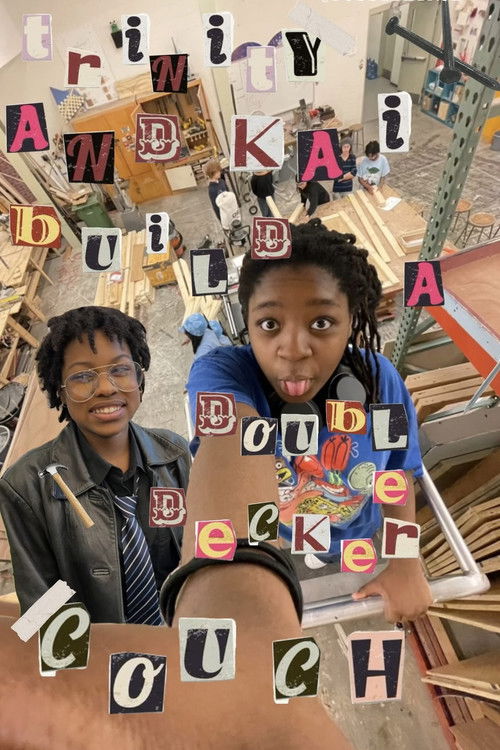
Trinity and Kai build a double decker couch (2026)
Directed by Not credited
No · Ultra Based
How we score movies →Consciousness Markers
The film features two young actors of apparent diverse background in lead roles, though the casting appears to stem from school availability rather than deliberate diversity strategy. Real-life siblings create authentic representation without commentary.
Both male and female characters participate equally in construction work without gendered commentary or special acknowledgment. The absence of feminist framing does not constitute feminist consciousness.
The film maintains a light, quest-narrative tone without preachy messaging or explicit moral instruction. The wise sage Julianne offers guidance but does not deliver speeches.
The diverse cast appears naturally within the school setting without any explicit racial commentary or consciousness-raising. The film treats race as entirely unremarkable.
No LGBTQ+ themes, representation, or subtext are present in this five-minute furniture construction narrative. The film contains no romantic or gender-identity elements whatsoever.
No environmental themes, sustainability messaging, or climate consciousness appears in this short film about furniture construction. The couch's material composition receives no examination.
The film contains no critique of capitalism, consumption, or economic systems. It portrays the construction of a luxury item as an unambiguous good.
No body-positive messaging, disability representation, or physical diversity considerations appear in the narrative. Bodies are treated as functional tools for construction.
The film contains no representation of neurodivergence, learning differences, or alternative cognitive styles. No characters are coded as neurodivergent.
This short film makes no claims about history or historical accuracy. Its entire scope concerns a present-day furniture construction project.
Synopsis
BSA students Kai and Trinity take on the challenge of wise sage Julianne to build a double decker couch in order to save Expressions.
Why it received this score
This five-minute short film represents a curious artifact of contemporary youth media: a school production so thoroughly committed to its own narrative stakes that one almost forgets the entire enterprise is fundamentally about furniture. The Baltimore School of the Arts has marshaled its resources toward the construction of a double-decker couch, framed as a salvation mission for the school's Expressions program, with the youthful protagonists positioned as heroes in a quest whose urgency remains entirely unclear to the outside observer. The Lego Movie reference suggests a postmodern awareness of children's entertainment, though whether this constitutes genuine cultural commentary or merely the recycling of previous intellectual property remains an open question.
The casting of real-life siblings Trinity and Kai Harris in the lead roles might be read as a nod toward authentic representation, though the film exists primarily as a school event document rather than a commercial entertainment product. No director receives screen credit, which either reflects the collaborative nature of school productions or suggests a collective decision to avoid individual accountability for what unfolds on screen. The wise sage Julianne, presumably a faculty member named after the Expressions director Julianne Franz, occupies a mentorship role that carries the faintest echoes of progressive pedagogical theory, though mostly the film appears to be about building a couch.
What distinguishes this film's minimal progressive sensibility is its almost aggressive indifference to contemporary social consciousness. It makes no apparent statements about gender, race, disability, or environmental concerns. It does not lecture. It simply presents two young people undertaking a task for reasons the narrative never adequately explains. In the vast ecosystem of contemporary youth media, this represents a kind of refreshing restraint, though whether restraint counts as an accomplishment depends entirely on one's theoretical framework.
Analysis generated by our Consciousness Algorithm