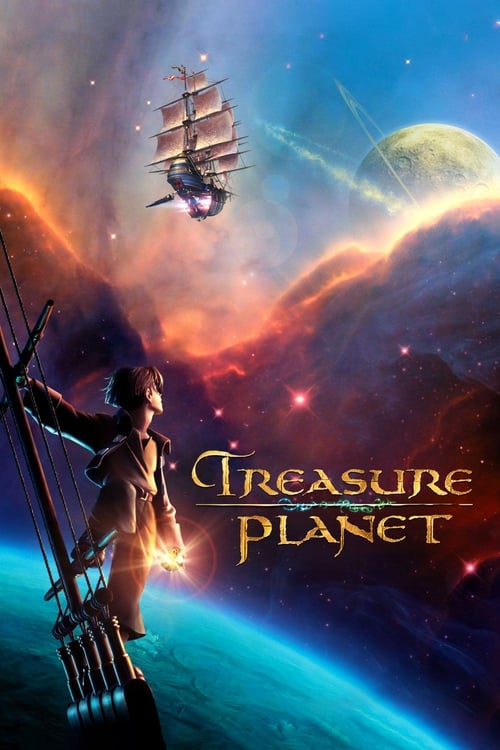
Treasure Planet (2002)
Directed by Ron Clements
No · Ultra Based
How we score movies →Consciousness Markers
The voice cast includes performers of color, but they inhabit a colorblind narrative where their ethnicity carries no thematic weight or explicit recognition.
Captain Amelia is a capable female character, but her presence functions within conventional action-adventure parameters without interrogating gender dynamics or power structures.
John Silver's cyborg body might be read as body diversity, but the film does not engage with disability or body representation in any explicit or intentional manner.
The central plot involves treasure hunting and wealth acquisition, with no critique of capitalism or economic systems. The villain's motivation is greed, presented as personal flaw rather than systemic critique.
The adaptation transplants Stevenson's colonial-era pirate narrative to space, but does not interrogate the original text's problematic elements or offer revisionist reframing.
The film operates in a colorblind framework where racial identity is neither acknowledged nor explored. Diverse voices exist without thematic or narrative significance.
The film delivers its narrative through conventional adventure storytelling without preachy messaging or explicit social commentary directed at the audience.
There are no LGBTQ+ themes or characters present in the film. The narrative centers exclusively on heterosexual relationships and male mentorship.
No environmental themes or climate-related messaging appears in this space adventure narrative.
No neurodivergent characters or representation appears in the narrative. Jim's troubled youth is presented as circumstantial rather than neurological.


Synopsis
When space galleon cabin boy Jim Hawkins discovers a map to an intergalactic "loot of a thousand worlds," a cyborg cook named John Silver teaches him to battle supernovas and space storms on their journey to find treasure.
Why it received this score
Treasure Planet operates in that peculiar Disney register of the early 2000s, when the studio had not yet fully internalized the cultural imperatives that would come to dominate its output in the following decades. The film presents a space adventure with a diverse voice cast and a notably absent father figure at its narrative center, yet these elements emerge more from conventional storytelling needs rather than conscious social positioning. Jim Hawkins is a troubled youth searching for paternal guidance in John Silver, a relationship that functions as the emotional spine of the narrative without any meta-textual awareness of its own gender or family dynamics.
The film's progressive gestures are incidental rather than purposeful. Emma Thompson voices a competent ship captain, but her presence serves the plot rather than interrogating power structures. The ensemble includes voices of color, but the characters exist in a colorblind universe where their ethnicity carries no particular significance to the story being told. This is not representation in the modern sense, which demands visibility coupled with explicit acknowledgment. The cyborg character of John Silver might register as body-positive coding to contemporary eyes, yet the film never develops this reading with any intentionality.
Treasure Planet remains, fundamentally, a traditional adventure narrative dressed in futuristic clothing. Its lack of social consciousness scoring reflects not moral deficiency but rather temporal positioning: it predates the cultural moment when animated films became vehicles for demonstrating institutional progressivism. The film is interesting precisely because it shows what mainstream Disney animation looked like before it became obligated to perform its values.
Analysis generated by our Consciousness Algorithm
Critic Reviews
“Disney's updated, animated version respects its source material while aiming at kids who grew up with extreme sports and edgy music.”
“Take a while to get their vehicle to sail and soar. But when it does, this Planet is a treasure.”
“The delicate magic of, for instance, Hayao Miyazaki's "Spirited Away," which Disney released earlier this fall, is absent from this brainless, mechanical picture.”