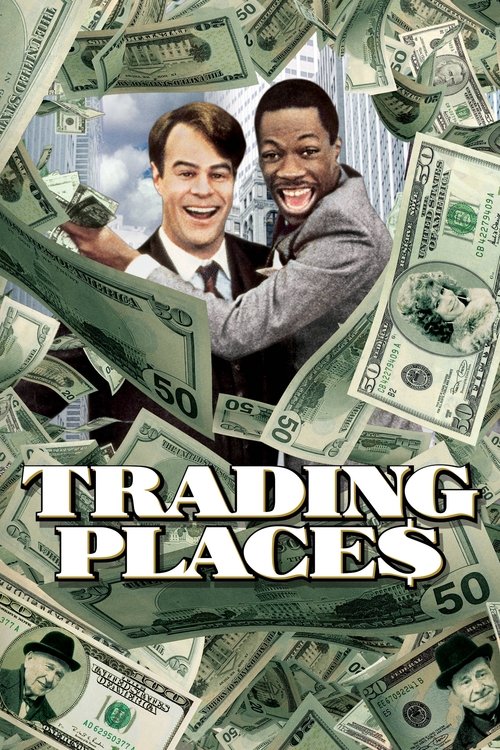
Trading Places (1983)
Directed by John Landis
No · Ultra Based
How we score movies →Consciousness Markers
Eddie Murphy's prominent role was notable for 1983, and the film includes diverse casting, but these choices are not foregrounded as expressions of cultural awareness. The casting operates within conventional entertainment logic rather than conscious representation.
The film satirizes individual wealthy characters but does not mount a coherent critique of capitalism itself. The narrative suggests class positions are arbitrary rather than systemic, which undermines any serious anti-capitalist argument.
While Eddie Murphy's casting is notable, the film does not engage with racial themes or systemic racism. His character's status as a street hustler operates without racial commentary, treated as a matter of class rather than race.
Jamie Lee Curtis plays a sex worker who functions primarily as a romantic prize and object of desire. The film contains no feminist critique or consciousness regarding gender roles or female agency.
The film is primarily concerned with entertainment and comedy rather than education or messaging. Any social commentary is delivered lightly and humorously, without preachy intent.
No LGBTQ+ themes, characters, or content of any kind. The film is entirely heteronormative in its romantic and social dynamics.
No climate themes, environmental consciousness, or ecological messaging of any kind. The film is entirely unconcerned with environmental issues.
No body positivity messaging or consciousness. The film operates within conventional 1980s entertainment standards regarding physical appearance and attractiveness.
No representation of neurodivergence, autism, ADHD, or any other neurological difference. The film contains no such themes or characters.
No historical content or revisionist engagement with history. The film is a contemporary comedy with no historical setting or claims.


Synopsis
A snobbish investor and a wily street con-artist find their positions reversed as part of a bet by two callous millionaires.
Why it received this score
Trading Places presents itself as a satire of wealth and class stratification, though its satirical bite is dulled by the fundamental comedy of its premise. The film's central conceit, in which a wealthy investment banker and a street hustler exchange positions in society at the behest of two millionaires conducting an experiment, touches upon economic inequality without ever seriously interrogating it. The humor operates at the level of spectacle and situation comedy rather than ideological critique. Eddie Murphy's casting was genuinely notable for 1983, and his presence lends the film a certain cultural currency, but the film treats race as incidental to its narrative rather than as a site of investigation or consciousness.
The narrative arc suggests that class positions are essentially arbitrary, shuffleable commodities, which paradoxically undermines any serious anti-capitalist argument. The wealthy remain powerful, the poor remain improvident, and what changes is merely the individual occupying each position. Jamie Lee Curtis's character exists primarily as a sexual object and romantic prize, while the film's treatment of gender roles remains conventional throughout. There is no engagement with systemic inequality, no examination of how power structures function beyond individual circumstance.
The film operates as an artifact of 1980s entertainment, competent and diverting, but uninterested in the specific forms of cultural consciousness that would later define progressive sensibility. It contains diverse casting and touches on class dynamics, which prevents it from scoring at the absolute zero point, but it exhibits virtually none of the markers that characterize contemporary social awareness. One watches it as a historical document of its moment, not as a work of sustained ideological engagement.
Analysis generated by our Consciousness Algorithm
Critic Reviews
“But what's most visible in the movie is the engaging acting. Murphy and Aykroyd are perfect foils for each other.”
“It's easily the best of the movies I've seen by the various "Saturday Night Live" alumni, and part of the reason it's funny and satisfying is that it doesn't strain. [09 Jun 1983]”
“It's the funniest new movie on town. [July 22, 1983]”
“Director John Landis is so deficient in basic storytelling skills that he must spend hours explicating the most elementary plot points while and Murphy are sidelined.”