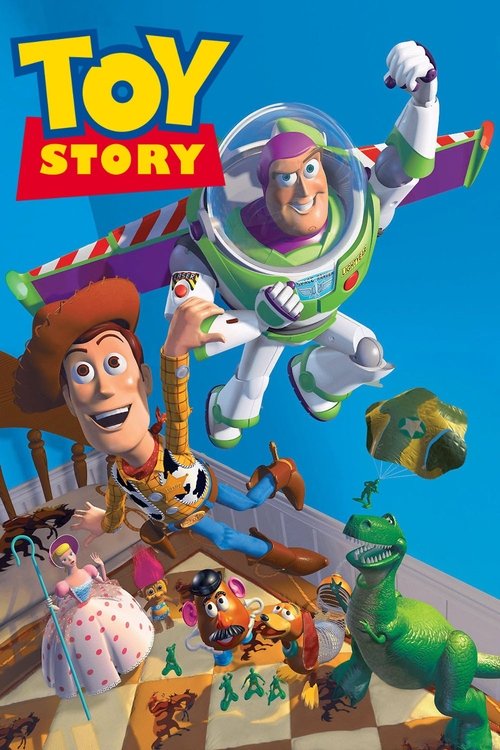
Toy Story (1995)
Directed by John Lasseter
No · Ultra Based
How we score movies →Consciousness Markers
Toys have varied designs and proportions without commentary. However, this reflects design necessity rather than any conscious commitment to body diversity messaging.
Predominantly white male voice cast with one female character (Bo Peep) who serves primarily as romantic interest. No characters of color in speaking roles.
Female toys exist but are marginalized. Bo Peep is the only female character with a voice and serves as a love interest rather than an agent in her own story.
No LGBTQ+ themes, characters, or representation whatsoever. The film operates entirely within heteronormative frameworks.
No characters of color appear in speaking roles. Race is not addressed or acknowledged in any way.
Climate themes are entirely absent. The film makes no environmental commentary or gestures.
The narrative centers on consumer desire for toys and treats capitalism as the natural order. No critique of consumerism is present.
No neurodivergent characters or representation. The film contains no such themes or acknowledgment.
The film is not historical fiction and makes no attempt to reframe historical events or narratives.
The film tells its story without preachy messaging or attempts to educate the audience on social issues.


Synopsis
Led by Woody, Andy's toys live happily in his room until Andy's birthday brings Buzz Lightyear onto the scene. Afraid of losing his place in Andy's heart, Woody plots against Buzz. But when circumstances separate Buzz and Woody from their owner, the duo eventually learns to put aside their differences.
Why it received this score
Toy Story arrives as a 1995 film, which places it in the pre-woke era by roughly two decades. The picture presents a fundamentally male-centered narrative with Woody and Buzz as the driving forces of the plot, supported by a cast of male toys whose names we remember (Slinky, Mr. Potato Head, Rex, Hamm) and female toys whose names we often do not (Bo Peep vanishes from the narrative almost entirely). The single female toy of consequence, Bo Peep, exists primarily as a love interest for Woody and disappears in the second act. The film's world is one of clear gender demarcation, where toys are gendered objects designed for boys or girls, and the story never questions this arrangement.
The representation casting presents what we might generously call a period-appropriate palette. The voice cast is predominantly white and male. Annie Potts provides the sole female voice of note as Bo Peep, delivering a character whose agency extends only to romantic interest in the protagonist. The film contains no characters of color in speaking roles, no LGBTQ+ representation, no neurodivergent characters, no climate messaging, and no serious engagement with body diversity or anti-capitalist critique. The capitalism itself, centered on toys as consumer objects and Andy's desire to possess the latest model, goes entirely unexamined. Any film from 1995 would struggle against modern metrics, but this one makes no attempt whatsoever to interrogate the frameworks within which it operates.
The film's cultural consciousness remains locked in 1995. It is an earnest, well-crafted product designed to sell toys and celebrate the emotional bonds between toys and their owner. This is not a failure on the film's part, merely a statement of historical fact. To score it as if it had been made yesterday would be to misunderstand the entire premise of this exercise.
Analysis generated by our Consciousness Algorithm
Critic Reviews
“Once again Disney has come up with a winning animated feature that has something for everyone on the age spectrum.”
“What the bright minds of Walt Disney have produced here is a must-see movie. Must-see, must-talk-about, must-plan-to-see-again.”
“There's a giddy, absurd charm to the story, in which the strange setting only enhances the comfortable familiarity of the narrative and characters.”
“The first all computer-animated feature, which brings a bedroom of playthings to bouncy life, is yummy eye candy spiked with 3-D-style tactile treats.”