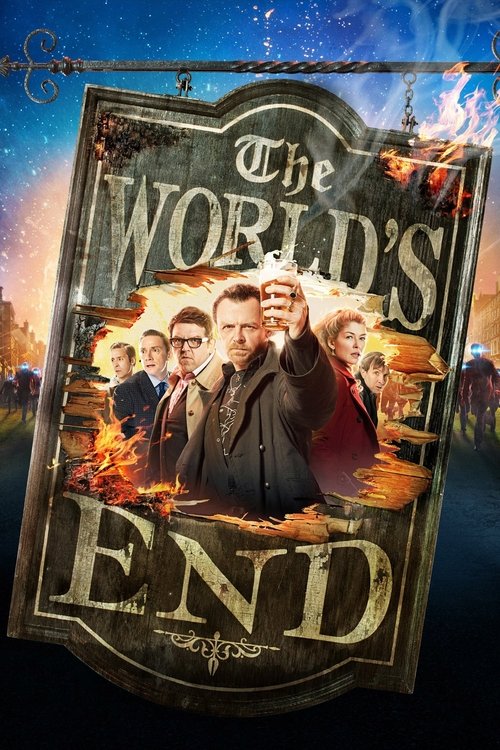
The World's End (2013)
Directed by Edgar Wright
No · Based
How we score movies →Consciousness Markers
The film carries preachy weight regarding maturity, growing up, and the dangers of nostalgia, though these themes are subordinate to comedic entertainment.
The alien invasion serves as metaphor for conformity and homogenization of culture, but critique targets social conformity rather than capitalism specifically.
The narrative is fundamentally male-centric with women serving peripheral roles. No feminist consciousness or gender-critical examination evident.
The cast is predominantly white and male. Rosamund Pike occupies a supporting role with minimal agency or development.
No LGBTQ+ characters, relationships, or thematic content present in the film.
The film contains no racial themes, commentary, or diversity consciousness. Cast is homogeneous without narrative justification.
No environmental or climate-related themes present in the narrative or subtext.
No body positivity messaging or representation of diverse body types. Characters presented with conventional appearances without commentary.
No representation of or engagement with neurodivergent characters or themes.
The film does not attempt to reframe or revise historical narratives or events.


Synopsis
Five friends who reunite in an attempt to top their epic pub crawl from 20 years earlier unwittingly become humankind's only hope for survival.
Why it received this score
The World's End arrives as a distinctly pre-woke artifact, a film concerned with male middle-age anxiety and the perils of nostalgia rather than contemporary social consciousness. Edgar Wright's final entry in his Cornetto Trilogy presents five aging friends attempting to recapture their glory days through a legendary pub crawl, only to discover their hometown has been absorbed into some sort of conformist collective. The metaphor is obvious enough, yet the film's critique of homogenization and loss of individual identity operates at a surface level, more interested in spectacular action sequences and comedic set pieces than in any genuine examination of systemic power structures.
The cast is reliably entertaining, with Simon Pegg delivering a career-best performance as an indelible specimen of arrested development, but the film's world is fundamentally male-centric. Rosamund Pike serves as a love interest and occasional plot device rather than a fully realized character with agency or depth. The narrative framework treats women as peripheral to the real drama, which concerns five men and their relationships with each other and their past selves. This is not a film wrestling with gender dynamics or power imbalances; it is simply a film where women occupy secondary roles.
The technical proficiency of Wright's direction yields an entertainment that traffics in self-aware humor about growing older and the impossibility of recapturing youth. The alien invasion plot functions as a literal externalization of conformist pressure, but the film never extends this critique into meaningful social commentary. It remains a comedy first and foremost, content to explore themes of maturity and change through the familiar lens of male bonding and camaraderie. By contemporary standards of progressive cultural consciousness, it registers as essentially inert.
Analysis generated by our Consciousness Algorithm
Critic Reviews
“An ordinary drama embellished and in some sense infringed on by genre elements rather than the other way around.”
“This is by light-years the most entertaining movie of the year. How many apocalyptic sci-fi action extravaganzas leave you feeling as if the world is just beginning?”
“The beauty of this movie, both a nostalgic romp and a futuristic scream, is its stubborn insistence on getting all the trapped-in-amber details right.”
“The movie independently bungles everything it tries, like a Central Park busker who simultaneously sucks at juggling, harmonica playing and skateboarding. ”