The Uprising (2026)
Directed by Paul Greengrass · $3.1M domestic
Yes · Woke
How we score movies →Consciousness Markers
The film's central engine is a furious indictment of wealth hoarding, labor suppression, taxation of the poor, and oligarchic clergy. Critics across outlets explicitly drew lines between the film's medieval lords and contemporary billionaire class, and the director confirmed the COVID-era economic frustration that shaped the script.
The film deliberately seeds anachronistic modern political language, including the phrase 'no kings' and the word 'deplorables', into 14th-century dialogue. The American distributor's attempt to retrofit the story as a Robin Hood origin further illustrates the film's loose relationship with historical fidelity in service of contemporary messaging.
Multiple critics independently described the film's social commentary as heavy-handed and on-the-nose. The director publicly confirmed the film as a direct allegory for 2020s political grievances, and the lead actor described it as 'prescient' to modern struggles, suggesting the sermon was fully intentional and not subtly delivered.
Thomasin McKenzie appears in the cast in what critics suggest is a meaningful supporting role, and the rebellion's framing gestures toward collective liberation, but no specifically feminist agenda is documented in the film's themes or reception.
The cast is largely white and British-adjacent, appropriate to the historical setting. No evidence of conscious diversity casting beyond the film's period constraints.
The film's class-struggle framing is explicitly socioeconomic rather than racial. No racial consciousness themes are identified in the research.
No LGBTQ+ themes, characters, or subtext are identified in any available research or reporting on the film.
No climate or environmental themes are present. The plague and ecological hardship are period-accurate historical backdrop, not modern environmental allegory.
No body positivity themes or messaging are present or documented anywhere in the film's reception.
No neurodivergence themes, characters, or framing are identified in any available research.
Synopsis
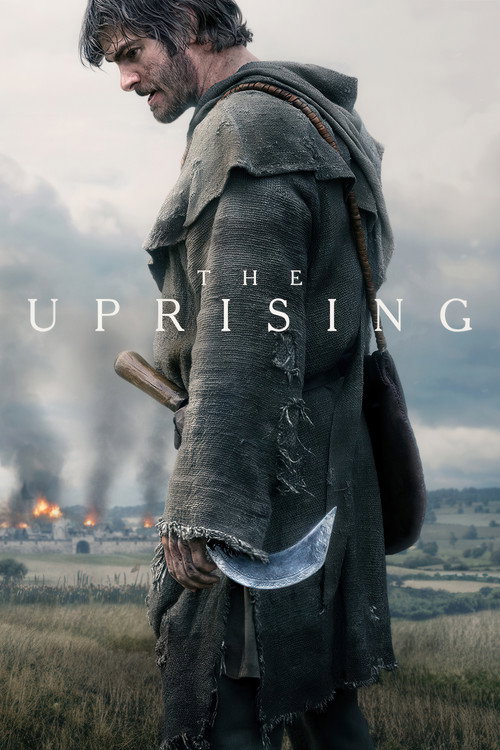
As war and plague devastate 14th-century England, a humble peasant ignites a rebellion, uniting an army of commoners to defy the King's might in a desperate fight for justice and survival.
Why it received this score
Paul Greengrass has made a film about the 1381 Peasants' Revolt in the same spirit that a man might send a very long text message to his landlord. Written during the COVID-19 lockdowns, when the director found himself with time, a laptop, and what appears to have been a great deal of productive grievance, *The Uprising* arrives as a medieval epic that is also, quite transparently, a press release about the present. The Black Death, it turns out, was always about 2020s housing costs. History is grateful for the clarification.
The film's social consciousness is not so much woven into the fabric of the narrative as it is embroidered on the outside in large, legible letters. Andrew Garfield's plowman eventually delivers the line "No kings," a phrase the director confirms he wrote before it became a modern political slogan, and which he kept in the film because, in his words, it was integral to "people power." That Garfield described the film as "prescient" during press tours suggests a cast and crew who are entirely aware they are making a parable, and are comfortable with you knowing it too. The medieval peasants of 14th-century England speak, critics noted, with a vocabulary that occasionally includes terms more familiar to 2024 political commentary. This is either bold artistic license or a continuity error of considerable scope, depending on your patience for the project.
Where the film is on firmest ground is in its anti-authoritarian populism, which at least has the advantage of being historically accurate to the revolt itself, even if the framing reaches aggressively toward the present. The class-war machinery is genuine and, by most accounts, viscerally effective. The revisionist seasoning, the anachronistic dialogue, the distributor's baffling eleventh-hour attempt to rebrand the whole enterprise as a Robin Hood origin story: these are the details that will occupy critics for years. The peasants of 1381 rose up against a system that extracted everything from them and gave nothing back. Greengrass has made a film that does something similar to historical nuance.
Analysis generated by our Consciousness Algorithm
Critic Reviews
“Anchored by a terrific Andrew Garfield, The Uprising is a terrific example of the historical epic, with strong central performances elevating it beyond the handful of underdeveloped elements that would otherwise hold it back.”
“The Uprising chronicles the infamous Peasants’ Revolt — the first populist rebellion in English history — with a rough-and-tumble energy and a bracing moral complexity. ”
“The vast majority of The Uprising is a competent, straightforward recreation of a landmark historical event. A talented team of below-the-line artists recreate the drab poverty of feudal England with impressive detail, and there shouldn’t be any complaints about Greengrass’ staging of the battle sequences. The parallels to today’s world are clearly on display, but the script stops just short of hitting audiences over the head too hard.”
“Mr. Greengrass has worked with some top screenwriters, yet unwisely assigned himself sole screenplay duties here. He isn’t really a word man and the deficiency is evident in the prosaic dialogue and barely imagined characters. ”