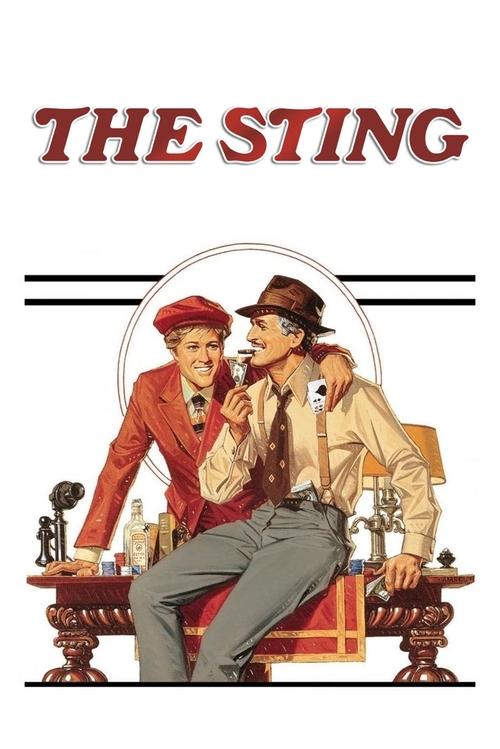
The Sting (1973)
Directed by George Roy Hill
No · Ultra Based
How we score movies →Consciousness Markers
While the film involves grifting and conning the wealthy, this is treated as entertainment rather than social critique. The exploitation is never interrogated as genuinely harmful.
The cast is predominantly white and male, reflecting 1970s Hollywood norms. Eileen Brennan's presence as a female character is minimal and her role offers little agency or complexity.
The film is set in 1936 but offers no meaningful historical context or interrogation of that period. It uses the setting as aesthetic backdrop rather than engaging with historical realities.
Female characters exist primarily as objects to be manipulated or deceived. Eileen Brennan's role serves the plot mechanics rather than presenting complex female agency.
No LGBTQ+ themes, representation, or subtext present in the film. The narrative is entirely focused on heterosexual male relationships and dynamics.
The film contains no exploration of racial dynamics or consciousness. Race is not addressed in any meaningful way in the narrative or casting.
Climate concerns are entirely absent from the film. The narrative operates without reference to environmental consciousness.
Body positivity is not a consideration in the film. All characters fit conventional 1970s Hollywood beauty standards without any diversity of body types.
No representation of neurodivergence or disability. The film contains no characters with visible disabilities or neurodivergent characteristics.
The film contains no preachy moments or lectures about social issues. It operates as pure entertainment without any educational or moral messaging.


Synopsis
A novice con man teams up with an acknowledged master to avenge the murder of a mutual friend by pulling off the ultimate big con and swindling a fortune from a big-time mobster.
Why it received this score
The Sting occupies a curious position in the cultural landscape of 1973, arriving precisely when public trust in institutions was collapsing under the weight of Watergate. Here we find two white men of considerable charm and talent celebrated as heroes for their elaborate deception of a mobster, a narrative that requires no interrogation whatsoever of their moral standing or the systems they exploit. The film is, by modern standards, aggressively unconcerned with any of the markers we use to assess contemporary social consciousness.
The casting is entirely reflective of mainstream 1970s Hollywood, which is to say it is not reflective of much of anything beyond the industry's own narrow preferences. Eileen Brennan appears as a supporting female character whose primary function is to be manipulated and deceived as part of the con, a role that offers no agency or complexity. The film contains no LGBTQ+ themes, no exploration of racial dynamics, no commentary on class exploitation that extends beyond the playful mechanics of the plot itself, and certainly no climate consciousness. The narrative treats con artistry as an elegant intellectual exercise rather than examining the actual harm inflicted on victims.
The Sting is not attempting to be progressive. It is a meticulously crafted entertainment designed to charm audiences in an era when such things required no justification beyond technical excellence and star power. Judging it by contemporary standards would be unfair, yet the exercise reveals how thoroughly such films operated within their own ideological bubble, asking no difficult questions and offering no reflection on the systems they depicted. The film remains beautifully made and narratively satisfying, which is precisely the problem.
Analysis generated by our Consciousness Algorithm
Critic Reviews
“The style here is so seductive and witty it's hard to pin down. It's like nothing else I've seen by Hill, and at times, it almost reminds me of Jacques Tati crossed with Robert Altman. It's good to get a crime movie more concerned with humor and character than with blood and gore; here's one, as we say, for the whole family.”
“In an age when films such as Guy Ritchie's Lock, Stock and Two Smoking Barrels and Steven Soderbergh's Ocean's Eleven are revered for their trickery, The Sting remains the definitive con artist comedy: as irresistible and ingenious as the scheme that hooks in Doyle. ”
“The Sting is the most purely enjoyable film in Oscar history – and that, I think, puts it in the most valuable American film-making tradition of all.”
“The Sting was not made to be taken seriously, but many people may find it difficult even to enjoy casually. It lacks the elements that could have given it true drive. [31 Dec 1973, p.50]”