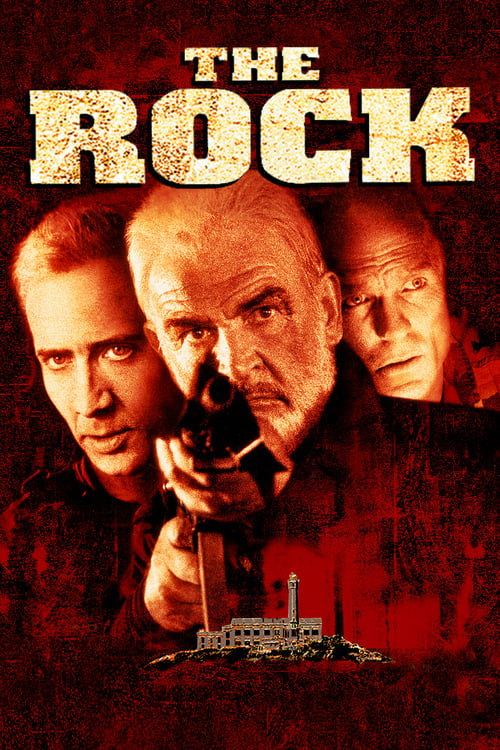
The Rock (1996)
Directed by Michael Bay
No · Ultra Based
How we score movies →Consciousness Markers
The cast includes primarily white male leads with minimal representation of other groups. Vanessa Marcil's role is conventional and subordinate. No particular attention to diverse casting beyond basic background characters.
General Hummel delivers speeches about military grievance and governmental neglect, but the film frames these as the villainous justification rather than legitimate social critique. Minimal preachy messaging overall.
The female lead exists primarily as romantic motivation for the male protagonist. She lacks agency in the central narrative conflict and serves traditional supportive role.
Characters of various racial backgrounds appear in the ensemble but receive minimal characterization or thematic focus. No examination of racial dynamics or systemic inequality.
Nicolas Cage's character exhibits eccentric behavior framed as comic relief rather than celebrated or examined with sensitivity. No genuine representation of neurodivergent experience.
No LGBTQ+ themes, characters, or representation of any kind. The narrative contains no same-sex relationships or queer subtext.
The film contains no climate-related themes, messaging, or environmental consciousness. Chemical weapons threaten the city, but this is a plot device rather than environmental commentary.
No critique of capitalism or class systems. The narrative assumes standard institutional hierarchies and military authority structures as natural and necessary.
The film celebrates conventional physical fitness and martial prowess. No body diversity or body-positive messaging appears in the narrative.
The film contains no revisionist historical narratives. It accepts American military history and institutional authority without question or reinterpretation.


Synopsis
When vengeful General Francis X. Hummel seizes control of Alcatraz Island and threatens to launch missiles loaded with deadly chemical weapons into San Francisco, only a young FBI chemical weapons expert and notorious Federal prisoner have the skills to penetrate the impregnable island fortress and take him down.
Why it received this score
The Rock arrives as a pre-woke action blockbuster, unconcerned with the social consciousness that would later dominate cultural discourse. Michael Bay's 1996 spectacle concerns itself solely with explosions, witty repartee between Nicolas Cage and Sean Connery, and the mechanics of siege warfare. The film's villain, General Hummel, is driven by a legitimate grievance regarding fallen Marines, which provides a thin moral dimension to what is otherwise a straightforward good-guys-versus-bad-guys scenario. There is no interrogation of American military power, no questioning of the geopolitical assumptions that undergird the narrative, no suggestion that perhaps the federal government's relationship to violence might warrant examination.
The casting reflects the uncomplicated sensibilities of mid-1990s Hollywood. Cage plays a brilliant but eccentric scientist without any suggestion that his neurodivergence requires special attention or celebration. Vanessa Marcil appears as his love interest, a role that functions primarily as motivation for the protagonist. The film's few women exist in service to the plot and the male characters' arcs. No racial consciousness informs the narrative; characters of color appear without particular significance to the story's thematic concerns. There is no body positivity discourse, no climate messaging, no anti-capitalist posturing, no revisionist history, no LGBTQ representation serving narrative purpose.
The Rock is what it is: a Jerry Bruckheimer-produced exercise in kinetic filmmaking that predates the cultural moment in which such exercises became occasions for critical scrutiny regarding their ideological content. It remains innocent of progressive sensibilities, which is to say it remains innocent of the markers by which we now measure such things. One might call it refreshingly unconcerned with the machinery of social consciousness. One might also call it a product of its era, before the era in question arrived.
Analysis generated by our Consciousness Algorithm
Critic Reviews
“A first-rate, slam-bang action thriller with a lot of style and no little humor.”
“The Guy Movie to end all Guy Movies, a ridiculously overblown summer testosterone blowout right down to the Wagnerian strains of the soundtrack and its stunningly high body count. It's also a hell of a lot of fun.”
“Can a mild-mannered toxicologist and an eccentric Alcatraz veteran stop him before it's too late? Learning the answer means sitting through more than two hours of violence, vulgarity, and all-around excess, served up with high-tech trimmings by director Michael Bay.”