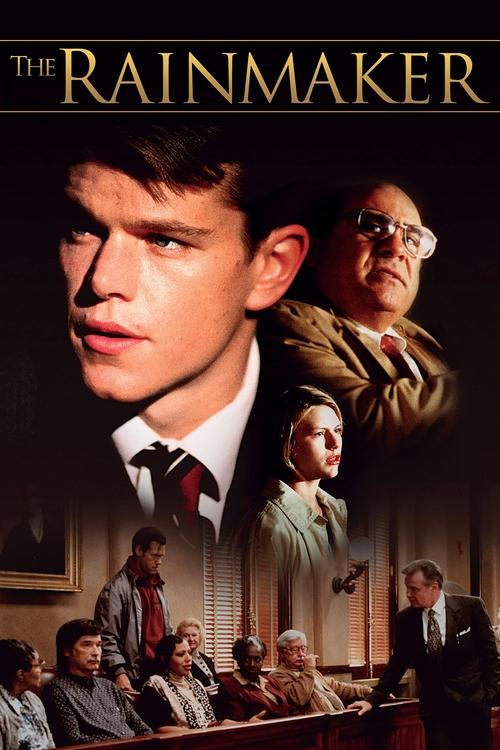
The Rainmaker (1997)
Directed by Francis Ford Coppola
No · Based
How we score movies →Consciousness Markers
The film critiques corporate malfeasance and insurance company greed, but frames this as individual moral failure rather than systemic capitalist dysfunction. The solution is legal reform, not structural change.
The cast includes Danny Glover and other minority actors, but they are incidental to the narrative rather than serving as commentary on representation or addressing systemic casting patterns.
While the courtroom scenes contain moral argument, the film's preachiness remains subtle and narrative-driven rather than preachy or overtly pedagogical about social justice.
Claire Danes plays a female character with agency, but she is primarily a love interest and supporting player in a male-centered narrative about masculine legal heroism.
No LGBTQ+ themes, representation, or subtext are present in the film.
The film contains no exploration of racial dynamics, systemic racism, or racial justice themes.
Environmental concerns are entirely absent from this legal drama.
No body positivity themes or commentary on physical appearance and acceptance are present.
No neurodivergent characters or themes are represented in the film.
The film contains no reinterpretation of historical events or revisionist historical framing.


Synopsis
Fresh out of law school and desperate for work, idealistic rookie Rudy Baylor takes on a powerful insurance company accused of denying a dying boy's claim. Teaming up with a scrappy, unlicensed paralegal, he finds himself in a David-versus-Goliath courtroom battle that tests his ethics, courage, and belief in justice.
Why it received this score
The Rainmaker presents itself as a moral fable about corporate malfeasance and the triumph of individual conscience, themes that align comfortably with late-1990s populism but register as almost quaint from the vantage point of contemporary progressive sensibilities. Coppola's adaptation of John Grisham's novel concerns itself primarily with the mechanics of legal combat and the spiritual corruption of the legal profession itself. The film features a diverse supporting cast, including Danny Glover and Mickey Rourke, but their presence serves the narrative rather than functioning as commentary on representation or systemic inequality.
The film's anti-corporate messaging, while genuine, operates from a fundamentally classical liberal position: the problem is not capitalism itself but rather individual bad actors within the system who lack moral fiber. A dying boy is denied insurance coverage by faceless bureaucrats, and the solution is the courtroom heroics of a determined young man with principles. This is advocacy for reform through proper channels, not a challenge to structural systems. The paralegal character, played by Danny DeVito, might be read as a working-class everyman, yet the film frames his unlicensed status as charming eccentricity rather than systemic exclusion.
There is no interrogation of broader social systems, no attention to identity-based oppression, and no suggestion that the problem extends beyond the particular villainy of individual actors. The film remains committed to the notion that the law, properly applied by virtuous individuals, can achieve justice. By the standards of 2020s progressive cultural consciousness, this represents a fundamentally insufficient analysis of power structures and institutional dysfunction.
Analysis generated by our Consciousness Algorithm
Critic Reviews
“Drawing a parade of colorful performances from a constantly surprising cast, the curiously titled ''John Grisham's 'The Rainmaker' '' is Mr. Coppola's best and sharpest film in years.”
“Though he's adapting the same story Grisham always tells, that of an ethical, talented and inexperienced attorney taking on and outwitting powerful and corrupt legal opponents, Coppola has infused The Rainmaker with enough humor, character, honest emotion and storytelling style to make it one of the year's most entertaining movies.”
“The film delivers old-fashioned star turns and glittering cameos (Jon Voight and Mickey Rourke are especially good, but Danny DeVito, Mary Kay Place, Danny Glover, Virginia Madsen, Roy Scheider, and Dean Stockwell--not to mention old-Hollywood icon Teresa Wright--also provide considerable pleasure).”
“John Grisham's The Rainmaker lulls you into the mindset you get while reading a bestseller at the beach. What a sad thing to say about a Francis Ford Coppola movie!”