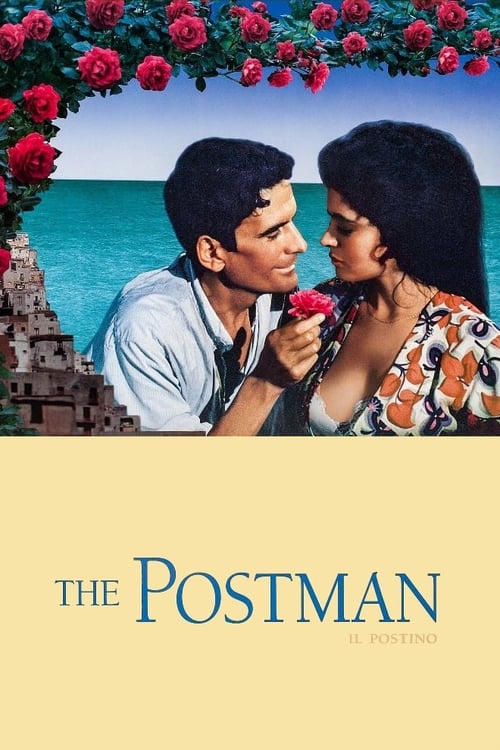
The Postman (1994)
Directed by Michael Radford
No · Ultra Based
How we score movies →Consciousness Markers
Neruda explains poetry and metaphor to the postman in somewhat preachy scenes. There is cultural instruction presented within the narrative framework.
The cast is primarily Italian and European, reflecting the island setting authentically. However, female representation is limited to Beatrice as a romantic object rather than a fully realized character.
Beatrice exists primarily as a romantic prize to be won by the protagonist. The film shows no feminist consciousness or exploration of women's agency.
The postman represents working-class labor, and there is mild acknowledgment of class difference, but no systematic critique of capitalism or wealth inequality.
The film depicts Pablo Neruda's exile accurately but romanticizes his political circumstances into a personal mentorship story. It simplifies rather than revises history.
No LGBTQ+ themes are present in the film. The narrative is entirely focused on heterosexual romance.
No racial themes or consciousness are evident. The film is set on an Italian island with European characters and contains no engagement with racial issues.
No environmental or climate themes appear in the film. The narrative is entirely personal and poetic in scope.
No themes of body positivity, disability representation, or body image consciousness appear in the film.
No representation or discussion of neurodivergence, autism, ADHD, or any neurodevelopmental conditions is present.
Synopsis
Simple Italian postman learns to love poetry while delivering mail to a famous poet; he uses this to woo local beauty Beatrice.
Why it received this score
The Postman arrives as a film almost entirely innocent of contemporary progressive sensibilities, which is precisely what we would expect from a 1994 Italian romance. Michael Radford's adaptation of this true story about the postman Mario Jimenez and his friendship with exiled Chilean poet Pablo Neruda operates in a fundamentally different register than modern cinema. The film celebrates poetry, working-class labor, and cross-class mentorship with genuine warmth and without irony. Massimo Troisi, who died shortly after completing the film, carries the narrative with affecting earnestness, and his posthumous Oscar nominations reflect the film's emotional sincerity rather than any cultural consciousness framework.
The female lead, Beatrice, functions as a romantic object to be pursued and won rather than as an autonomous character with her own arc or agency. She exists in the film to give the postman motivation and to provide the romantic resolution. This is not presented as problematic but simply as the natural order of the narrative. The film's gentle class commentary amounts to little more than suggesting that poetry and beauty can transcend social station, a sentiment that is humanist rather than systemic in its critique.
The analysis yields a film so thoroughly pre-woke that it reads almost as a period piece from an entirely different cultural moment. There is no racial consciousness, no gender analysis, no environmental concern, no neurodivergent representation, and certainly no anti-capitalist framework. The film is interested only in beauty, love, and the transformative power of art. One could argue this makes it refreshingly innocent, or one could argue it makes it invisible to contemporary cultural conversations. Either way, its score reflects its honest distance from modern progressive frameworks.
Analysis generated by our Consciousness Algorithm
Critic Reviews
“Although The Postman conveys a thoroughly imagined vision of a future society, its basic concerns are actually far from those of traditional sci-fi, as it quickly comes to feel more like a Western than anything else.”
“If you take The Postman at face value - that it's a straightforward, post- apocalyptic adventure tale, then it could seem like one of the worst movies of the year, if not of all time.”
“It's tempting to accuse director and star Kevin Costner of taking the idea of vanity production to a new level in this frontier adventure based on a book by David Brin.”
“Every truly awful movie epic has a point of no return, a moment when the accumulated bad lines and bogus sentimentality become so cloying that the best defense against a mounting queasiness is an awed amusement. The Postman, offers a new opportunity for levity every few minutes after its first hour.”