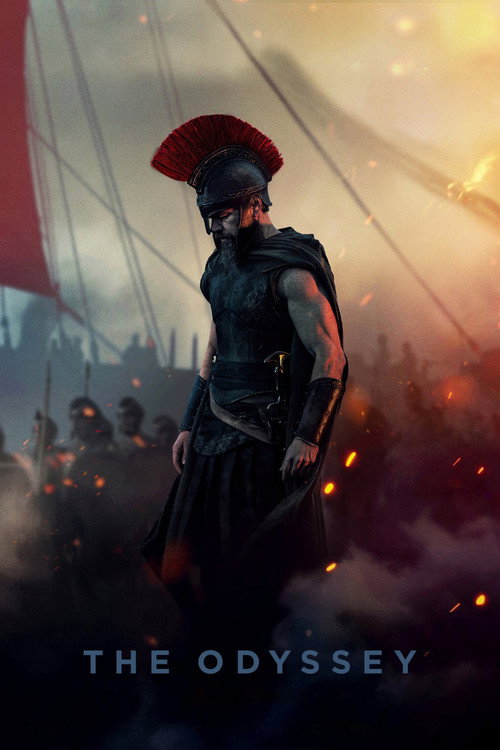
The Odyssey (2026)
Directed by Christopher Nolan · $601.2M domestic
No · Based
How we score movies →Consciousness Markers
The casting of Lupita Nyong'o in the dual roles of Helen and Clytemnestra, alongside Elliot Page as a Greek soldier, represents a deliberate and high-profile diversification of a canonically Mediterranean epic. The ensemble is broadly multicultural in a manner that clearly reflects contemporary industry casting philosophy, even if the film's defenders cite the mythological rather than historical status of the source material.
The film's multicultural casting implicitly repositions a text long associated with European classical heritage as belonging to a global, racially diverse tradition. This is a mild form of cultural revisionism, though Nolan and classicists both argue it is actually more historically accurate to the cosmopolitan ancient Mediterranean than the whitewashed versions that preceded it.
Penelope receives an expanded emotional arc compared to prior adaptations, but feminist critics were notably disappointed, characterizing the film as a male-centric action epic that sidelines Homer's complex female dynamics. The expansion is modest and the structure remains traditionally masculine.
Nolan explicitly framed the film around archetypal human themes and avoided political discourse entirely in press. Conservative critics praised the film's moral seriousness without finding it preachy. The Oppenheimer-style allegory about civilizational trust is noted by critics but appears to be a reading of the film rather than a sermon delivered by it.
The film does not appear to engage with racial consciousness as a narrative or thematic element. The racial discourse surrounding the production is almost entirely external, driven by casting controversy rather than anything the film itself says or does on screen.
Elliot Page appears in the film, but the research is unambiguous: the character contains no textual or thematic reference to transness and serves a purely narrative function in the Trojan Horse sequence. The film's content itself presents no LGBTQ themes.
No evidence of climate themes in the film's narrative, imagery, or critical reception. The gods control the weather here, and they have a different agenda entirely.
No evidence of anti-capitalist themes. The film is concerned with Bronze Age hospitality codes and sea monsters, not the means of production.
No evidence of body positivity themes in the film's content or critical reception.
No evidence of neurodivergence themes. Odysseus's cunning is framed as heroic virtue, not a clinical profile.
Synopsis
Odysseus, the legendary King of Ithaca, embarks on a long and perilous journey home following the Trojan War. Throughout his voyage, he is forced to confront the whims of gods, mythological monsters, and trials that stretch both his cunning and his humanity to the breaking point.
Why it received this score
Christopher Nolan's adaptation of Homer's Odyssey arrives carrying the full weight of Western civilization on its shoulders, plus approximately three hundred million dollars of Universal Pictures' money. It is, by most accounts, a serious and technically accomplished film. It is also, by the standards of the current cultural moment, a moderately interesting case study in how the casting of a mythological epic can generate more philosophical debate than the actual mythology.
The central controversy, for those who have been living in a cave without internet access, concerns Lupita Nyong'o's casting as Helen of Troy. Classicists rushed to point out that Helen is not a historical figure and that the ancient Mediterranean was not, in fact, a monoculture. Conservative commentators rushed to point out that they did not care. Both sides expended enormous energy on a woman who, in the original text, barely appears and causes an enormous amount of trouble. In the film itself, the racial politics that consumed the discourse are largely absent from the screen. The film is about a man trying to get home. It is not about anything else, and Nolan, to his considerable credit, declined to make it about anything else. The lecture energy is low. The sea monsters are large.
What the film does carry is a casting philosophy that is unmistakably contemporary: a broadly diverse ensemble assembled for a text that has, for most of its Hollywood history, been treated as the exclusive property of actors who look like they could plausibly be on a Greek postage stamp. This is the film's most legible social gesture, and it is a gesture, not an argument. Anne Hathaway's Penelope gets more emotional architecture than the character has historically received on screen, though feminist critics noted, with the weary accuracy of people who have been here before, that the film remains structurally a story about a man. The Trojan Horse sequence, featuring Elliot Page in a role with no thematic freight attached to Page's identity, comes and goes without incident. The internet had already decided what it meant. The film, admirably, did not agree.
Analysis generated by our Consciousness Algorithm