The Observance (2026)
Directed by Robert Hollocks
No · Based
How we score movies →Consciousness Markers
The lead character is a woman and the cast includes diverse performers, though this appears to reflect natural demographic distribution rather than deliberate representation strategy. No particular emphasis on casting choices as a social statement.
A female protagonist in a survival narrative, but the feminism here is incidental rather than ideological. The story does not center on feminist critique or gender-based power dynamics as thematic material.
Some critical commentary suggests the film occasionally pauses to reflect on cult psychology and trauma, but this remains within the bounds of character development rather than preachy exposition.
The cast includes performers of various backgrounds, but there is no indication that racial dynamics or systemic racism form any part of the film's thematic content or social commentary.
Religious cults are presented as a contemporary horror phenomenon, but the film does not appear to engage in revisionist reinterpretation of historical events or narratives.
While cults operate outside mainstream economic systems, the film does not appear to mount any critique of capitalism or wealth inequality. The cult functions as a psychological horror mechanism rather than a political statement.
No discernible LGBTQ+ themes, representation, or subtext in the available plot descriptions or critical reception. The film does not engage with this dimension.
No environmental or climate-related themes apparent in the film's premise, plot, or critical discussion. This dimension is entirely absent.
No evidence of body positivity messaging, discussion of body standards, or related themes in the film's premise or reception.
The protagonist's coma and recovery might touch on neurological concerns, but there is no indication this is treated as neurodivergence representation or advocacy.
Synopsis
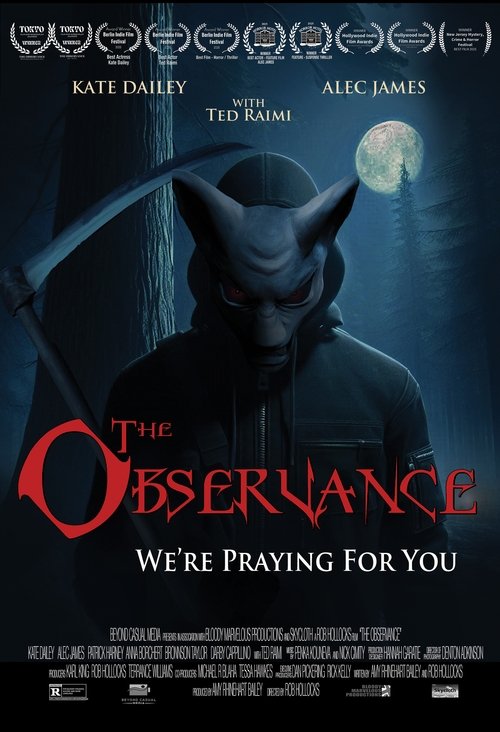
After five years in a coma following a fatal car accident, Madison Neubauer wakes to find her home and family in the grip of 'The Observance', a religious cult who will stop at nothing to protect their secrets.
Why it received this score
The Observance presents itself as a straightforward cult horror thriller, and in this endeavor it succeeds with modest ambition. The film centers on Madison Neubauer, a woman emerging from a prolonged coma to discover her family has fallen under the control of a religious cult. Director Robert Hollocks employs the familiar machinery of the genre: family separation, psychological manipulation, and the gradual revelation of sinister secrets. The film's exploration of cult dynamics shows occasional depth, particularly in its attention to how such organizations fracture family bonds and generate lasting trauma. This is competent work within a familiar framework.
What distinguishes The Observance from purely generic horror fare is its willingness to linger on psychological aftermath rather than rushing toward visceral spectacle. The film touches on genuine human damage, the way cult indoctrination corrodes trust, and the difficulty of deprogramming loved ones. These are serious topics treated with appropriate gravity. The casting is straightforward and functional, with Ted Raimi anchoring the ensemble in what amounts to a conventional ensemble of character roles. None of this rises to the level of progressive social commentary, but neither does it undermine such concerns.
The film operates almost entirely within the bounds of conventional horror storytelling, which is to say it asks little of its audience regarding contemporary cultural sensibilities. It concerns itself with evil as manifested through religious manipulation and family dysfunction, themes that predate modern progressive discourse by centuries. The Observance is content to be a moderately effective thriller about a recognizable social pathology, without layering additional social consciousness onto that foundation. It is a film that knows what it is and pursues that goal with reasonable consistency.
Analysis generated by our Consciousness Algorithm