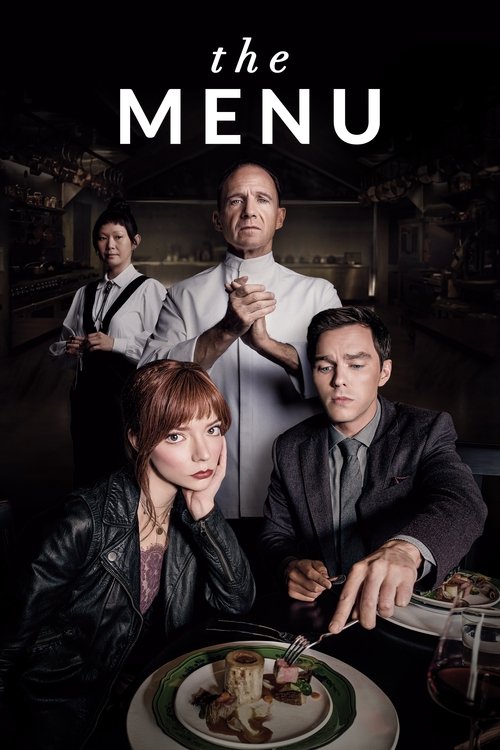
The Menu (2022)
Directed by Mark Mylod
No · Based
How we score movies →Consciousness Markers
The film contains explicit critique of wealth inequality, exploitation of service workers, and artistic pretension in capitalist markets, though these themes are deployed primarily for entertainment shock value rather than genuine political engagement.
The film frequently pauses to have characters explicitly state its themes about class, artistic pretension, and labor exploitation, prioritizing direct messaging over subtlety or nuance.
The cast includes actors of various ethnicities and genders reflecting contemporary Hollywood practices, but this diversity serves no thematic function and characters are not developed beyond plot mechanics.
While the cast is racially diverse, the film makes no explicit examination of race or racial dynamics. Characters of color occupy standard supporting roles without specific racial dimension to their narratives.
Female characters exist primarily as supporting figures or victims. Anya Taylor-Joy's character has minimal agency and the film contains significant violence toward women without meaningful commentary.
No LGBTQ+ characters, themes, or representation are present in the film.
No climate-related themes, imagery, or messaging appear in the film.
The film contains no body positivity messaging or representation. Bodies are primarily treated as objects within the thriller narrative.
No representation of or engagement with neurodivergence appears in the film.
The film contains no historical content or revisionist historical framing.


Synopsis
A young couple travels to a remote island to eat at an exclusive restaurant where the chef has prepared a lavish menu, with some shocking surprises.
Why it received this score
The Menu presents itself as a scathing critique of wealth, artistic vanity, and the service economy, yet the film's relationship to contemporary progressive sensibilities proves more complicated than its surface messaging suggests. The narrative weaponizes class consciousness and labor exploitation as plot devices within a thriller framework, treating these systemic concerns as vehicles for shock and spectacle rather than genuine interrogation. The diverse casting reflects contemporary industry standards rather than serving any thematic purpose, and the few female characters exist primarily to facilitate male character development or serve as targets for violence.
The film's satirical impulse toward the wealthy elite contains traces of anti-capitalist sentiment, though this remains largely performative. We observe the brutal consequences of inequality and the dehumanization of service workers, yet the film offers no substantive perspective on these realities beyond using them as shock value. The chef's motivations derive from personal grievance rather than systemic critique, collapsing any meaningful political commentary into individual pathology. The film mistakes cynicism about the rich for actual social consciousness, a distinction it never bothers to examine.
What emerges is a work that borrows the aesthetic of progressive critique while remaining fundamentally conservative in its actual worldview. The violence inflicted upon the characters reads as cathartic rather than troubling, and the film seems less interested in exploring the conditions that produce such violence than in depicting it with visceral style. For a 2022 release, The Menu operates in a register of social awareness that is superficial, more concerned with the appearance of cultural commentary than with its substance.
Analysis generated by our Consciousness Algorithm
Critic Reviews
“The Menu is the most entertaining ensemble film since Knives Out, and the most engaging horror-satire since Get Out. But no matter what comparisons and assumptions are made, The Menu will not be the movie you expect.”
“The complexity, both tonally and visually, is there to tease out the film’s black genre heart, and it’s that heart that makes The Menu a delicious and deeply filling experience that will make you beg for a second helping.”
“It’s a perfectly-cooked cheeseburger of a movie, which isn’t trying to be foie gras seared on a hot rock over a bed of foraged botanicals, but in which every element — bun, patty, cheese, veg — is lovingly prepared, perfectly executed, and working together in perfect harmony.”
“The pungent whiff of designer cynicism pervades every scene, so not only is it difficult to understand why these diners aren’t taking their business elsewhere (which they absolutely would do if they’re the capitalist scum we’re told they are), but it’s difficult to give two hoots as to whether they stay or go.”