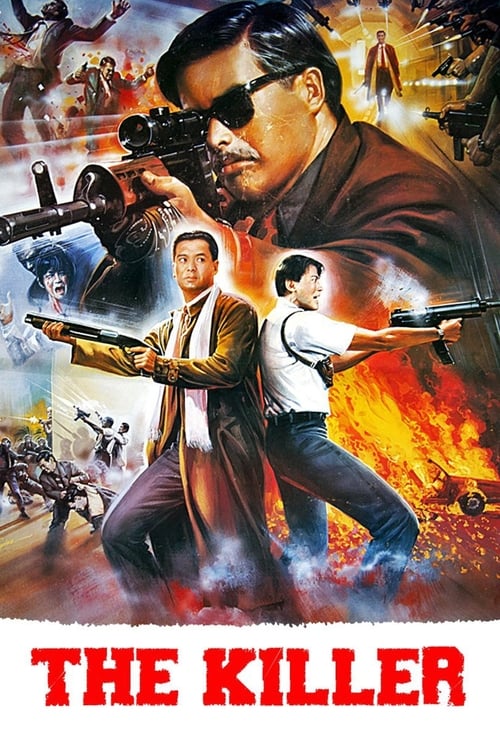
The Killer (1989)
Directed by John Woo
No · Ultra Based
How we score movies →Consciousness Markers
The film features an all-Hong Kong Chinese cast, which is simply a reflection of its production context rather than any conscious casting statement. There is no evidence of deliberate diversity programming or cross-demographic casting choices made in the name of representation.
Academic critics have noted a homoerotic subtext in the intense male bonding between Jeffrey and Inspector Li, including a climactic scene of near-embrace framed with the visual grammar of a romance. The film neither acknowledges nor endorses this reading; it simply exists in the charged space between male melodrama and gunfire.
The protagonist is betrayed by his criminal employer after completing a contract, which could be construed as a meditation on the disposability of labor under extractive economic systems. John Woo almost certainly did not intend this. The score reflects the plot mechanics, not any ideological intent.
Jennie, the blinded singer, exists almost entirely as a narrative device to motivate the male protagonist's guilt and redemption arc. She is treated with tenderness but not agency. The film's gender politics are resolutely 1989.
The film occasionally pauses its carnage to let characters reflect on honor, loyalty, and the code of the professional killer. These moments read as melodramatic sincerity rather than social instruction. The film wants to move you, not correct you.
There is no racial consciousness in any modern sense. The film is a Hong Kong production about Hong Kong characters, and race is never framed as a social category to be examined or critiqued.
The film contains no environmental themes whatsoever. Several churches are destroyed, which could be read as a commentary on carbon emissions from structural fires, but we will resist that reading.
The film displays no interest in body positivity as a social framework. Bodies appear primarily as vehicles for balletic violence and, occasionally, for being shot.
No character is coded as neurodivergent, and the film makes no gestures toward that discourse. Jeffrey's single-minded professionalism might attract armchair diagnosis, but that is the audience's problem, not the film's.
The film is not based on historical events and makes no attempt to reframe any historical narrative. It is set in a present-tense Hong Kong of doves, slow motion, and extremely large handguns.


Synopsis
Mob assassin Jeffrey is no ordinary hired gun; the best in his business, he views his chosen profession as a calling rather than simply a job. So, when beautiful nightclub chanteuse Jennie is blinded in the crossfire of his most recent hit, Jeffrey chooses to retire after one last job to pay for his unintended victim's sight-restoring operation. But when Jeffrey is double-crossed, he reluctantly joins forces with a rogue policeman to make things right.
Why it received this score
John Woo's 1989 masterpiece arrives at our scoring desk with the serene confidence of a man walking through a hail of bullets in slow motion, doves aloft, and a toothpick firmly in place. We have reviewed it carefully. We have weighed its social consciousness with the precision it deserves. The result is, to use the technical term, not very woke at all.
The film's central concerns are honor, guilt, male friendship, and the logistical challenges of funding a stranger's corneal surgery through contract killing. These are not the concerns of the current cultural moment. The female lead, Jennie, is blinded and then waited upon by the man who blinded her, which is either a profound statement about masculine guilt or simply a 1989 Hong Kong action movie doing what it does. The film does not appear to know the difference, and this ignorance is, in its way, refreshing. Academic critics have detected homoerotic subtext in the relationship between Jeffrey and Inspector Li, and they are not wrong, but the film is far too busy choreographing shootouts in candlelit churches to make any deliberate argument about it.
Where the film does accumulate the faintest traces of progressive reading material, it does so accidentally. The assassin is betrayed by his employer, which maps loosely onto anxieties about precarious labor. The cast is uniformly Chinese, which in 2025 gets a modest representation credit, though in 1989 it was simply the natural consequence of filming in Hong Kong. The lecture energy is minimal: Woo wants your tears and your adrenaline, in that order, and he has no interest in your politics. This is a film that believes in redemption, loyalty, and the dramatic potential of two men pointing guns at each other while reluctantly admitting they are friends. As cultural documents go, it is a deeply uncomplicated one. We mean that as a compliment.
Analysis generated by our Consciousness Algorithm