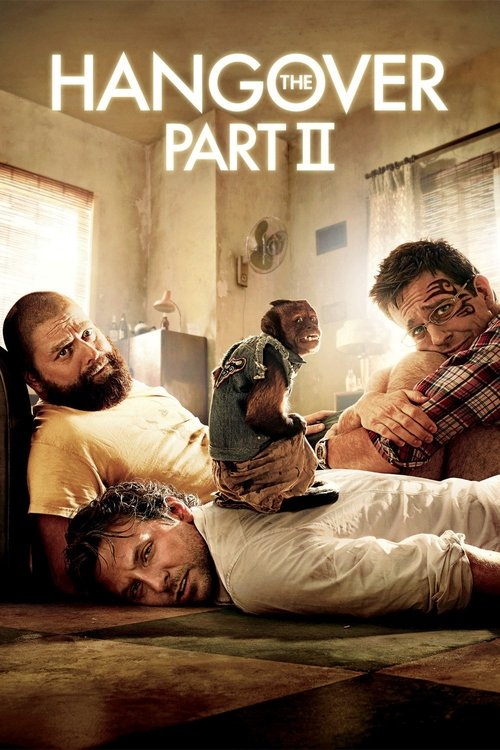
The Hangover Part II (2011)
Directed by Todd Phillips
No · Ultra Based
How we score movies →Consciousness Markers
The film includes Asian and Asian American actors but deploys them primarily in stereotypical or comedic roles that reinforce rather than challenge existing caricatures of Asian identity and culture.
Female characters remain peripheral to the narrative, existing primarily to support male character arcs. Women are objectified rather than developed as full participants in the story.
Physical appearance and bodily difference are used as sources of humor. The film does not challenge conventional beauty standards and relies on body-based comedy.
Transgender characters are treated as punchlines and sources of shock humor rather than as people with agency or dignity. The film's approach to LGBTQ representation is dismissive and rooted in discomfort.
The film treats Thai culture and Asian identity as exotic curiosities to be mocked. Cultural differences are framed as inherently ridiculous rather than as valid alternative ways of being.
The film makes no attempt to educate or inform viewers about cultural or social issues. Any social messaging is incidental to the pursuit of comedy.
No engagement with climate or environmental themes whatsoever. The film is a buddy comedy with no interest in ecological consciousness.
No critique of capitalism or wealth structures. The film celebrates consumption and excess as sources of comedy and adventure.
No meaningful engagement with neurodivergent representation. Zach Galifianakis's character traits are played for laughs without any recognition of neurodiversity.
The film contains no historical narrative or revisionist historical commentary. It is purely set in contemporary times with no engagement with history.


Synopsis
The Hangover crew heads to Thailand for Stu's wedding. After the disaster of a bachelor party in Las Vegas last year, Stu is playing it safe with a mellow pre-wedding brunch. However, nothing goes as planned and Bangkok is the perfect setting for another adventure with the rowdy group.
Why it received this score
The Hangover Part II presents a curious artifact of pre-woke comedy sensibilities, though calling it merely "pre-woke" would be charitable. The film's relocation to Bangkok serves not as a setting but as a backdrop for what critics have described as an extended exercise in orientalism and cultural reduction. Every element of Thai culture becomes a punchline, every unfamiliar custom a source of discomfort designed to generate laughter from audiences assumed to share in the characters' alienation and superiority.
The cast includes Ken Jeong, Mason Lee, and Jamie Chung, though their presence operates more as decoration than representation. Jeong in particular is deployed in a manner that reinforces rather than challenges Asian stereotypes, while the film's treatment of transgender characters crosses from comedy into what can only be described as mockery of identity itself. The female characters remain ornamental, their agency subordinated to the male characters' misadventures, a pattern the sequel doubles down on compared to its predecessor.
What makes The Hangover Part II relevant to cultural analysis is not that it was controversial in 2011, but that it was successful, suggesting a mainstream audience comfortable with its particular brand of cultural tourism and ridicule. The film weaponizes comedy as a shield against criticism, operating under the assumption that anything can be joked about provided the joke lands. By contemporary standards, its casual disregard for respectful representation across multiple axes marks it as a product of a different era in mainstream cinema, one less burdened by considerations of how marginalized groups might experience their own caricature.
Analysis generated by our Consciousness Algorithm
Critic Reviews
“Here, as in "The Hangover," the laughs aren't just staged, they're superlatively engineered. ”
“It's deja vu all over again in The Hangover Part II, only dirtier and more dangerous, if you can imagine that.”
“Manages to deliver more laughs than most of the competition.”
“It's a dumb, ugly and, most of all, painfully unfunny movie.”