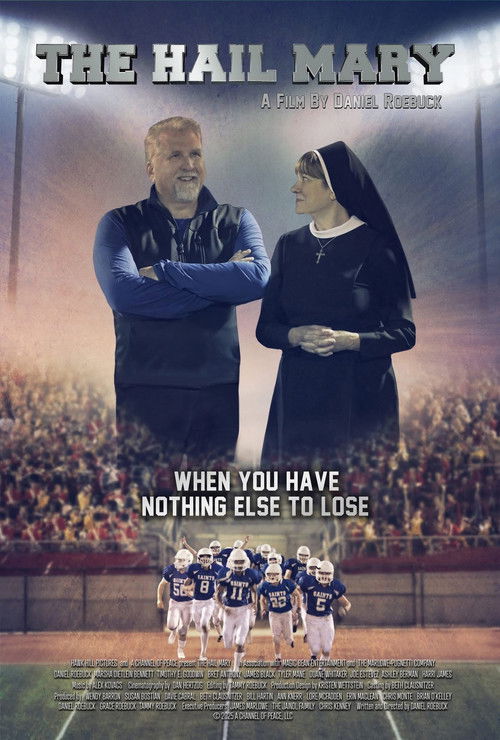
The Hail Mary (2026)
Directed by Daniel Roebuck
No · Ultra Based
How we score movies →Consciousness Markers
The redemption narrative carries implicit moral instruction about faith and personal transformation. The nun character likely delivers guidance, though not in an overt preachy register.
Sister Kathy is portrayed as having agency and purpose, though the narrative centers male redemption. Female empowerment is not the primary thematic concern.
The film centers on a Catholic school struggling with resources, implying critique of institutional underfunding, though this is not developed thematically.
Cast appears predominantly white with no apparent strategic diversity initiatives. The film does not foreground representation as a value.
The film operates within traditional Catholic institutional frameworks without revisiting or reinterpreting historical narratives.
No evidence of LGBTQ+ themes or characters. The setting is an all-boys Catholic school with no apparent queer subtext.
No evidence of racial consciousness or commentary. The film appears racially homogeneous without addressing this fact.
No climate-related themes are present. The film is entirely unconcerned with environmental issues.
No evidence of body positivity themes. The film's context is athletic competition with traditional masculine frameworks.
No indication of neurodivergence representation or thematic engagement. The narrative does not address this category.
Synopsis
Sister Kathy finds an angry loner in need of redemption and leads him to his atonement by conning him into creating a football team for her Catholic School.
Why it received this score
The Hail Mary represents a curious artifact of contemporary indie filmmaking: a small, faith-based redemption narrative that appears entirely indifferent to the cultural anxieties that preoccupy modern cinema. Director Daniel Roebuck's film concerns itself with the restoration of a broken soul through the intervention of a nun with purpose and humor, a premise that operates in a register almost aggressively orthogonal to contemporary progressive sensibilities. The story unfolds within an all-boys Catholic school, a setting that speaks to tradition, institutional religion, and male community rather than to the diversification and complication of social structures that characterize presently fashionable cinema.
What unfolds from the available materials is a film committed to the language of faith, redemption, and second chances without the apparatus of contemporary social consciousness. The narrative does not appear concerned with interrogating power structures, examining systemic inequity, or deploying representation as a statement of principle. Instead, it proceeds from the assumption that personal transformation through moral instruction and community participation represents a legitimate subject for cinema. The football team serves not as a vehicle for commentary on masculinity or institutional critique but as a concrete expression of teamwork and shared purpose.
One observes in The Hail Mary the aesthetic of the faith-based indie film, a genre that has persisted in the margins of contemporary cinema with minimal engagement from the cultural institutions that determine which works receive serious attention. The film's modest ambitions and its grounding in specifically Catholic theology place it firmly outside the contemporary mainstream conversation about what cinema ought to address. This is not to say it is good or bad, but rather that it operates according to an entirely different set of assumptions about narrative purpose and moral instruction.
Analysis generated by our Consciousness Algorithm
Critic Reviews
“This is the best film I've seen so far in 2026, my first four-star review of the year, and almost assuredly going to wind up on my top ten list come the end of December.”
“An adaptation of The Martian author Andy Weir's same-titled novel, "Project Hail Mary" follows Dr. Ryland Grace (Gosling) as he travels through space alone toward a distant star that he hopes holds the key to saving life on Earth.”
“Who knew putting glasses on Ryan Gosling and giving him an alien best friend could lead to something so spectacular – and the first great movie of 2026?”
“Tale of a brilliant molecular biologist cast into outer space with only a helpful alien for company is a bit silly, but Gosling's charisma keeps it watchable.”