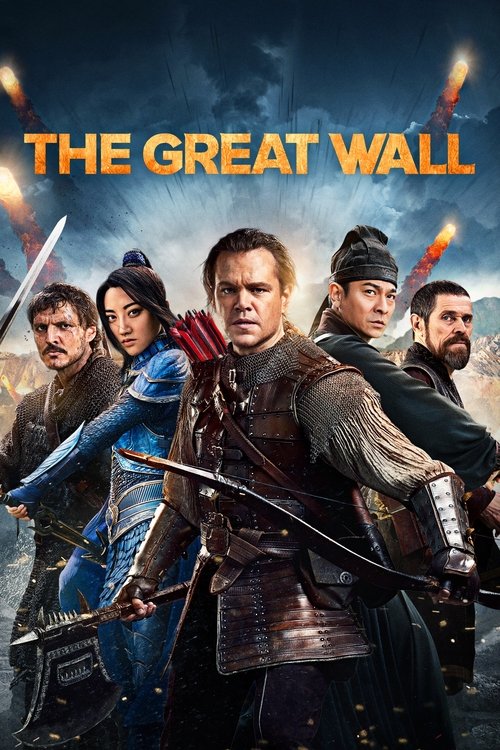
The Great Wall (2016)
Directed by Zhang Yimou
No · Ultra Based
How we score movies →Consciousness Markers
The film features significant Chinese and Asian cast members in prominent roles, but the positioning of Matt Damon as the lead protagonist undermines the representation and triggered widespread whitewashing criticism.
While the film engages with Chinese setting and Chinese actors, it lacks any meaningful exploration of racial dynamics, colonial history, or intercultural consciousness; the narrative is purely action-driven.
Female characters exist as warriors and soldiers but are not developed with any feminist consciousness or commentary; they function primarily as action-sequence participants.
The film takes considerable creative liberty with the Great Wall and Chinese history, but this operates in the service of fantasy action rather than revisionist historical commentary.
The film is primarily spectacle-driven and contains minimal dialogue or exposition that would constitute preachy messaging or moral instruction.
No LGBTQ themes, characters, or representation are present in the film.
No climate-related themes or environmental consciousness are present in the film.
The film contains no critique of capitalism, corporate power, or class systems; it is a straightforward action adventure narrative.
No body positivity themes or non-traditional body representation are evident; the film features conventionally attractive actors in typical action roles.
No neurodivergent characters or representation are present in the film.


Synopsis
European mercenaries searching for black powder become embroiled in the defense of the Great Wall of China against a horde of monstrous creatures.
Why it received this score
The Great Wall presents a peculiar case study in the contradictions of contemporary Hollywood's engagement with Chinese cinema and casting practices. On one hand, the film features a substantial ensemble of Chinese actors in prominent roles, with Jing Tian, Andy Lau, Zhang Hanyu, and others occupying positions of genuine narrative importance within the defense of the Great Wall itself. The production was a Chinese-American co-production backed by major studios, and the director Zhang Yimou is one of China's most celebrated filmmakers. Yet the film's decision to position Matt Damon as the lead mercenary and de facto protagonist created an immediate and persistent controversy that overshadowed all other elements of representation. The casting choice read, to many observers, as a reassurance to Western audiences that a European character would anchor and contextualize the Chinese setting, a familiar Hollywood pattern of cultural mediation that undermines the apparent commitment to diverse casting elsewhere in the film.
Beyond the casting debate, the film operates almost entirely within the register of spectacle and action adventure, offering no particular engagement with social consciousness or progressive themes. The narrative concerns itself with defending a wall against invading monsters, a straightforward plot that carries no thematic freight regarding gender dynamics, class struggle, environmental concerns, or any other marker of contemporary progressive sensibility. The female characters exist primarily as warriors and supporting players rather than as vehicles for feminist commentary. There is no meaningful LGBTQ representation, no interrogation of capitalist systems or colonial power dynamics, no climate consciousness, and no neurodivergent representation. The film is, in essence, a spectacle film from 2016 that happens to have been made in collaboration with Chinese studios and a Chinese director, but it carries no particular progressive burden or commitment.
The film's score reflects this absence of intentional progressive cultural engagement. What representation exists appears functional rather than ideological. The Great Wall remains a curious artifact of pre-2020 Hollywood's approach to Asian co-productions, notable primarily for what it failed to do rather than what it accomplished in terms of modern social consciousness.
Analysis generated by our Consciousness Algorithm
Critic Reviews
“The Great Wall has significant problems — namely with Damon and sidekick Pedro Pascal's lack of bromantic chemistry — but chief among its rewards is its ability to marry its Eastern and Western sensibilities.”
“Viewers are in good hands — if they’re not too demanding — as Zhang Yimou puts the easily distinguishable characters through their paces.”
“The absurdity is what makes it such a hoot-and-a-half.”
“While it shows fleeting moments of promise, there's precious little great about The Great Wall. Instead, it should be called "The Ridiculous Wall."”