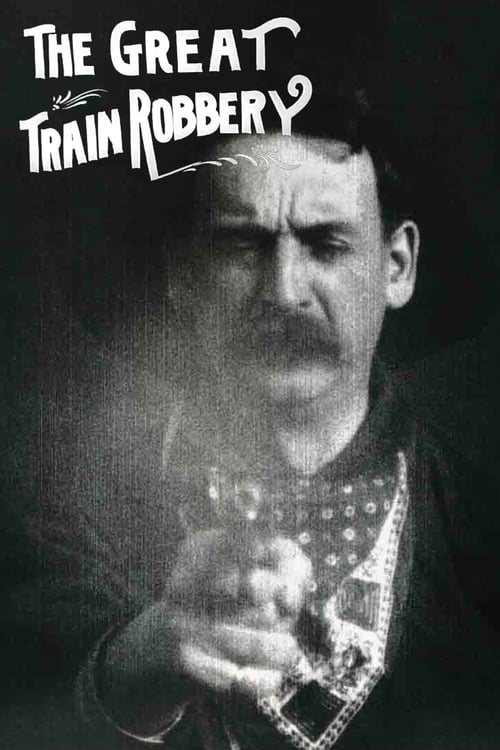
The Great Train Robbery (1903)
Directed by Edwin S. Porter
No — The Great Train Robbery is not woke, scoring 0 out of 100 on our wokeness meter.
The Great Train Robbery runs twelve minutes and concerns the robbery of a train.
Consciousness Markers
A 1903 Edison short cast entirely with white stage and studio performers; no casting on representational grounds exists as a concept here.
No LGBTQ+ characters, themes, or subtext of any kind in this train-robbery chase narrative.
The sole female figure is the telegraph operator's daughter, who arrives to revive her father with water — a domestic function, not a feminist statement.
No engagement with race or racial politics; the posse, bandits, and passengers are uniformly white and unremarked upon.
Steam locomotives and mountain chases, but no environmental consciousness whatsoever — the landscape is scenery, not a cause.
The bandits rob a train for valuables, but the film treats this as outlawry to be suppressed by a posse, not as a critique of capital.
No body-diversity themes; figures are indistinguishable in wide shots and bodies exist only as action elements.
No neurodivergent characters or themes; the comic dance-hall tenderfoot is a regional joke, not a neurological one.
A fictional Western melodrama loosely drawing on the stage play and period outlaw lore; it makes no revisionist historical argument.
Pure spectacle and chase — the film's only direct address is an outlaw firing point-blank at the audience, which is the opposite of a lecture.
Why it received this score
The Great Train Robbery runs twelve minutes and concerns the robbery of a train. A gang of outlaws binds a telegraph operator, dynamites a strongbox, shoots a fleeing passenger, and is eventually gunned down in the mountains by a posse of locals. It was released in December of 1903, which is to say it predates the entire apparatus of contemporary social messaging. Nobody involved appears to have considered that a Western might be expected to hold a position on anything. The result is a chase, a locomotive, and an outlaw firing a revolver directly at the audience, which remains the most confrontational thing the film does.
The cast is drawn from white stage and studio performers, and the film makes no comment on the fact, because the framework for such a comment did not yet exist. The sole woman is the telegraph operator's daughter, who arrives to douse her father with water and restore him to consciousness. That is a domestic errand, not a statement. The comic interlude at the dance hall, in which an Eastern tenderfoot is made to dance while the locals shoot at his boots, is a regional joke about softness. It is not a portrait of a neurological condition, and reading it as one would require a generosity the material does not earn.
The bandits take valuables from a train, but the film frames this as outlawry to be suppressed. Capital is not indicted. Order is restored, the mail is recovered, and the sheriff goes home. The mountains, the water tank, and the Delaware, Lackawanna and Western Railroad exist as scenery and logistics, never as a cause. No argument is advanced about the land, the body, or the arrangement of society. Porter wanted movement and danger, and he got them.
It is a landmark, preserved in the National Film Registry, endlessly imitated and misremembered as the first of several things it was not first of. None of that registers here. On the scale that concerns us, the film is a clean zero across the board: a genuine null set, achieved without effort and without shame. We record it without penalty. A picture from 1903 could not have scored otherwise, and saying so plainly is the whole of the discipline.
Analysis generated by our Consciousness Algorithm

Synopsis
After the train station clerk is assaulted and left bound and gagged, then the departing train and its passengers robbed, a posse goes in hot pursuit of the fleeing bandits.
Questions about The Great Train Robbery
Is The Great Train Robbery woke?
No — The Great Train Robbery is not woke, scoring 0 out of 100 on our wokeness meter. That earns it a verdict of Ultra Based.
Does The Great Train Robbery have any woke elements?
No. All 10 markers score zero.
How is the Woke Score calculated?
An AI-assisted process researches the film and its reception, scores it 0–100 on ten markers, then combines those into one 0–100 Woke Score. It measures a specific set of 2020s cultural themes, not film quality.