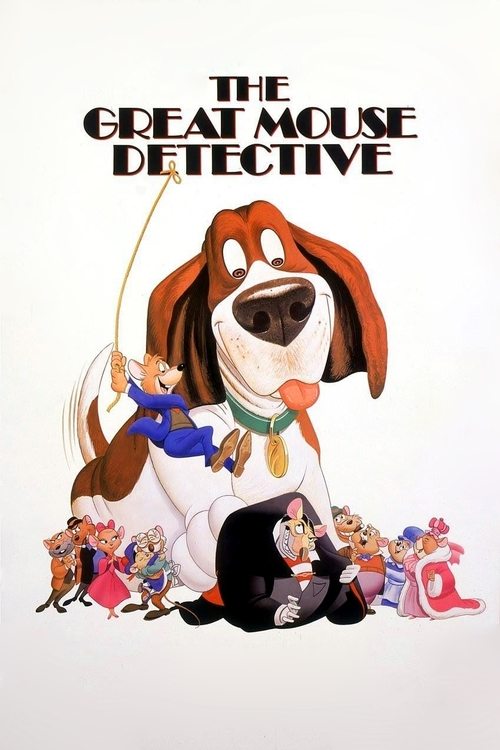
The Great Mouse Detective (1986)
Directed by Ron Clements
No · Ultra Based
How we score movies →Consciousness Markers
The film features anthropomorphic animals of various species, which provides nominal diversity of character types, but the principal roles are occupied by male characters. Olivia Flaversham, the young female mouse, functions primarily as a kidnapped plot device rather than a developed character.
The villain, Professor Ratigan, is a criminal motivated by personal power and wealth rather than systemic critique. While crime is portrayed as villainous, there is no anti-capitalist ideology or class consciousness in the narrative.
The film does not advance feminist themes. Olivia is rescued rather than rescuing herself, and the story centers on male protagonists solving the crime. No meaningful female agency or empowerment narratives are present.
As an animated film featuring anthropomorphic animals in Victorian London, racial consciousness is not a narrative concern. The film contains no commentary on race or racial representation, though it also does not reproduce contemporary prejudices.
The film maintains a light entertainment tone without preachy moralizing. While it contains some dialogue advancing the plot and character relationships, it does not lecture the audience about social values or progressive principles.
While the film is a creative adaptation set in a fantasy version of Victorian London, it does not engage in revisionist history per se. It takes libertarian creative license with the Sherlock Holmes universe but does not rewrite historical events.
There is no LGBTQ+ representation or thematic content in this 1986 family adventure film. The narrative focuses entirely on heteronormative relationships and contains no queer characters or subtext.
Climate themes are entirely absent from this mystery adventure. The film's focus on detective work and criminal intrigue leaves no room for environmental consciousness or climate advocacy.
Body positivity is not a thematic consideration in this film. Characters are drawn in conventional animated styles appropriate to their animal species, with no commentary on body diversity or acceptance.
Neurodivergence representation and themes are absent. No characters are portrayed as neurodivergent, and there is no narrative engagement with disability or cognitive difference.


Synopsis
When the diabolical Professor Ratigan kidnaps London's master toymaker, the brilliant master of disguise Basil of Baker Street and his trusted sidekick Dawson try to elude the ultimate trap and foil the perfect crime.
Why it received this score
The Great Mouse Detective arrives from an earlier epoch of popular entertainment, before the cultural vocabulary of progressive social consciousness had fully calcified into the diagnostic framework we now apply to film. This is a competent, amusing mystery adventure that satisfied audiences in 1986 and continues to entertain children today, which is precisely the problem from the vantage point of contemporary critical analysis. The film contains no markers of the modern sensibilities we have learned to identify and measure, because such sensibilities had not yet become the baseline expectation for mainstream entertainment.
The narrative structure adheres to classical detective fiction: a brilliant male investigator, his bumbling but loyal sidekick, a criminal mastermind, and a young female character whose primary function is to be imperiled and rescued. Vincent Price's voice work as Professor Ratigan provides genuine menace, and the animation demonstrates technical competence. Yet for all its craftsmanship, the film remains stubbornly indifferent to representation, gender dynamics, or any of the progressive concerns that would later become ubiquitous in animated features. Olivia Flaversham exists not as a character with agency but as a plot mechanism, a child to be saved, a means by which Basil can demonstrate his detective prowess.
What we observe here is not hostility toward progressive values but rather their complete absence from the creative consciousness. The filmmakers were not choosing to exclude feminist themes or diverse representation, they were operating within a framework where such considerations simply did not register as relevant to the task of making an entertaining children's film. This historical innocence is not a virtue, but neither is it a liability worth assessing by standards that did not exist when the film was made. The Great Mouse Detective deserves recognition as a competent work of its era, and its low woke score reflects not artistic failure but temporal displacement.
Analysis generated by our Consciousness Algorithm
Critic Reviews
“What it all comes down to is the basic question: Is this just a movie for children? Not really. It's more a movie for the childlike--of any age. [02 July 1986, p.3C]”
“Disney's signature touch is in the movie's perspective. It's all seen from a mouse-eye's view, low to the ground and looking up, just as small children see the world. [04 July 1986, p.N29]”
“Disney unleashes a mousey minor masterpiece. [02 July 1986, p.C5]”
“The Great Mouse Detective‘s few tunes are unmemorable and all the action (aside from the inventive chase sequences) is snooze-worthy. Only the incomparable Vincent Price (as Ratigan) is worth the price.”