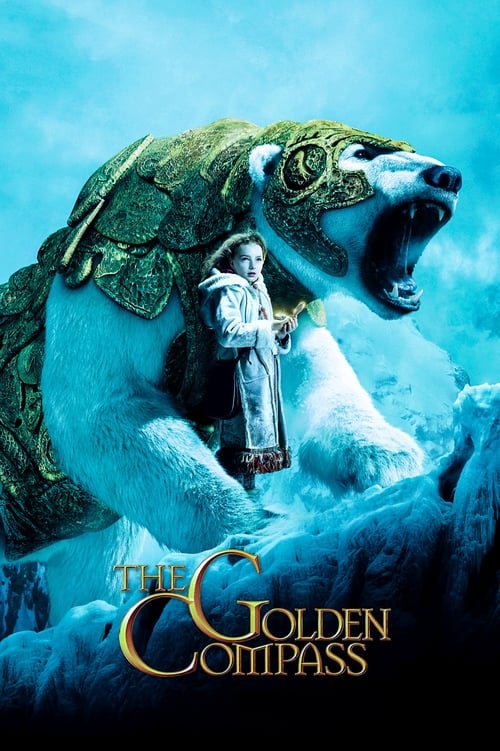
The Golden Compass (2007)
Directed by Chris Weitz
No · Based
How we score movies →Consciousness Markers
The film contains expository dialogue about the Magisterium and institutional control, though considerably toned down from the books' philosophical density.
Lyra is an active, resourceful female protagonist who drives the narrative, though the film lacks explicit feminist messaging or contemporary gender critique.
The protagonist is female, but the supporting cast is predominantly white European actors typical of 2000s fantasy cinema. No meaningful racial or ethnic diversity is evident.
The film critiques institutional authority and power structures, though this is theological rather than explicitly anti-capitalist in nature.
No LGBTQ+ themes are present in the film itself, despite some queer subtext existing in the source material.
No engagement with racial consciousness or racial themes. The fantasy world is presented without racial context or diversity.
No climate or environmental themes are present in the film.
No body positivity themes or diverse body representation are evident in the film.
No representation of neurodivergent characters or conditions appears in the film.
The film takes place in a fantasy world and does not engage in historical revisionism.


Synopsis
In a parallel universe, after overhearing a shocking secret, precocious orphan Lyra Belacqua trades her carefree existence roaming the halls of Jordan College for an otherworldly adventure in the far North, unaware that it's part of her destiny.
Why it received this score
The Golden Compass arrives as a curious artifact from the pre-woke era of fantasy cinema, a $180 million adaptation of Philip Pullman's aggressively anti-religious source material that somehow managed to strip away most of its theological provocations in translation to screen. The Catholic League's boycott campaign, though ultimately ineffective, speaks to a genuine tension between the books' ideological commitments and the film's desire to court mainstream audiences. What remains is a fairly conventional adventure film centered on a resourceful young female protagonist, which provides a degree of representation without necessarily constituting a coherent progressive project.
The film's approach to institutional critique, which forms the thematic core of Pullman's work, has been substantially diluted. The Magisterium, that terrifying amalgamation of church and state, becomes a vague antagonistic force rather than a systematic interrogation of religious authority. Chris Weitz's direction favors spectacle over substance, trading the books' philosophical density for set pieces and talking animals. This represents a fundamental misalignment with the source material's entire raison d'etre, though whether one laments or celebrates this depends entirely on one's tolerance for preachy fantasy literature.
Dakota Blue Richards carries the film with admirable conviction, and there is something to be said for a mainstream fantasy film that bothered to center a clever, defiant girl rather than another brooding young man. Yet the film's feminism, such as it is, remains largely incidental to the narrative rather than integral to its worldview. The supporting cast of celebrated British and European actors lends prestige, though the racial composition of the world remains stubbornly monochromatic, a choice that reads as historical accident rather than conscious design. The film ultimately presents as a missed opportunity to translate Pullman's radical vision into contemporary visual language, settling instead for a handsomely appointed but ideologically neutered fantasy adventure.
Analysis generated by our Consciousness Algorithm
Critic Reviews
“A darker, deeper fantasy epic than the "Rings" trilogy, "The Chronicles of Narnia" or the "Potter" films. It springs from the same British world of quasi-philosophical magic, but creates more complex villains and poses more intriguing questions. As a visual experience, it is superb. As an escapist fantasy, it is challenging.”
“Represents the year's biggest gamble - and it delivers the year's biggest and most ambitious fantasy.”
“It’s pure introductory adventure, meant to immerse readers in Pullman’s richly complicated fantasy universe.”
“Me, I just think it blows. What does it matter if you spend millions on a movie - love the talking, battling bears! - if the effects are cheesy, the story runs off on tangents and after watching the movie fail utterly to be the next Lord of the Rings, you just want to go home.”