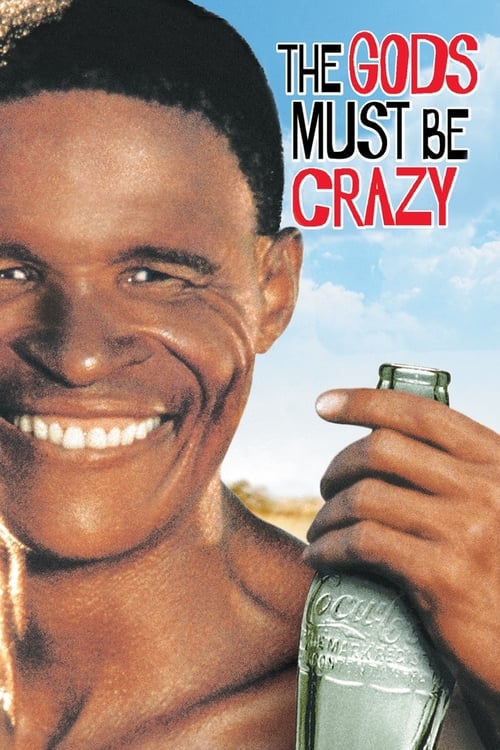
The Gods Must Be Crazy (1980)
Directed by Jamie Uys
No · Ultra Based
How we score movies →Consciousness Markers
The film features N!xau, an actual San actor, in the lead role, which was genuinely notable for 1980. However, the San people are portrayed as exotic others for the amusement of the audience rather than as fully realized human characters with agency.
The film satirizes some aspects of consumer culture and modernity through the introduction of the Coca-Cola bottle, though this critique is incidental rather than systemic.
The film is male-centered with minimal female characterization. Women appear as secondary figures with little agency in the narrative.
While the film depicts an African protagonist sympathetically, it treats racial and cultural difference as inherently comic rather than engaging with any structural understanding of colonialism, exploitation, or systemic inequality.
The film is primarily a comedy that avoids preachy messaging, though its central premise does implicitly lecture audiences about the superiority of modern life over indigenous existence.
No LGBTQ+ themes or representation present in the film.
No environmental or climate-related themes present in the film.
No body positivity messaging or discussion of body image appears in the film.
No representation of neurodivergence or neurodiversity present in the film.
The film does not engage with historical revisionism or reexamination of historical narratives.


Synopsis
A Coca-Cola bottle dropped from an airplane raises havoc among a normally peaceful tribe of African bushmen who believe it to be a utensil of the gods.
Why it received this score
The Gods Must Be Crazy arrives at the threshold of contemporary social consciousness with the cultural awareness of a man who has never encountered it. Released in 1980, this South African comedy treats the San people of the Kalahari as a source of gentle amusement, presenting their encounter with modernity through a lens that flattens the specificity of indigenous life into a whimsical anthropological curiosity. The film's humor rests almost entirely on the premise that these people, portrayed as noble savages untouched by civilization, will find contemporary objects bewildering. This is not malicious so much as it is the unexamined default position of its era, a casual exoticization that would later become impossible to maintain.
What complicates the assessment is that the film does not traffic in explicit cruelty or caricature in the manner of earlier colonial cinema. Actor N!xau gives a genuinely charismatic performance that generates real sympathy, and the narrative structure suggests, if only accidentally, that the San protagonist possesses wisdom that the modern world has lost. The film's actual villains are bureaucrats and militaristic types, not the indigenous people. Yet these modest virtues cannot overcome the fundamental premise: the movie asks us to laugh at cultural difference, to find the unfamiliar inherently comic. The San are not characters in their own story so much as they are a device for satirizing Western excess, rendered exotic and other through every frame.
By contemporary standards, this film registers as a historical artifact of its moment, when such representations were the norm rather than the exception. It lacks the deliberate effort to challenge power structures or to center marginalized perspectives that would later become markers of progressive filmmaking. The casting of an actual San actor in the lead role provided some meaningful employment and representation in an industry that had largely excluded such voices, which carries its own modest progressive weight for the period. Still, the film remains fundamentally a work of outsider perspective, comfortable in its assumption that indigenous life is inherently amusing to modern audiences.
Analysis generated by our Consciousness Algorithm
Critic Reviews
“The Gods Must Be Crazy is like nothing you've ever seen, a one-of-a-kind experience that's both strange and wonderful. It's most like an anthology of vintage Disney -- a wildlife narrative, a fairy tale with little people, and a love story suitable for general audiences. [02 Nov 1984, p.29]”
“The Gods Must Be Crazy is so genial, so good-natured and, on occasion, so inventive in its almost Tati-like slapstick routines, that it would would seem to deny the existence of any racial problems anywhere. ”
“Film’s main virtues are its striking, widescreen visuals of unusual locations, and the sheer educational value of its narration.”
“The movie's smarmy condescension toward the Bushmen, how dainty and gentle and unknowable they are, is not at all foreign to the old American image of lovable blacks who were granted some sort of emotional superiority as a sop for the horrors they suffered. This kind of thing might spell liberalism in South Africa, but here it just leaves you reaching for your Rolaids. [05 Nov 1984, p.C6]”